

Picking a vendor from a sea of it services and consulting companies gets messy fast. Every website promises “end to end solutions” and “strategic partnerships,” but you still need to know who actually installs cabling on schedule, who understands hospital compliance, and who can handle a government RFP without missing deadlines. That’s the gap this list closes.
Instead of a generic ranking, this rundown focuses on companies with proven track records in specific environments: healthcare, hospitality, multifamily housing, and public sector work. If you’ve been searching for it consulting services companies that match your actual project rather than a one-size-fits-all sales pitch, you’ll find clearer criteria here to separate serious contenders from firms that just talk a good game.
We built this guide from the same questions we hear from hospital administrators, property managers, and procurement officers every week. You’ll get a breakdown of ten firms, what each one specializes in, and where they tend to excel, so you can shortlist an it consulting services firm that fits your budget, timeline, and technical requirements without wasting weeks on vendor calls that go nowhere.
1. Trindom Global
Trindom Global sits at the top of this list because it does the unglamorous work that most it services and consulting companies skip: showing up on-site, running the cabling, and staying through commissioning. As a certified minority and women-owned small business, Trindom Global built its reputation on design-build execution rather than slide decks, which matters if your last vendor left you with a plan but no installed hardware.

Core services offered
Trindom Global specializes in physical infrastructure and integration work across a handful of demanding environments. Its core service lines include:
- Medical equipment installations in hospital settings, handled by qualified technicians with dedicated project management
- Structured cabling and headend buildout for network, telecom, and TV infrastructure
- RF and network installation for commercial and hospitality properties
- Government project support built around procurement rules and RFP requirements
- Multifamily high-speed ISP solutions delivered through its sister brand, Trintel, drawing on 25+ years of ISP experience
This mix makes Trindom Global less of a generalist it consulting services firm and more of a specialist that pairs design consultation with hands-on installation, so the same team that plans your headend room also builds it.
Ideal customer fit
Trindom Global fits organizations that need infrastructure work done correctly the first time in environments where mistakes carry real consequences. Hospitals and healthcare systems installing new medical equipment need technicians who understand clinical workflows and compliance, not just cable runs. Multifamily property operators rolling out high-speed internet across a campus need a partner who has done it 25 times before, not once.
A design-build firm that installs what it plans is worth more than a consultant who only plans.
Government agencies issuing RFPs also gain from working with a certified MWBE, since it can satisfy procurement requirements while still delivering technical depth. Commercial and hospitality businesses installing RF or network systems benefit similarly, since Trindom Global’s teams handle both the design and the physical buildout under one contract.
Pricing structure
Trindom Global prices projects based on scope, not a flat consulting rate, which is standard for design-build work involving hardware, labor, and site logistics. Expect a discovery call to define your objectives, followed by a proposal that separates design and consultation costs from installation and integration labor. Because much of the work involves physical installation crews and project management on-site, smaller single-location jobs typically cost less than multi-site rollouts like a multifamily campus buildout. Government and healthcare clients often see pricing structured around RFP specifications rather than a standard rate card, since compliance documentation and specialized technicians add to the project cost. Reach out directly for a scoped quote rather than relying on a published price list, since infrastructure work rarely fits a one-size-fits-all number.
2. Accenture
Accenture shows up on nearly every list of major it services and consulting firms, and for good reason: it operates in more than 120 countries and covers everything from strategy to managed services. If Trindom Global wins on hands-on installation, Accenture wins on sheer scale and the ability to run a global digital transformation program with thousands of consultants across time zones.
Core services offered
Accenture organizes its work around a few broad practice areas: strategy and consulting, technology services, operations, and industry-specific solutions. Typical engagements include:
- Cloud migration and modernization for large enterprise systems
- Enterprise application implementation, including SAP and Salesforce projects
- Cybersecurity consulting and managed security services
- AI and data analytics platforms built for specific industries
Ideal customer fit
Accenture fits large enterprises and multinational corporations that need a single vendor capable of managing complex, multi-year transformation programs. Companies in banking, insurance, retail, and manufacturing often turn to Accenture when they need deep bench strength across dozens of technologies at once. Smaller businesses or single-site projects, like a regional hospital installing new imaging equipment, usually find Accenture’s engagement model too heavy and too slow for what they actually need.
Global scale helps when your project spans continents, but it rarely helps when your project spans one building.
Government agencies also work with Accenture on large federal contracts, though the procurement process tends to move slower than working with smaller certified firms.
Pricing structure
Accenture doesn’t publish rate cards, and pricing varies heavily by region, industry, and project scope. Expect proposals built around time-and-materials or fixed-fee contracts for larger programs, often running into the millions for multi-year enterprise transformations. Smaller advisory engagements can start in the low six figures, but Accenture generally isn’t the right call for businesses expecting a lean, budget-conscious project.
3. Deloitte
Deloitte built its consulting arm on top of a global audit and advisory business, which shapes how it approaches technology work. Where Accenture leans on scale, Deloitte leans on its ties to finance, risk, and regulatory teams, making it a common pick for organizations that need IT decisions to survive an audit as much as they need them to work technically.
Core services offered
Deloitte’s technology practice covers strategy through execution, but it’s strongest where IT decisions intersect with regulation and risk. Common service lines include:
- Cybersecurity and risk advisory, including compliance-driven security architecture
- Cloud strategy and migration paired with governance frameworks
- ERP implementation, particularly for regulated industries like banking and healthcare
- Technology risk assessments tied to audit and compliance requirements
Ideal customer fit
Deloitte suits large enterprises in heavily regulated sectors, think banks, insurers, and healthcare systems, that need technology recommendations backed by the same firm handling their financial audits. Public sector clients also work with Deloitte on large-scale modernization contracts where compliance documentation matters as much as the technical build. Smaller businesses or single-site infrastructure projects rarely fit this model well, since Deloitte’s engagement structure assumes a large internal IT and compliance team on the client side.
If your project needs to satisfy auditors and regulators as much as end users, Deloitte’s structure fits that pressure better than most it consulting services companies.
Companies without an existing relationship with Deloitte’s audit side sometimes find onboarding slower, since much of the firm’s value comes from that cross-practice knowledge.
Pricing structure
Deloitte doesn’t publish standard rates, and engagements typically run on fixed-fee or retainer models tied to project scope. Enterprise-wide transformation work often reaches seven figures across a multi-year timeline, while smaller risk assessments or advisory sprints can start in the low six figures. Budget-conscious buyers should expect Deloitte’s pricing to sit closer to Accenture’s than to a regional specialist firm.
4. IBM Consulting
IBM Consulting carries a different kind of weight than Accenture or Deloitte because it’s tied directly to IBM’s own hardware, software, and research divisions. That connection matters if your project runs on IBM infrastructure already, since IBM Consulting often gets deeper technical access to systems like mainframes, Watson AI tools, and hybrid cloud platforms than outside vendors do.

Core services offered
IBM Consulting focuses heavily on hybrid cloud and AI integration, building on the company’s own product stack. Typical work includes:
- Hybrid cloud architecture built around Red Hat OpenShift and IBM Cloud
- AI and automation deployment, often using Watson-based tools
- Enterprise application modernization for legacy mainframe systems
- Cybersecurity consulting tied to IBM’s own security software
Ideal customer fit
IBM Consulting fits organizations already running IBM hardware or software who need a vendor that understands the underlying systems, not just the surface-level integration. Large enterprises modernizing decades-old mainframe environments, particularly in banking and insurance, tend to get the most value here. Healthcare systems and government agencies with existing IBM contracts also find the transition smoother than bringing in an unfamiliar firm.
A vendor tied to your existing hardware stack can move faster, but that speed comes with less flexibility to switch platforms later.
Companies without any IBM footprint usually don’t gain much advantage over choosing a platform-neutral it consulting services company instead.
Pricing structure
IBM Consulting doesn’t publish flat rates, and most engagements run on fixed-fee or time-and-materials contracts scoped to the specific IBM products involved. Large modernization projects tied to mainframe migrations or hybrid cloud rollouts commonly reach seven figures over multi-year timelines. Smaller advisory work, like an AI proof-of-concept, can start lower but still assumes an enterprise budget rather than a lean one.
5. Cognizant
Cognizant built its reputation on large-scale IT outsourcing before expanding into digital transformation and consulting, and that outsourcing DNA still shapes how it operates today. Where IBM Consulting ties you to its own product stack, Cognizant stays platform-agnostic, working across AWS, Azure, and Google Cloud depending on what the client already runs.
Core services offered
Cognizant organizes its work around digital engineering and IT outsourcing, with a heavy emphasis on staff augmentation and application management. Typical service lines include:
- Application development and maintenance for large enterprise software portfolios
- Cloud migration across AWS, Azure, and Google Cloud environments
- Digital engineering, including custom software builds and QA testing
- IT infrastructure outsourcing, covering help desk and network operations support
Ideal customer fit
Cognizant fits mid-size to large enterprises that need ongoing application support or a large pool of developers rather than a single strategic project. Retail, healthcare payer organizations, and insurance companies often use Cognizant to manage legacy applications while freeing internal teams for newer initiatives. Businesses looking for a one-time infrastructure buildout, like a hospital installing new imaging equipment or a property operator wiring a new building, generally won’t find the right fit here since Cognizant’s model leans toward long-term staffing contracts.
Outsourcing works best when you need sustained capacity, not a single project delivered and closed out.
Companies already running lean internal IT teams sometimes use Cognizant specifically to backfill skill gaps during a busy transformation cycle.
Pricing structure
Cognizant typically prices work through staff augmentation rates or managed service contracts, often billed monthly rather than as a single fixed project fee. Offshore and nearshore delivery models keep costs lower than firms like Accenture or Deloitte, making Cognizant a common pick for cost-sensitive, long-running engagements. Expect ongoing monthly retainers rather than a one-time quote, since the pricing model assumes a continuing relationship.
6. TEKsystems
TEKsystems built its business on IT staffing before expanding into managed services, and that history still defines how it works with clients today. Rather than pitching multi-year transformation programs like Accenture or Deloitte, TEKsystems focuses on getting skilled IT talent into your organization fast, whether that’s a single contractor or an entire project team.
Core services offered
TEKsystems splits its work between staffing and delivery-based services, giving clients flexibility depending on how much control they want to keep in-house. Core offerings include:
- IT staffing and talent solutions, covering contract, contract-to-hire, and permanent placements
- Application development and modernization delivered through dedicated project teams
- Infrastructure and network support, including help desk and systems administration
- Managed services, where TEKsystems takes ownership of specific IT functions long-term
Ideal customer fit
Organizations that need to fill skill gaps quickly, without running a lengthy vendor selection process, tend to get the most value from TEKsystems. Mid-size companies dealing with a sudden spike in project demand, like a hospital system rolling out a new EHR platform, often use TEKsystems to bring in specialized talent without a permanent hire commitment.
Staffing-first firms solve capacity problems fast, but they rarely replace a design-build partner who owns the outcome.
Businesses needing a fully managed infrastructure buildout, such as multifamily ISP installation or medical equipment integration, usually need a firm with hands-on installation experience instead, since TEKsystems’ strength lies in placing people rather than executing physical builds.
Pricing structure
TEKsystems prices staffing engagements through hourly bill rates or salary-based placement fees, depending on the arrangement. Contract roles typically bill weekly or monthly, while permanent placements carry a percentage-based fee tied to the hired employee’s salary. Managed services contracts run on retainers scoped to the specific function being outsourced, making costs more predictable than a one-time infrastructure project.
7. Thoughtworks
Thoughtworks earned its name in software engineering circles long before it became a broader consulting brand, and that engineering-first culture still separates it from the staffing and outsourcing firms earlier on this list. Rather than sending you a pool of contractors, Thoughtworks builds small, senior teams that pair custom software development with organizational change work, often pushing clients toward agile practices they haven’t fully adopted yet.
Core services offered
Thoughtworks centers its practice on custom software delivery, treating technology and process change as inseparable. Typical engagements include:
- Custom software development using agile and extreme programming methods
- Cloud-native architecture design for scalable, modern platforms
- Digital platform strategy, often paired with organizational coaching
- Data and AI engineering built around real-time analytics needs
Ideal customer fit
Companies that already value engineering craft, and want a partner that pushes back on bad technical decisions rather than just executing them, tend to get the most out of Thoughtworks. Mid-size to large businesses modernizing a core product or platform, particularly in finance and retail, often bring Thoughtworks in when internal teams need both extra hands and a culture shift toward better development practices.
A team obsessed with clean code solves different problems than one obsessed with hitting a deadline.
Organizations needing physical infrastructure work, like a hospital installing medical equipment or a property operator wiring a multifamily campus, won’t find a fit here, since Thoughtworks stays entirely in the software and platform space.
Pricing structure
Thoughtworks generally works on time-and-materials contracts billed against dedicated team rates, since most engagements run for months rather than a single deliverable. Rates sit closer to boutique consulting firms than offshore outsourcing shops, reflecting the seniority of the engineers assigned. Smaller proof-of-concept engagements can start lower, but ongoing platform work typically requires a sustained monthly budget rather than a one-time fixed fee.
8. EPAM Systems
EPAM Systems grew out of software engineering outsourcing in Eastern Europe before expanding into a global digital transformation player, and that engineering pedigree still shows in how it staffs projects. Compared to Thoughtworks, EPAM runs larger teams at scale, making it a fit for companies that need dozens of engineers rather than a handful of senior specialists.
Core services offered
EPAM organizes its work around product engineering and platform modernization, with a strong bench in emerging technology. Typical service lines include:
- Custom product engineering for web, mobile, and embedded software
- Cloud and DevOps transformation across AWS, Azure, and Google Cloud
- Data engineering and AI/ML development for enterprise analytics platforms
- Digital experience design, pairing UX research with front-end development
Ideal customer fit
EPAM suits mid-size to large companies building or rebuilding a digital product, especially in fintech, healthcare tech, and travel, where speed to market matters as much as code quality. Businesses that need to scale a development team quickly, without the overhead of a full staffing search, often turn to EPAM instead of hiring directly.
Scaling a product team fast matters less than scaling the right team, and EPAM’s engineering depth tends to cover both.
Companies looking for hands-on physical installation work, like structured cabling or medical equipment integration, won’t find a match here, since EPAM stays focused entirely on software and digital platforms.
Pricing structure
EPAM typically bills through dedicated team models or time-and-materials contracts, with rates varying by region and seniority mix. Offshore delivery centers keep costs lower than US-based boutique firms, though EPAM’s blended teams often include onshore leads for client-facing coordination. Long-term product engagements usually require a monthly retainer rather than a fixed one-time project fee.
9. Slalom
Slalom built its business on local delivery teams paired with big cloud partnerships, which sets it apart from the offshore-heavy firms earlier on this list. Rather than staffing projects from a distant delivery center, Slalom keeps consultants close to the client, often in the same metro area, which matters for organizations that want a partner showing up in person rather than dialing in from another time zone.

Core services offered
Slalom organizes its work around cloud, data, and customer experience consulting, with deep certifications across the major cloud providers. Typical service lines include:
- Cloud migration and modernization across AWS, Azure, and Google Cloud
- Data and analytics strategy, including business intelligence platform builds
- Customer experience consulting, covering CRM implementation and digital design
- Change management, helping internal teams adopt new systems and workflows
Ideal customer fit
Mid-size to large businesses that want a consulting partner embedded locally, rather than a rotating cast of offshore contractors, tend to get the most value from Slalom. Retailers, healthcare payers, and financial services firms often bring Slalom in for cloud modernization projects where local presence speeds up stakeholder alignment and change adoption.
Local delivery teams solve trust and communication problems that offshore staffing models rarely address.
Organizations needing hands-on physical infrastructure work, like structured cabling or medical equipment installation, won’t find that expertise here, since Slalom’s practice stays firmly in the cloud, data, and digital consulting space.
Pricing structure
Slalom generally prices engagements through time-and-materials or fixed-fee contracts, scoped around specific cloud or data initiatives. Rates run closer to boutique consulting firms than offshore outsourcing shops, reflecting the local, senior-heavy staffing model. Smaller advisory engagements can start in the low six figures, while multi-phase cloud transformation work typically requires a sustained budget across several quarters.
10. Protiviti
Protiviti operates as the consulting arm of Robert Half, and that lineage shows in how tightly its practice ties to risk, internal audit, and business process work rather than pure technology delivery. Businesses searching through a long it consulting services list often overlook Protiviti because it markets itself as a risk and business consulting firm first, but its technology practice runs deep enough to handle full IT risk assessments, data governance builds, and compliance-driven system implementations.
Core services offered
Protiviti structures its technology work around risk, controls, and process improvement, which separates it from pure software or infrastructure vendors. Core service lines include:
- IT risk and controls consulting, covering audit readiness and regulatory compliance
- Data governance and privacy, including frameworks tied to HIPAA and financial regulations
- Business process and technology transformation, pairing software recommendations with operational redesign
- Cybersecurity assessments, focused on control gaps rather than hands-on remediation
Ideal customer fit
Companies in banking, insurance, and healthcare that need IT decisions validated against regulatory frameworks tend to get the most value from Protiviti. Internal audit and compliance teams often bring Protiviti in specifically because it speaks the language of both IT and risk management, bridging a gap that pure technology consultants usually can’t fill.
Risk-focused consulting protects you from the wrong technology decision more than it builds the right one.
Organizations needing physical installation, like structured cabling or medical equipment integration, should look elsewhere, since Protiviti’s practice stays entirely advisory.
Pricing structure
Protiviti prices most engagements through time-and-materials or fixed-fee retainers, scoped around specific risk or compliance deliverables. Rates sit closer to boutique advisory firms than large offshore outsourcing shops, given the seniority of staff assigned to regulatory work. Smaller assessments can start in the low six figures, while enterprise-wide compliance overhauls run considerably higher across a multi-quarter timeline.
11. How to choose the right IT consulting company
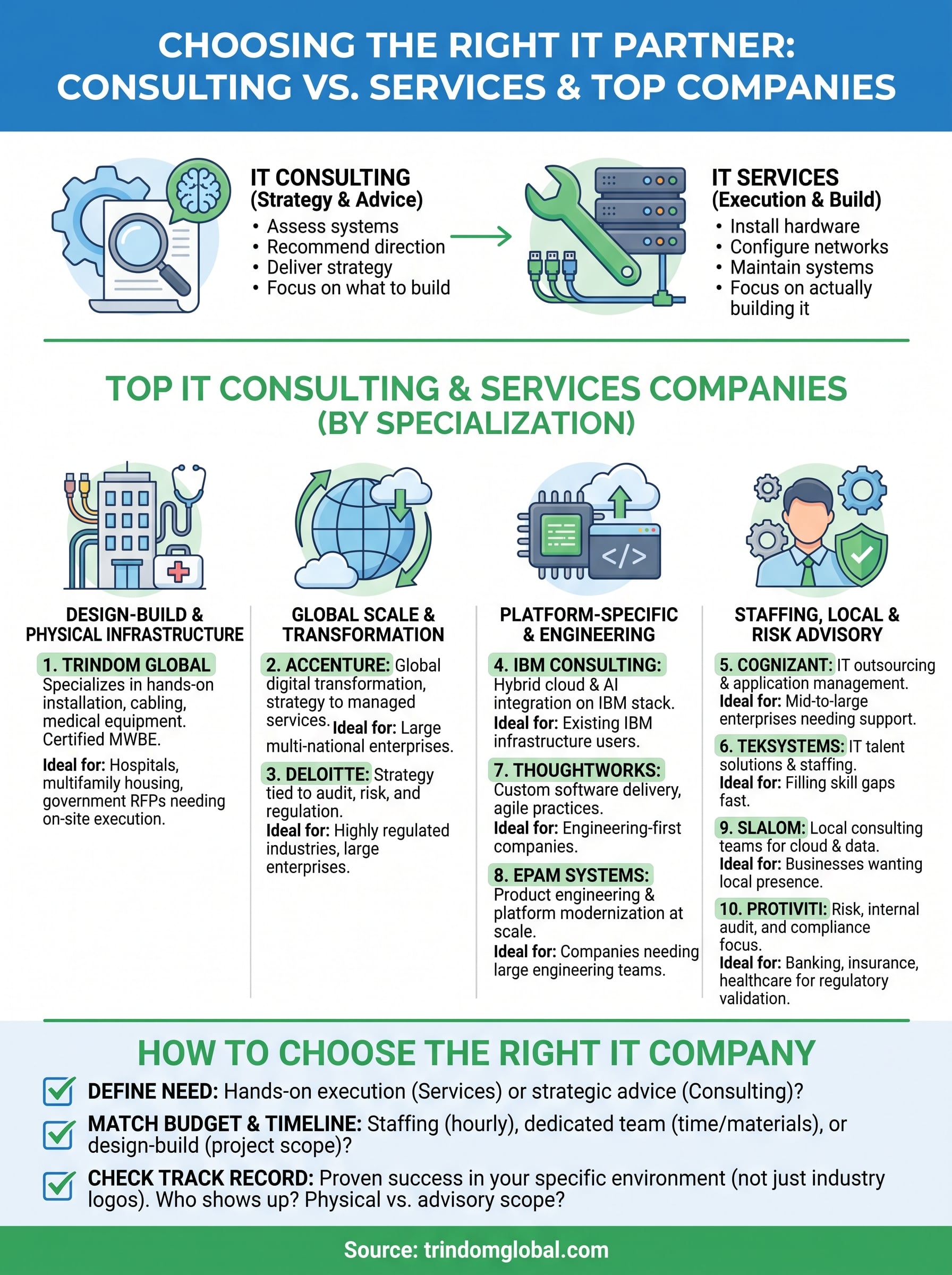
After reading through ten firms, the real work starts: matching your project to the right one. Start by defining whether you need hands-on execution or strategic advice, since that single question eliminates half the list immediately. A hospital installing imaging equipment needs technicians on-site, not a slide deck from a firm that stops at recommendations. A bank rebuilding its risk framework needs the opposite.
Budget-conscious buyers should map their timeline against each firm’s engagement model before requesting proposals. Staffing-first firms bill hourly or by placement fee, boutique consultancies run time-and-materials against dedicated teams, and design-build firms scope pricing around hardware, labor, and site logistics together.
Match the engagement model to your problem before you match the brand name to your budget.
Check these factors before signing anything:
- Track record in your environment, not just industry logos on a website
- Who actually shows up, senior staff, junior contractors, or offshore teams
- Certifications relevant to your procurement needs, including MWBE status for government or public contracts
- Physical vs advisory scope, since many firms on this list stop at recommendations and never touch installation
- Contract flexibility, since multi-year retainers suit different budgets than single-project scopes
Companies searching for best it consulting services often default to the biggest name they recognize, but scale rarely predicts fit. A regional hospital doesn’t need Accenture’s global footprint any more than a multinational bank needs a firm built for on-site cabling work. Match the vendor’s actual delivery model, not its brand recognition, to the scope of what you’re building, and you’ll avoid the vendor calls that go nowhere.
12. IT services vs IT consulting: what’s the difference
People often use these terms interchangeably, but the distinction changes who you should hire. IT consulting means paying for advice: a firm assesses your systems, recommends a direction, and hands you a strategy document. Deloitte’s risk advisory work and Protiviti’s compliance reviews fall squarely into this bucket. You get expertise and a plan, but someone else still has to build it.
IT services cover the execution side: installing hardware, running cabling, configuring networks, and maintaining systems after they go live. Trindom Global’s medical equipment installations and structured cabling work sit here, since the value comes from what gets physically built and commissioned, not just recommended. Staffing firms like TEKsystems blur this line too, since they deliver labor rather than strategy.
Consulting tells you what to build. Services actually build it.
Most projects need both, which is why so many it consulting and services companies try to offer each under one roof. The trouble starts when a firm markets itself as full-service but really only delivers the advisory half, leaving you to find a separate installer once the recommendations arrive. That gap costs weeks, sometimes months, especially on projects with hard deadlines like a hospital equipment rollout or a government contract with a fixed completion date.
Before signing with any it consulting services company, ask directly whether the contract includes hands-on delivery or stops at recommendations. Firms like Accenture and Thoughtworks lean toward strategy and software, while Trindom Global’s design-build model keeps consultation and installation under the same team. Knowing which side of that line you actually need saves you from paying twice, once for the plan and again for someone else to execute it.
Finding the right IT partner for your business
Ten firms, ten different strengths, and one clear takeaway: the right choice depends on whether your project needs strategy or execution. Global consultancies like Accenture and Deloitte solve boardroom-level problems. Staffing firms like TEKsystems and Cognizant fill capacity gaps. But if you’re staring at a hospital wing that needs medical equipment installed, a property that needs high-speed ISP infrastructure, or a government RFP with a hard deadline, you need a team that shows up and builds, not one that hands you a report and walks away.
Go back to the questions from the buying guide above, match them against your actual scope, and pick the firm whose delivery model fits your problem instead of its brand recognition. If your project involves physical installation, compliance-driven procurement, or a design-build partner who stays through commissioning, talk to Trindom Global about your next project.


