

Most organizations don’t need another vendor pitching generic tech support. They need someone who understands their infrastructure, their compliance requirements, and their budget constraints before recommending a single piece of equipment. If you’re evaluating consulting IT services for a hospital wing, a hospitality property, or a government facility, you’re likely trying to figure out what’s actually included before you sign a contract.
This article breaks down what it consulting services cover in practice, from initial design consultation through installation and integration, and explains who typically provides them. You’ll see how these engagements differ by industry, why some providers specialize in sectors like healthcare or multifamily housing, and what separates a true design-build partner from a company that just sells hardware.
We’ll also walk through how procurement requirements, vendor certifications, and project management structures shape the consulting process, especially for government RFPs and MWBE-eligible contracts. By the end, you’ll have a clear picture of what to expect from an IT consulting and services engagement, so you can ask better questions and choose a provider suited to your project’s scope.
Why consulting IT services matter for your business
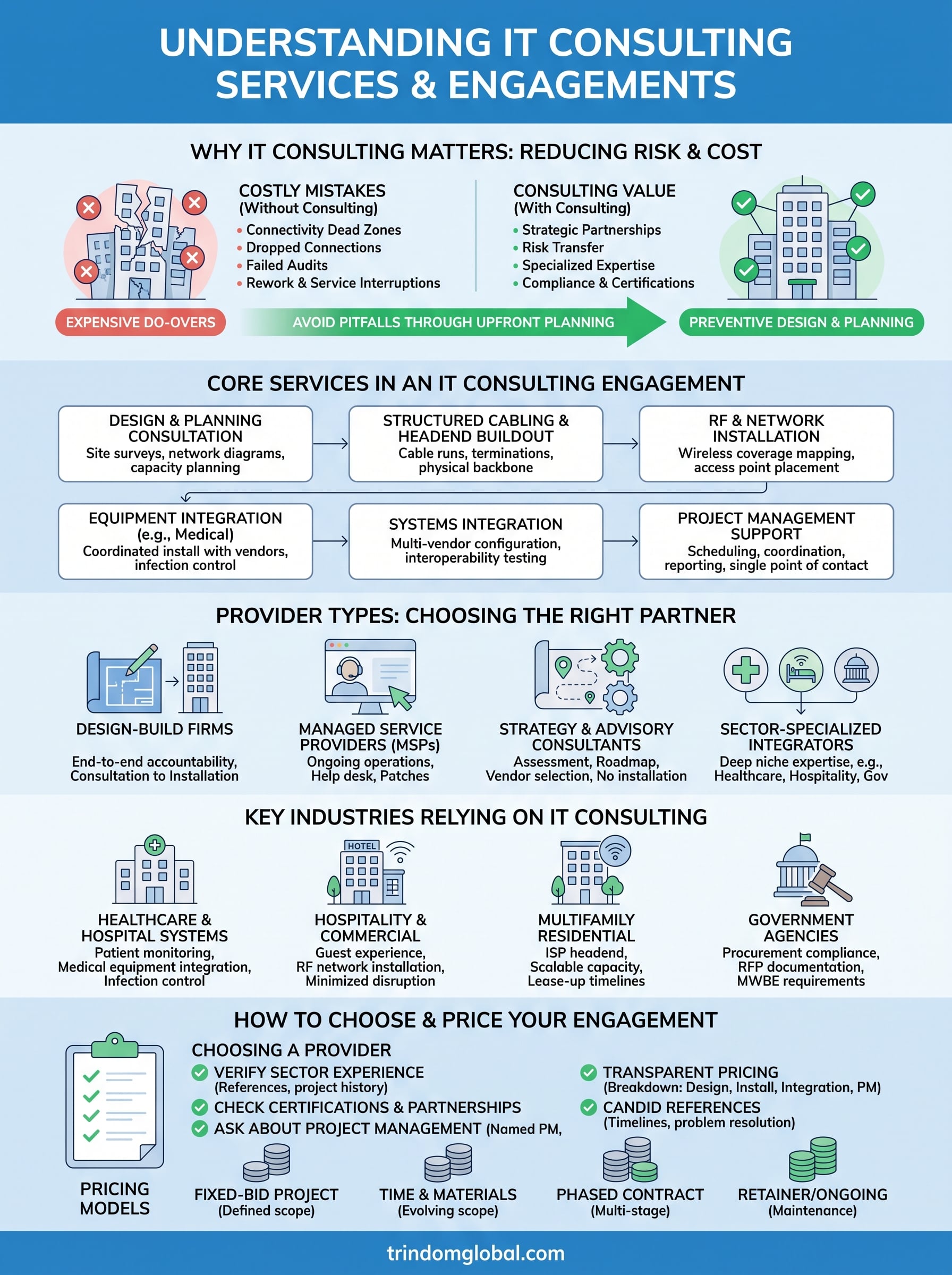
Getting infrastructure decisions wrong costs more than money. A hospital that installs medical imaging equipment without proper structured cabling ends up with connectivity dead zones in patient care areas. A hotel that rushes an RF network rollout deals with dropped guest connections during peak occupancy. These aren’t hypothetical scenarios; they’re the kind of project failures that IT consulting services exist to prevent by catching design flaws before installation crews ever show up on site.
The real cost of infrastructure mistakes
Mistakes discovered after installation are exponentially more expensive to fix than mistakes caught during the design phase. Rerouting cable runs through a finished hospital wing means tearing into walls that already passed inspection. Reconfiguring a headend buildout after a property has gone live means service interruptions for paying tenants or guests. A qualified it consulting services provider builds in site surveys, network diagrams, and capacity planning upfront specifically to avoid these expensive do-overs.
The cheapest fix for bad IT infrastructure is the one you make on paper, before anyone touches a wire.
Regulatory and procurement pressure
Healthcare facilities operate under HIPAA-driven data handling rules, and government agencies work within strict procurement frameworks that dictate who can bid and how contracts get awarded. Neither environment tolerates a vendor who treats compliance as an afterthought. Firms that understand government projects and RFP requirements build documentation, certifications, and reporting into the engagement from day one, which matters enormously when an agency needs a minority or women-owned business enterprise on record for a contract. Skipping this step doesn’t just risk a failed audit; it can disqualify a bid entirely before the technical work even begins.
Where internal IT teams reach their limits
Organizations often keep skilled IT staff on payroll, but staff who manage help desks and software updates rarely have hands-on experience with structured cabling, RF network design, or medical equipment integration. Internal teams handle day-to-day operations well; they’re rarely equipped for capital projects that require specialized licensing, vendor certifications, or experience coordinating with contractors on a hospital renovation. This gap is exactly where consulting and IT services engagements add value: they bring in people who’ve done the specific type of build before, not generalists learning on the job at your expense.
Signs your organization likely needs outside consulting support include:
- A capital project involves cabling, headend, or RF infrastructure your team hasn’t installed before
- You’re responding to a government RFP with technical requirements outside your staff’s expertise
- A healthcare renovation requires coordination between IT infrastructure and biomedical equipment vendors
- Your property needs multifamily ISP infrastructure but lacks in-house telecom design experience
- Procurement rules require documented MWBE participation you can’t fulfill internally
Strategic partnerships that reduce risk
Vendor relationships matter more than most buyers realize. A consulting firm with established partnerships across equipment manufacturers, cabling suppliers, and integration platforms can secure better pricing, faster lead times, and technical support that an isolated internal team simply can’t access on its own. Working with a provider that has 25-plus years in a niche like ISP solutions, for instance, means you benefit from relationships already built with the manufacturers whose gear ends up in your walls. Ultimately, the value of it services and consulting isn’t just technical execution; it’s risk transfer. You’re paying someone with deeper sector expertise to own the parts of a project where mistakes are costly, so your team can focus on running the business instead of troubleshooting a network buildout gone wrong.
How to choose the right IT consulting services provider
Picking a provider based on a glossy proposal is how most infrastructure projects go sideways. You need a way to separate firms that talk a good game from those that can actually execute a design-build project in your specific environment. The right it consulting services provider should be able to point to completed work that resembles your project in scope, industry, and complexity, not just a list of services on a website.
Verify sector-specific experience
Ask for references tied to your exact use case. A firm that’s done structured cabling for office buildings isn’t automatically qualified to handle a hospital headend buildout, where infection control protocols and equipment coordination add layers most commercial projects never touch. Request project photos, site names (when permitted), and the names of the technicians who’ll actually show up, not just the sales team who closed the deal. If a provider hesitates to share verifiable project history, treat that as a warning sign rather than a formality to skip past.
A provider’s past projects tell you more about their fit than anything in a sales deck.
Check certifications and vendor partnerships
Certifications matter because they signal a provider has met a manufacturer’s or regulator’s bar, not just their own. For government work, confirm MWBE or other procurement-relevant certifications are current and properly registered, since an expired certification can invalidate a bid after the fact. For technical work, ask which manufacturers certify their installers and whether that certification covers the equipment your project actually uses.
| What to ask | Why it matters |
|---|---|
| Which vendor certifications does your team hold? | Confirms hands-on training on the actual equipment being installed |
| Are your MWBE or procurement certifications current? | Prevents disqualification on government bids |
| Who manages the project day-to-day? | Identifies accountability once work begins |
| Can you provide references from similar projects? | Validates real experience over marketing claims |
Ask about project management structure
Every it consulting and services engagement needs a single point of accountability, someone who owns the schedule, coordinates subcontractors, and answers when something goes wrong mid-installation. Firms without dedicated project management tend to push that burden back onto the client, which defeats the purpose of hiring outside expertise in the first place. Push for a named project manager before you sign anything, along with a communication cadence you can hold them to.
Organizations evaluating multiple bids often benefit from a short scoring checklist:
- Confirmed experience in your specific sector (healthcare, hospitality, multifamily, government)
- Active, verifiable certifications relevant to your project type
- A named project manager with defined communication expectations
- Transparent pricing that separates design, installation, and integration costs
- References willing to speak candidly about timelines and problem resolution
Treating this like due diligence, not a formality, saves you from discovering a provider’s limitations halfway through a capital project.
Core services included in IT consulting engagements
An IT consulting engagement rarely means just one deliverable. Most projects move through a sequence of distinct phases, and understanding that sequence helps you spot a provider who’s skipping steps to save time or money. Consulting services it buyers should expect typically bundle several of the phases below into a single contract, though the depth of each phase depends on project scope.
Design and planning consultation
Before anyone touches equipment, a qualified provider conducts site surveys, reviews existing infrastructure, and drafts network diagrams that map out cable runs, headend placement, and equipment locations. This phase also covers capacity planning, sizing the system for current needs plus reasonable growth, so you’re not renegotiating a redesign eighteen months after go-live. Skipping this step is the single most common cause of the expensive rework discussed earlier in this article.
Good design work is invisible until something goes wrong without it.
Structured cabling and headend buildout
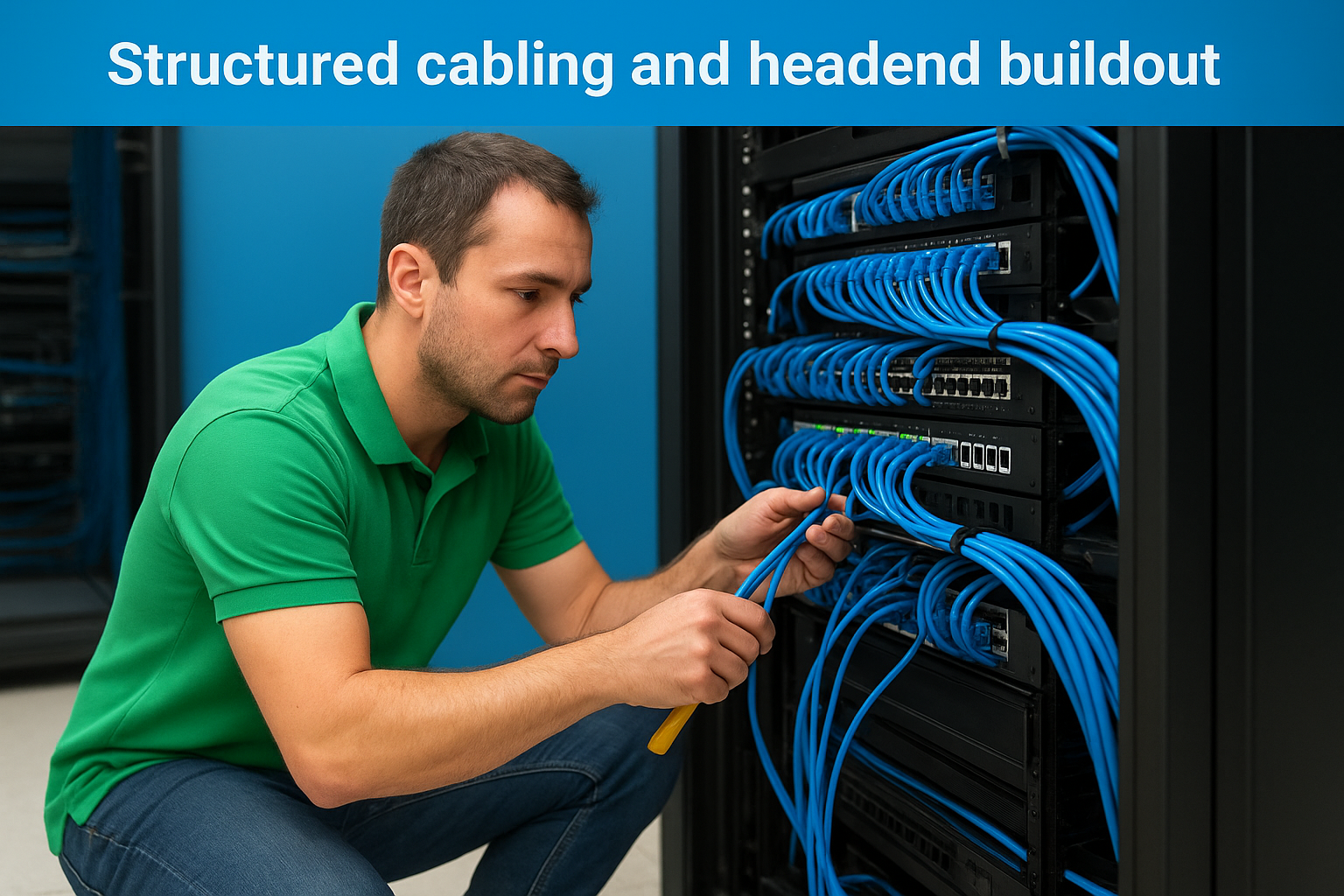
This is the physical backbone work: running cable, terminating connections, and building out the headend that ties network, telecom, and TV infrastructure together. Quality here determines whether a facility experiences dead zones, signal degradation, or reliable connectivity for the life of the system. Firms with headend buildout experience know how to sequence this work around occupied spaces, which matters enormously in hospitals and multifamily properties that can’t simply shut down during construction.
RF and network installation
Commercial and hospitality environments depend on properly designed wireless networks, and RF installation requires more than mounting access points. It requires interference analysis, coverage mapping, and placement decisions that account for building materials, guest density, and device load during peak hours.
Medical equipment installation and integration
Hospital environments add a layer most commercial projects never encounter: coordinating IT infrastructure with biomedical equipment vendors, working around infection control protocols, and scheduling installations during limited maintenance windows. Qualified technicians handle both the technical installation and the project management needed to keep clinical operations running during the work.
Integration and vendor coordination
A design-build provider doesn’t just install hardware, they integrate systems from multiple manufacturers so everything communicates correctly. This includes configuring equipment, testing interoperability, and troubleshooting conflicts before handoff.
Project management support
Every phase above depends on coordination, and dedicated project management is what keeps a multi-vendor, multi-phase engagement on schedule.
A typical it consulting professional services contract might break down like this:
| Service phase | What’s delivered |
|---|---|
| Design consultation | Site survey, network diagrams, capacity plan |
| Structured cabling/headend | Cable runs, terminations, headend buildout |
| RF/network installation | Wireless coverage mapping, access point placement |
| Medical equipment integration | Coordinated install with biomedical vendors |
| Systems integration | Multi-vendor configuration and testing |
| Project management | Scheduling, subcontractor coordination, reporting |
Understanding which of these phases a provider actually delivers, versus which they outsource without disclosing it, is worth clarifying before you sign anything.
Types of IT consulting providers and firms
Not every firm calling itself an IT consulting provider does the same kind of work, and confusing one type for another is how buyers end up with a mismatched contractor. Some outfits sell hardware and call installation a courtesy. Others are pure strategy shops that never touch a cable. Knowing which category you’re dealing with before you request a proposal saves you from a scope mismatch three weeks into a project.
Design-build firms
Design-build providers handle consultation, planning, installation, and integration under one contract, which means a single point of accountability from site survey to final testing. This model matters most when a project spans multiple disciplines, say structured cabling plus RF network plus systems integration, because coordinating those handoffs internally introduces risk that a design-build firm absorbs instead. Trindom Global operates this way, which is why the firm can manage a hospital cabling project and a hospitality RF rollout without handing pieces off to unrelated subcontractors.

A design-build partner owns the project from blueprint to handoff, not just the parts that are easy to bill.
Managed service providers (MSPs)
MSPs focus on ongoing operations: monitoring networks, managing help desks, patching software, and handling day-to-day IT support under a recurring contract. They’re valuable for keeping systems running, but most MSPs aren’t equipped for capital infrastructure projects like headend buildouts or medical equipment integration. If your need is a one-time build rather than continuous management, an MSP is the wrong tool for the job.
Strategy and advisory consultants
Some firms specialize purely in assessment and recommendation work: audits, technology roadmaps, and vendor selection guidance without any hands-on installation. This fits organizations that already have execution capacity but need outside judgment on direction. It doesn’t fit anyone expecting a single provider to carry a project from concept through installed equipment.
Sector-specialized integrators
Certain firms build deep expertise in one vertical, healthcare, hospitality, or multifamily housing, rather than spreading thin across every industry. A provider with 25-plus years in ISP solutions for multifamily campuses, for example, understands lease-up timelines and resident expectations in ways a generalist never will.
A quick comparison of what each type actually delivers:
| Provider type | Best fit | Typical limitation |
|---|---|---|
| Design-build firm | Multi-phase capital projects | Higher upfront scoping required |
| Managed service provider | Ongoing IT operations | Rarely handles capital builds |
| Strategy/advisory consultant | Planning and vendor selection | No installation capability |
| Sector-specialized integrator | Industry-specific builds | Narrower service range outside niche |
Matching the provider type to your actual need, rather than defaulting to whoever pitches hardest, is the difference between a smooth IT consulting services engagement and one that stalls halfway through.
Industries that rely on IT consulting services
Four sectors generate most of the demand for it consulting and services: healthcare, hospitality and commercial properties, multifamily residential, and government. Each one brings its own compliance rules, timelines, and technical quirks, which is exactly why generalist providers struggle once a project moves past basic cabling.
Healthcare and hospital systems
Hospitals need infrastructure that supports patient monitoring, imaging equipment, and clinical data systems without interruption, and that requirement doesn’t pause for construction schedules. A medical equipment installation project has to work around infection control zones, limited maintenance windows, and biomedical vendors who need coordinated access to the same spaces IT crews are wiring. Health systems that skip this coordination end up with equipment that’s installed but not properly networked, which creates downtime during patient care rather than during a planned outage.

Hospitals can’t afford a network redo during patient hours, which is why sequencing matters more here than almost anywhere else.
Hospitality and commercial properties
Hotels, restaurants, and retail operators live or die by guest experience, and a dropped connection during checkout or a weak signal in a conference room translates directly into lost revenue. RF and network installation for these properties requires interference analysis and coverage mapping tailored to lobbies, ballrooms, and guest floors, not a generic office wifi layout. Commercial properties also tend to run tighter renovation windows than hospitals, so providers who can install without shutting down operations hold a real advantage.
Multifamily residential operators
Property owners running apartment complexes and residential campuses need connectivity that supports lease-up timelines and resident expectations, both of which move faster than a typical commercial build. Firms with decades of experience in multifamily ISP solutions understand how to design a headend buildout that scales as units come online, rather than reworking capacity every time occupancy climbs. This is a narrow specialty, and it shows in how well a provider handles resident-facing service issues after installation.
Government agencies
Government procurement adds a layer of documentation that private-sector projects rarely require, including RFP compliance and, in many cases, verified participation from minority or women-owned business enterprises. Agencies issuing government projects contracts need providers who understand bid requirements as well as the technical scope, since a technically sound proposal can still get disqualified over paperwork.
| Industry | Primary infrastructure need | Key constraint |
|---|---|---|
| Healthcare | Medical equipment integration, structured cabling | Infection control, limited maintenance windows |
| Hospitality/commercial | RF network installation, guest connectivity | Minimal disruption to operations |
| Multifamily residential | ISP headend buildout, scalable capacity | Lease-up timelines, resident expectations |
| Government | Compliant procurement, structured cabling | RFP and MWBE documentation |
Matching a provider’s sector history to your industry, rather than assuming every infrastructure project looks the same, is what separates a smooth build from one that stalls on details a generalist never anticipated.
What IT consulting services typically cost
Pricing for IT consulting services varies more than most buyers expect, because the cost depends on project scope, industry, and how many phases a provider bundles into one contract. A small structured cabling job in a single office suite might run a few thousand dollars, while a hospital-wide headend buildout with medical equipment integration can reach six or seven figures once you factor in design, installation, and project management. Asking for a flat number before scoping the project is the fastest way to get a meaningless quote.
What drives the price
Several factors push cost up or down on any given consulting IT services engagement. Square footage and building complexity matter most for cabling and RF work, since running lines through a finished hospital wing costs far more than an open commercial shell. Compliance requirements add cost too: government projects require documentation and reporting that a private-sector job never needs, and healthcare installations require coordination with biomedical vendors that adds hours to every phase.
The lowest bid rarely reflects the true cost of a project once scope gaps surface mid-installation.
Typical pricing models
Providers generally structure pricing one of a few ways, and knowing which model you’re being quoted helps you compare bids accurately:
| Pricing model | How it works | Best fit |
|---|---|---|
| Fixed-bid project | Single price for defined scope | Well-documented projects with stable requirements |
| Time and materials | Billed hourly plus equipment costs | Projects with evolving or unclear scope |
| Phased contract | Separate pricing per phase (design, install, integration) | Multi-stage capital projects |
| Retainer/ongoing | Recurring fee for continued support | Post-installation maintenance, not capital builds |
Budgeting for hidden costs
Contracts that look inexpensive upfront often exclude items buyers assume are included. Watch for scopes that separate design consultation from installation as add-on fees, since a consulting services it buyer expects both bundled unless told otherwise. Equipment procurement lead times can also shift budgets if a provider doesn’t lock pricing with manufacturers early, which is where established vendor partnerships pay off for the client, not just the provider.
Before signing, request a breakdown that separates:
- Design and planning consultation fees
- Materials and equipment costs
- Labor for installation and integration
- Project management and reporting
- Post-installation support or warranty terms
Getting this breakdown in writing protects you from change orders that appear once the project is already underway, and it gives you a real basis for comparing one IT consulting professional services proposal against another rather than comparing bottom-line numbers alone.
In-house IT vs. outsourced IT consulting
Deciding whether to lean on internal staff or bring in an outside firm isn’t an either-or question for most organizations, it’s a matter of matching the right resource to the right task. Internal IT teams know your systems, your users, and your daily pain points better than any outsider ever will. But capital infrastructure projects demand skills that rarely overlap with day-to-day support work, which is exactly where outsourced IT consulting earns its keep.
What in-house teams handle well
Internal staff excel at the recurring work that keeps an organization running: password resets, software patching, network monitoring, and fielding help desk tickets. They understand the quirks of your existing setup and can respond fast because they’re already on-site. Nobody outsources this layer of support without losing responsiveness, and few consulting firms want that business anyway.
Internal IT teams are built for continuity, not for one-off capital builds that require specialized licensing and equipment expertise.
Where outsourced consulting fills gaps
Projects involving structured cabling, headend buildout, RF network design, or medical equipment integration require certifications and hands-on experience that most internal teams never develop, simply because they don’t do this kind of work often enough to justify the training. Bringing in a consulting IT services provider for these projects means access to technicians who’ve handled similar builds dozens of times, plus vendor relationships that shorten equipment lead times. Government contracts add another layer entirely, since RFP compliance and MWBE documentation require expertise most internal departments were never staffed to provide.
Comparing the two models
| Factor | In-house IT | Outsourced consulting |
|---|---|---|
| Daily support and monitoring | Strong fit | Not the primary use case |
| Capital infrastructure builds | Limited experience | Specialized expertise |
| Vendor certifications | Rarely maintained in-house | Actively maintained |
| Government RFP compliance | Requires added staffing | Built into engagement |
| Cost structure | Fixed salary overhead | Project-based or phased |
Choosing based on project type, not habit
Organizations that default to whichever model they already have on hand often end up misallocating resources, either paying a consulting firm for routine tickets or asking internal staff to learn medical equipment integration under deadline pressure. Reserve internal teams for ongoing operations and bring in IT services consulting specialists for anything that resembles a capital project: new construction, a system-wide upgrade, or a compliance-driven build. Plenty of organizations run both simultaneously, keeping internal staff focused on operations while a design-build partner handles the infrastructure work neither team was ever meant to carry alone.
Making sense of your IT consulting options
Choosing between provider types, pricing models, and in-house versus outsourced support comes down to one question: does this provider actually understand your project, or are they learning on your dime? The strongest IT consulting and services engagements combine sector-specific experience with design-build accountability, so you’re not chasing separate vendors for design, cabling, and integration. Whether you’re managing a hospital renovation, a hospitality RF rollout, a multifamily headend buildout, or a government RFP with MWBE requirements, the provider you choose should be able to point to work that looks like yours, not just a services page that lists everything under the sun.
If you’re weighing options for a capital infrastructure project and want a design-build partner who handles consultation, installation, and integration under one contract, talk to Trindom Global about your project’s scope before you request another generic proposal.


