

If you’re planning an IT infrastructure project, whether it’s a hospital equipment rollout or a network buildout for a multifamily campus, you’ve probably run into the term design-build and wondered how it actually plays out day to day. Understanding the design build process steps upfront saves you from budget surprises and timeline slips later, and it’s the first question you should get answered before signing any contract.
This article breaks down exactly what happens at each stage, from picking your design-build team through the final punch list and handoff. We walk through the five phases in order, explaining who’s involved, what decisions get made, and how each phase feeds into the next. You’ll see why combining design and construction under one contract, rather than hiring separate firms, changes how problems get caught and solved.
We’ve run this process on projects ranging from structured cabling installs to complex medical equipment integrations in active hospital environments, so what follows reflects how the phases actually unfold on real jobs, not just theory. By the end, you’ll know what to expect at each step and what questions to ask your design-build partner before work begins.
Why the design-build process matters for your project
Every week a hospital equipment installation runs late, or a multifamily network buildout stalls, someone loses money. Delays on IT infrastructure projects rarely stay contained to the schedule; they ripple into staffing costs, missed go-live dates, and sometimes disrupted patient care when medical equipment can’t come online on time. Understanding the design-build process before you sign a contract tells you where the risk sits and who owns it, which is exactly why the sequencing of these steps matters more than most clients expect going in.
One team, one contract, one point of accountability
Traditional construction splits design and construction into separate contracts with separate firms, which means when something goes wrong, you spend weeks figuring out whose mistake it was. Design-build collapses that into a single contract with one team responsible for both the drawings and the installation. Nobody points fingers between the architect and the contractor because they’re the same outfit, working from the same set of goals you outlined at the start.
When one team owns both design and construction, you get one answer instead of two excuses.
Ownership like this changes behavior on site. A crew installing structured cabling for a headend buildout will flag a conflict with the electrical plan immediately, because the same company drew that plan and has to live with the consequences of ignoring it.
Overlapping phases save real time
Design-bid-build forces you to wait until drawings are 100% complete before construction even goes out to bid. Design-build lets procurement and early construction work start while later design details are still being finalized. On a hospital equipment integration, that might mean ordering long-lead imaging equipment while the design team finalizes room layouts and power requirements. That overlap alone can shave weeks or months off a project timeline, which matters when a facility loses revenue every day a room sits unfinished.
Catching conflicts before they cost you
Problems caught on paper cost hundreds of dollars to fix. The same problems caught after installation cost thousands, sometimes tens of thousands, plus schedule delays. Design-build teams review constructability throughout the design phase, not after it’s locked, so conflicts surface early when a redesign is still cheap.
| Issue caught | Design-bid-build cost impact | Design-build cost impact |
|---|---|---|
| Cabling path conflicts with HVAC ductwork | Rework after rough-in, weeks of delay | Resolved during design review, no field rework |
| Equipment power requirements underestimated | Change order mid-construction | Verified against vendor specs before drawings finalize |
| RF interference in commercial network install | Discovered during testing, re-run cabling | Site survey during design phase flags interference risk |
Governments and healthcare systems especially can’t absorb surprise change orders once a project is underway, since budgets often get locked before construction even starts.
Higher stakes when equipment and compliance are involved
Nothing exposes the weakness of a fragmented process faster than a hospital installation, where a missed detail can mean a delayed surgery suite or a failed inspection. Government projects carry their own version of this pressure: procurement rules and RFP requirements demand documentation and accountability that a disorganized handoff between separate design and construction firms rarely delivers cleanly. Working through structured design-build phases with a team that understands both the equipment and the compliance side keeps those higher-stakes projects from turning into liability problems later.
Multifamily property operators face a quieter version of the same risk. An ISP buildout across a large residential campus touches dozens of units and shared infrastructure at once, so a design flaw discovered late doesn’t just cost money, it disrupts residents. That’s the real argument for design-build: it puts the risk-catching earlier in the timeline, where it’s cheap to fix instead of expensive to explain.
The five phases of the design-build process
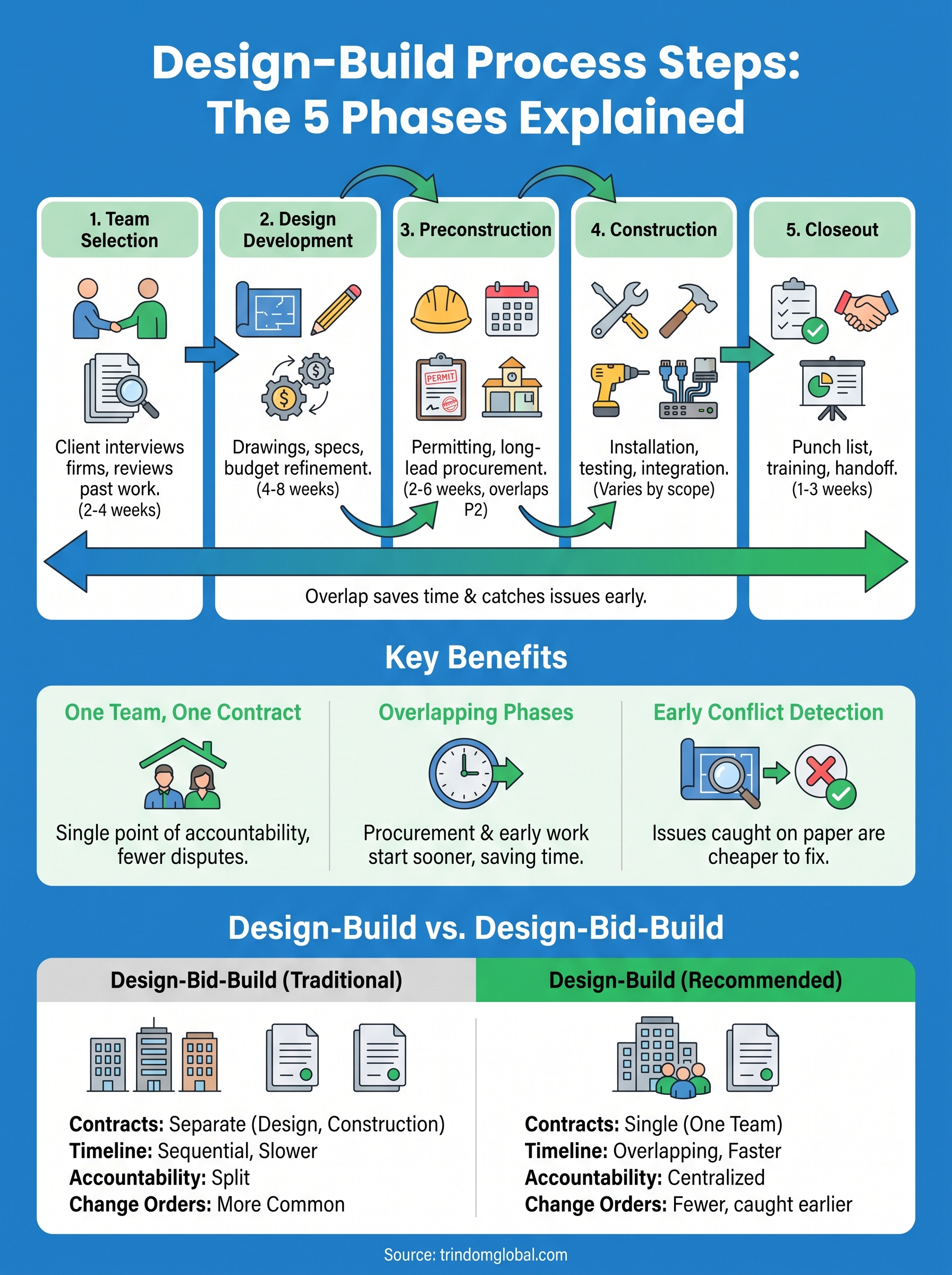
Every design-build project moves through the same five phases, though the exact names shift a bit depending on who you ask. Knowing this sequence gives you a map before work starts, so you can tell whether your project is actually on track or quietly falling behind. The core value comes from how these phases overlap rather than run strictly one after another, which is the opposite of how traditional construction unfolds.
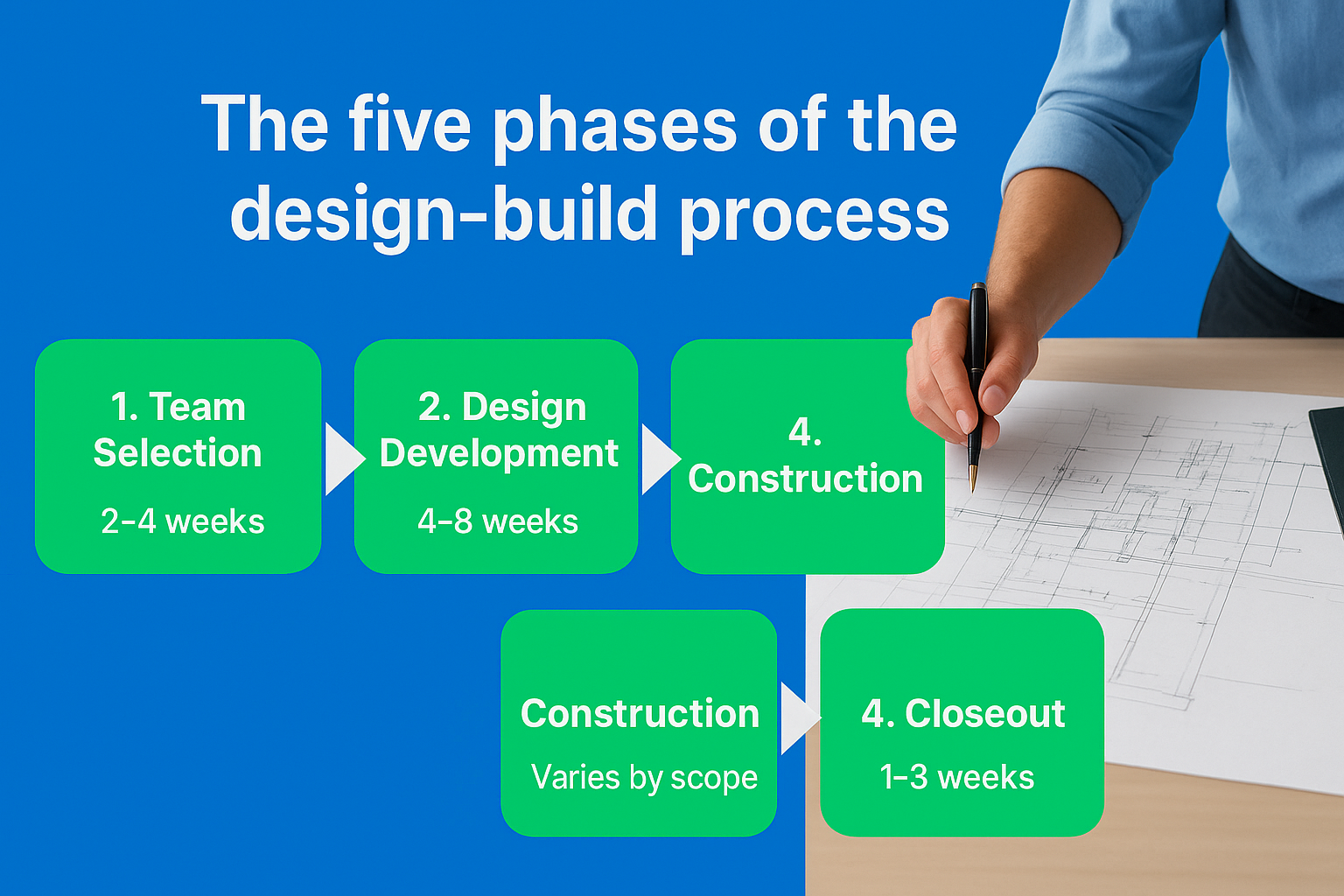
The five phases aren’t five separate projects, they’re one continuous workflow with a single team carrying it forward.
| Phase | What Happens | Typical Duration |
|---|---|---|
| 1. Team Selection | Client interviews design-build firms, reviews qualifications and past projects | 2-4 weeks |
| 2. Design Development | Concept drawings, engineering, equipment specs, and budget refinement | 4-8 weeks |
| 3. Preconstruction | Permitting, procurement of long-lead equipment, final scheduling | 2-6 weeks, often overlapping with Phase 2 |
| 4. Construction | Installation, integration, testing, and inspections | Varies by scope |
| 5. Closeout | Punch list, training, documentation handoff | 1-3 weeks |
From concept to contract
Selection and design happen fast in a healthy design-build relationship. During Phase 1, you’re vetting a team’s track record on projects similar to yours, whether that’s medical equipment installs or structured cabling headend buildouts, and confirming they carry the right licensing and insurance. Phase 2 starts almost immediately after, with engineers and designers producing drawings while your budget gets refined against real vendor quotes instead of rough estimates. Government clients often add an RFP review step here to confirm compliance requirements are baked into the design before anything moves to procurement.
From ground to grand opening
Getting equipment ordered early defines Phase 3, particularly for hospital installations where imaging systems or specialized racks can carry lead times of several months. Once procurement is underway, Phase 4 construction begins, with crews installing, integrating, and testing systems against the specs locked in during design. Handoff closes the loop in Phase 5, when your team walks the site, resolves any punch list items, and receives training and documentation for the systems now in place. Notably, these phases don’t wait politely for each other to finish, which is exactly why design-build projects tend to move faster than a strictly sequential process ever could.
Design-build vs. design-bid-build: key differences
Comparing these two delivery methods side by side makes the tradeoffs obvious fast. Design-bid-build splits your project into three separate stages, design, competitive bidding, and construction, each handled by a different firm with its own contract. Design-build merges design and construction under one contract with one team, which changes everything from how fast you move to who answers when something goes sideways.
Sequencing and speed
Separation defines the traditional path: architects finish drawings, then those drawings go out to bid, then a contractor gets selected, then construction starts. Nothing overlaps, so a project that takes fourteen months under design-bid-build might run nine or ten months under design-build because procurement and early construction start before every drawing is finalized. Layered timelines like this matter most on hospital equipment installs, where a delayed go-live date has real financial and clinical consequences.
Accountability and risk
Gaps between firms create the biggest risk in design-bid-build. If a structured cabling run conflicts with HVAC ductwork, the architect blames the contractor’s field team, the contractor blames the drawings, and you’re stuck mediating a dispute while the schedule burns. Design-build removes that gap entirely because one company owns both the drawings and the installation.
Split contracts create split blame; one contract creates one answer.
Owning the outcome changes how a team behaves on site, since there’s nowhere to point the finger but at their own work.
Cost predictability
Bidding wars define the traditional model’s pricing logic, with the lowest bidder often winning regardless of whether they fully understood the scope. That gap between bid and reality shows up later as change orders. Design-build teams price the project holistically from the start, since the same firm managing the budget also manages the fieldwork, which tends to produce fewer surprise costs.
| Factor | Design-Bid-Build | Design-Build |
|---|---|---|
| Contracts | Separate for design and construction | Single contract, one team |
| Timeline | Sequential, slower | Overlapping, faster |
| Accountability | Split between firms | Centralized |
| Change orders | More common | Fewer, caught earlier |
| Best fit | Simple, well-defined scopes | Complex, time-sensitive IT/equipment projects |
Government and healthcare clients tend to lean toward design-build once they’ve been burned by a change order dispute under the traditional model. Multifamily operators managing large ISP rollouts see the same benefit, since fewer parties means fewer places for miscommunication to hide across a sprawling campus install.
How to choose the right design-build partner
Picking the wrong partner undoes every advantage design-build offers. A firm that’s fast but sloppy on documentation will leave you exposed during a government audit. A firm with great credentials but no hospital experience will stall the first time they hit infection control protocols or equipment clearance requirements. Choosing the right design-build partner means matching their actual track record to the specific risks your project carries, not just checking a box on their brochure.
Look for sector-specific experience, not general contracting chops
General construction experience doesn’t transfer cleanly to specialized IT and equipment work. A team that’s built office parks may know nothing about RF interference testing or the power redundancy a hospital imaging suite requires. Ask for references from projects similar to yours, whether that’s structured cabling headend buildouts, medical equipment installs, or multifamily ISP rollouts, and actually call those references instead of taking the case study at face value.
A design-build partner who’s never touched your type of project is learning on your dime, not theirs.
Confirm licensing, certifications, and procurement fit
Government projects add a layer most general contractors aren’t built to handle. RFP requirements, procurement rules, and compliance documentation demand a partner who’s navigated that process before, not one who’s guessing at what a contracting officer expects. If your organization prioritizes minority or women-owned business enterprise vendors, confirm that certification directly rather than assuming it from a website badge.
- Verify active licensing in your state and any equipment-specific certifications
- Ask how many similar-scope projects they’ve completed in the past two years
- Request documentation samples from a past government or healthcare project
- Confirm they carry adequate insurance and bonding for your project size
Evaluate how they communicate before you sign anything
Communication style during the sales process usually predicts how a project runs once contracts are signed. A partner who answers questions clearly, sets realistic timelines instead of overpromising, and explains tradeoffs rather than glossing over them tends to carry that same discipline into design and construction. Watch for vague answers about long-lead procurement or evasive responses about past change orders. Those are early warning signs, not minor details.
Ask about their design-build track record directly
Don’t rely solely on marketing language. Ask the firm to walk you through a past project from Phase 1 to Phase 5, including something that went wrong and how they handled it. A partner confident in their process will have a real answer, not a rehearsed one. That single conversation often tells you more about fit than any proposal document, and it’s worth the extra thirty minutes before you commit.
Tips for a smooth design-build project
Even the best design-build partner can’t compensate for a client who shows up unprepared. Projects run smoothest when you treat your own role as active, not passive, especially during the early phases when decisions still cost little to change. Smooth design-build projects share a handful of habits you can start applying before the first drawing ever gets produced.
Nail down scope and priorities before design starts
Vague goals produce vague drawings, and vague drawings produce change orders later. Sit down before Phase 1 wraps and write out exactly what success looks like: go-live dates, budget ceilings, compliance requirements, and any equipment specs you already know you need. Clear scope documentation gives your design team something concrete to work against instead of guessing at priorities halfway through.
A project with a written scope rarely drifts; a project without one always does.
Keep decision-makers available during design development
Design development moves fast, and a stalled decision on your end can stall the entire schedule behind it. Designate one person on your side with authority to approve drawings, sign off on equipment substitutions, and answer questions within a day or two, not a week. Hospital and government clients especially benefit from this, since committee-style approvals tend to be where timelines quietly slip.
Ask for a procurement plan up front
Long-lead equipment, whether it’s imaging systems for a hospital suite or headend hardware for a multifamily network, needs to get ordered early to keep Phase 3 and Phase 4 on schedule. Request a written procurement timeline showing what gets ordered when, and check in on it monthly rather than assuming it’s handled.
- Confirm lead times on every major piece of equipment before design finalizes
- Ask what happens if a vendor slips their delivery date
- Request updates on procurement status at set intervals, not just when something’s wrong
- Flag any equipment substitutions immediately, since specs can shift performance or compliance
Document everything, especially changes
Verbal agreements disappear the moment a dispute starts. Every change, no matter how small, should get documented in writing and tied back to the budget and schedule. Written change documentation protects you during a government audit and gives you leverage if a dispute ever surfaces after closeout.
Walk the site regularly during construction
Regular site visits catch small problems before they become expensive ones. You don’t need construction expertise to notice a mismatch between what was promised and what’s being installed, and your design-build partner should welcome the visibility rather than resist it. Trust builds when both sides see the same progress in real time, not just through a status report.
Putting the process into practice
The design build process steps work because they put one team on the hook for the whole outcome, from that first team selection meeting through the final walkthrough. You’ve seen how the five phases overlap instead of running in a strict line, why that overlap catches problems while they’re still cheap to fix, and what separates a partner who’s done this before from one who’s guessing. None of that matters if you skip the prep work on your end: a clear scope, an available decision-maker, and a procurement plan you actually check on.
If you’re weighing a hospital equipment install, a structured cabling buildout, or a multifamily ISP rollout, the sequencing above is your checklist for holding any partner accountable. Trindom Global has run this exact process across those project types for years, and we’re glad to walk through your scope before you commit to anything. Reach out to Trindom Global to talk through your next project.


