

You’ve decided your network needs fiber, but you’re not sure what you’re actually paying for when you hire a contractor. That confusion costs money, either through change orders mid-project or a scope so vague the installer skips steps your building actually needs. Understanding what fiber optic cable installation services cover before you sign a contract puts you in control of the negotiation, not the other way around.
At its core, professional fiber optic installation services work spans site survey and design, cable pulling and splicing, termination, testing, and documentation, plus the headend or equipment room build that ties it all together. A serious provider also handles permitting, coordinates with existing infrastructure, and manages the project so your timeline holds. Skip any of these pieces and you end up with a network that fails inspection or underperforms once it’s live.
This article breaks down each stage of the process, what separates capable fiber optic installation contractors from crews that just pull cable, and what to ask before hiring one. Whether you’re outfitting a hospital, a commercial property, or a multifamily campus, knowing the full scope of a fiber optic cable installation service helps you evaluate proposals and avoid gaps that show up months later.
Why professional fiber optic installation matters
Fiber is unforgiving in a way copper never was. A bend radius violation, a dirty connector, or a splice done under time pressure won’t always show up on day one, but it will show up. Fiber optic cable installation services exist because the margin for error in glass fiber is measured in microns, not inches, and a contractor who understands that difference protects your network’s performance for the next 15 to 20 years, not just through the final walkthrough.
The cost of cutting corners
Getting it wrong isn’t cheap to fix after the fact. Reopening walls, ceilings, or conduit runs to correct a bad pull costs far more than the cost of a fiber optic install done right the first time, and downtime on a live hospital or commercial network has its own price tag in lost productivity or, in healthcare settings, patient safety. Poor installation work also tends to fail certification testing, which means you’re paying twice: once for the original install and again for the rework crew that fixes it.
A network built on a rushed fiber install costs you twice: once to build it, once to rebuild it.
Why experience and certification matter
Qualified fiber optic installation contractors carry manufacturer certifications from companies like Corning or CommScope, follow TIA/EIA-568 standards for structured cabling, and know the codes and gear a fiber install requires in your specific building type. That matters because a hospital headend build has different fire-code and redundancy requirements than a multifamily property’s telecom closet, and a contractor who’s only ever pulled cable in office buildings may not catch what’s specific to your environment. Government projects add another layer entirely, with procurement rules and RFP requirements that inexperienced vendors routinely misjudge.
Experience also shows up in how a crew handles the unexpected. Every building has surprises, whether that’s asbestos in an older ceiling, undocumented conduit runs, or equipment rooms that don’t match the as-built drawings. A seasoned installer adjusts on site without blowing the timeline or the budget, because they’ve seen the problem before.
Ultimately, the value of hiring proven fiber optic installation services comes down to risk transfer. You’re not just buying labor, you’re buying a company that stands behind test results, warranties the work, and has the vendor relationships to source parts fast when something needs replacing. That’s the difference between a network that runs quietly for a decade and one that generates a service ticket every quarter.
What’s included in a fiber optic installation service
A complete scope breaks down into distinct phases, and knowing them lets you check a proposal against what’s actually required rather than what a contractor decided to quote. Fiber optic cable installation services should cover the full path from planning to sign-off, not just the physical cable pull.
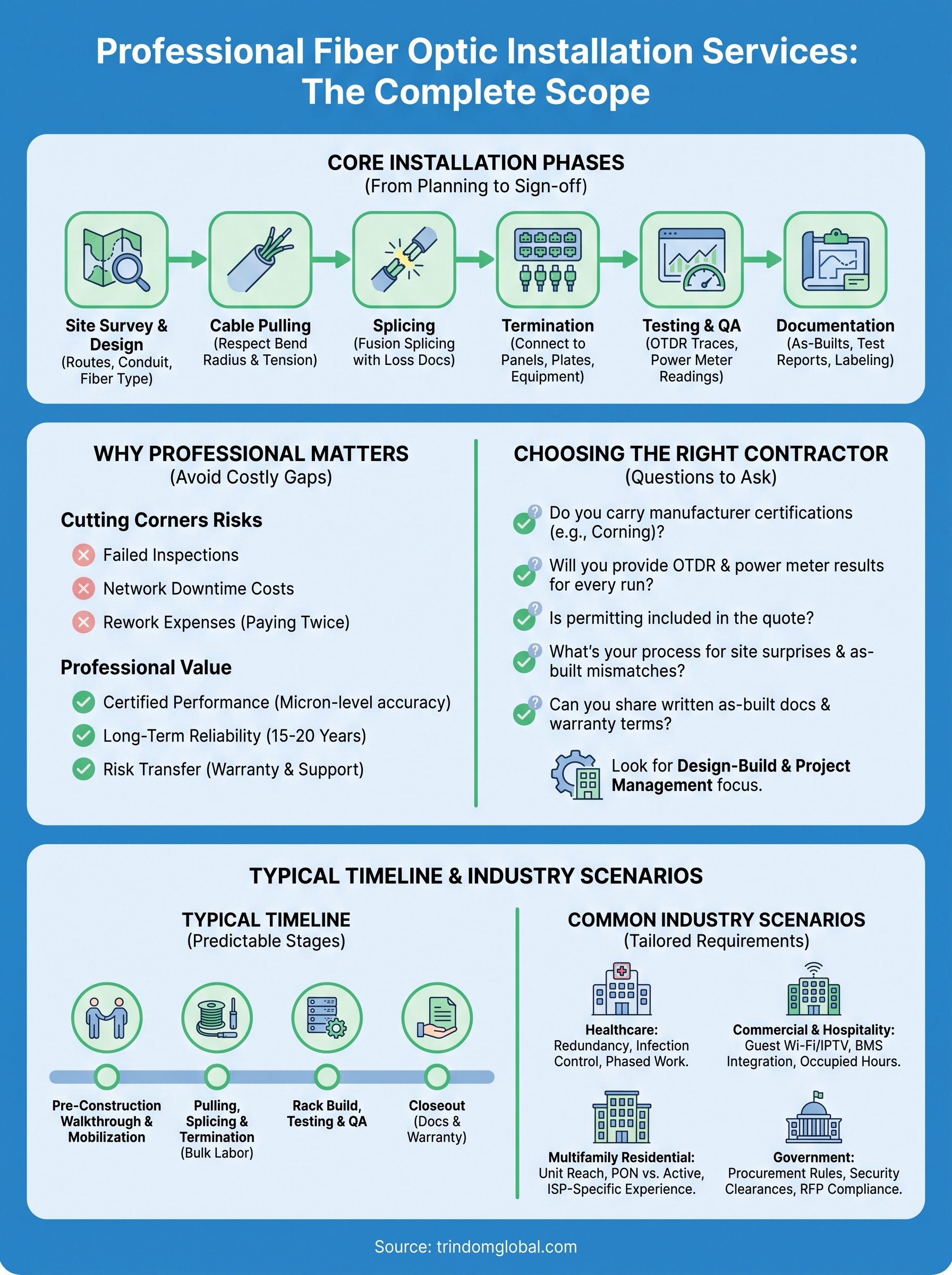
The core phases
- Site survey and design: mapping routes, measuring distances, identifying conduit or aerial paths (including installing underground fiber optic cable), and specifying fiber count and type (single-mode vs multi-mode)
- Cable pulling: running fiber through conduit, cable tray, or aerial strand while respecting bend radius and pulling tension limits
- Splicing: fusion splicing fiber strands at junctions with loss figures documented for each splice
- Termination: connecting fiber to patch panels, wall plates, or equipment using the correct connector type
- Testing: OTDR traces and power meter readings to confirm loss budgets are met end to end
- Documentation: as-built drawings, test result reports, and labeling that matches your building’s existing system
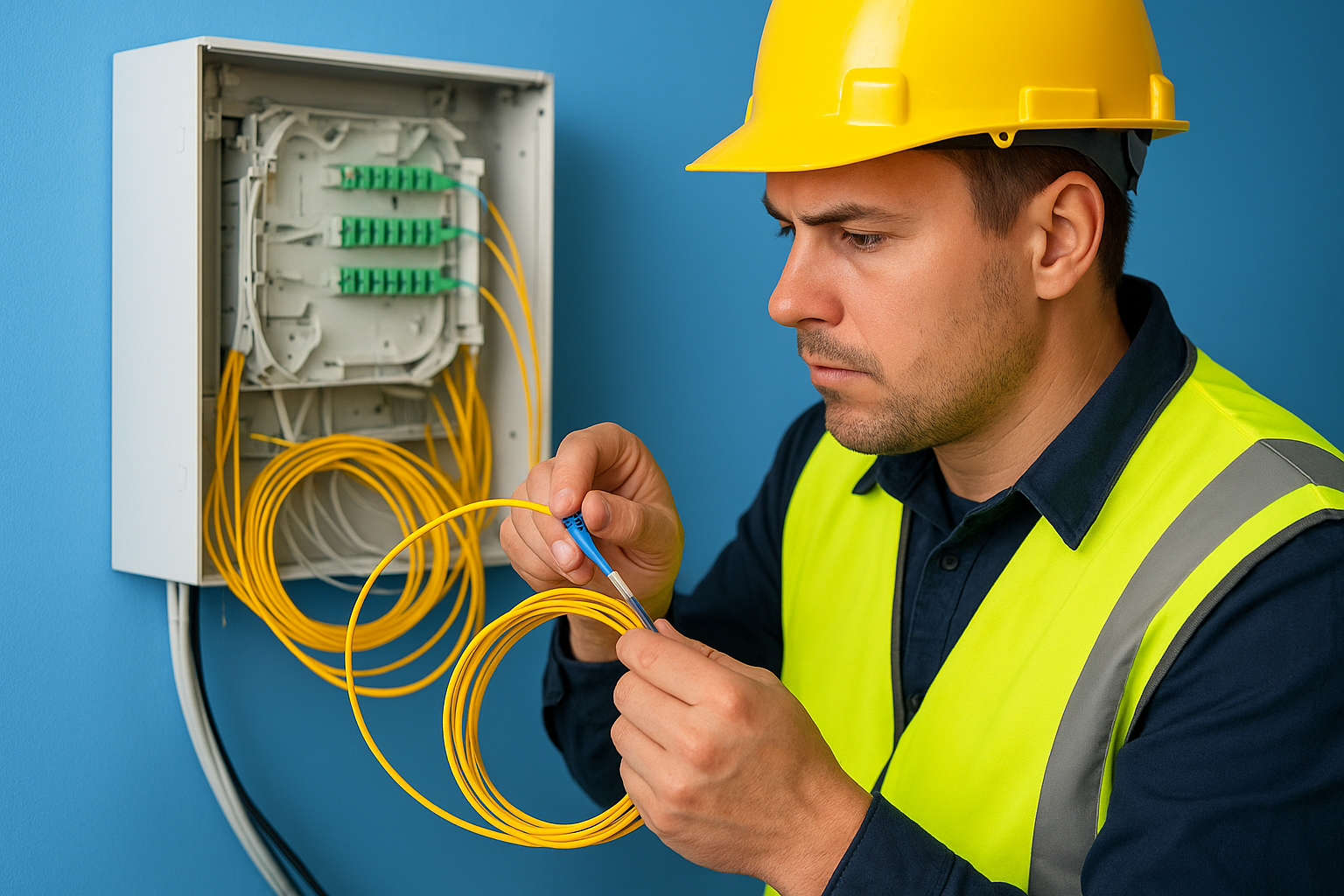
Every phase left off the scope is a phase you’ll pay someone else to finish later.
The headend or equipment room build
Beyond the cable itself, most projects need a headend or telecom room built out to house the equipment that makes the fiber useful, racks, patch panels, splice trays, power, and cooling. This is where headend and equipment room buildout work overlaps with the fiber install, and it’s often the piece contractors underscope because it involves electrical and HVAC coordination outside a typical cable crew’s comfort zone.
Finally, look for project management folded into the service rather than billed as an afterthought. Coordinating permits, scheduling around your operations, and managing subcontractors keeps the project on your timeline instead of the contractor’s convenience.
How to choose the right fiber optic installation contractor
Picking a contractor comes down to verifying claims, not just reading a glossy sales sheet. Ask for references from projects similar to yours, whether that’s a hospital wing, a hotel property, or a government building with strict procurement rules. A contractor who’s done fifty office installs but zero healthcare jobs will learn on your dime, and that’s a risk you shouldn’t absorb.
Questions to ask before signing
- Do you carry manufacturer certifications (Corning, CommScope, or similar)?
- Will you provide OTDR and power meter test results for every fiber run?
- Who handles permitting, and is that included in the quote?
- What’s your process when site conditions don’t match the as-built drawings?
- Can you share as-built documentation and warranty terms in writing?
If a contractor can’t answer these five questions without hedging, keep looking.
Credentials that actually matter
Certifications and standards compliance separate reliable fiber optic installation services from crews that just own a fusion splicer. Look specifically for adherence to the ANSI/TIA-568 cabling standards, documented safety training, and, if you’re a government agency or work with one, experience navigating RFP requirements and minority or women-owned business enterprise (MWBE) certification requirements that some contracts mandate.
Finally, weigh how the contractor manages the project, not just the install. A firm that folds design-build consultation, permitting, and project management into one scope, rather than farming pieces out to subcontractors, gives you a single point of accountability. That’s the model Trindom Global built its design-build services around, and it’s worth asking any contractor whether they offer the same before you commit budget to a project that spans multiple trades and timelines.
What to expect during the installation process
A fiber project moves through predictable stages, and knowing the sequence helps you plan around it instead of getting surprised by a crew showing up when you expected them gone. Fiber optic installation services typically start with a pre-construction walkthrough, move into physical installation, and close with testing and sign-off, each stage with its own deliverables and checkpoints.
The typical timeline
- Pre-construction walkthrough: contractor confirms the design against actual site conditions
- Mobilization: crew, materials, and permits arrive on site
- Pulling and splicing: the bulk of physical labor, often the longest phase
- Termination and rack build: connectors, patch panels, and equipment room work
- Testing and QA: OTDR and power meter results reviewed against loss budgets
- Closeout: as-built documentation and warranty paperwork handed over
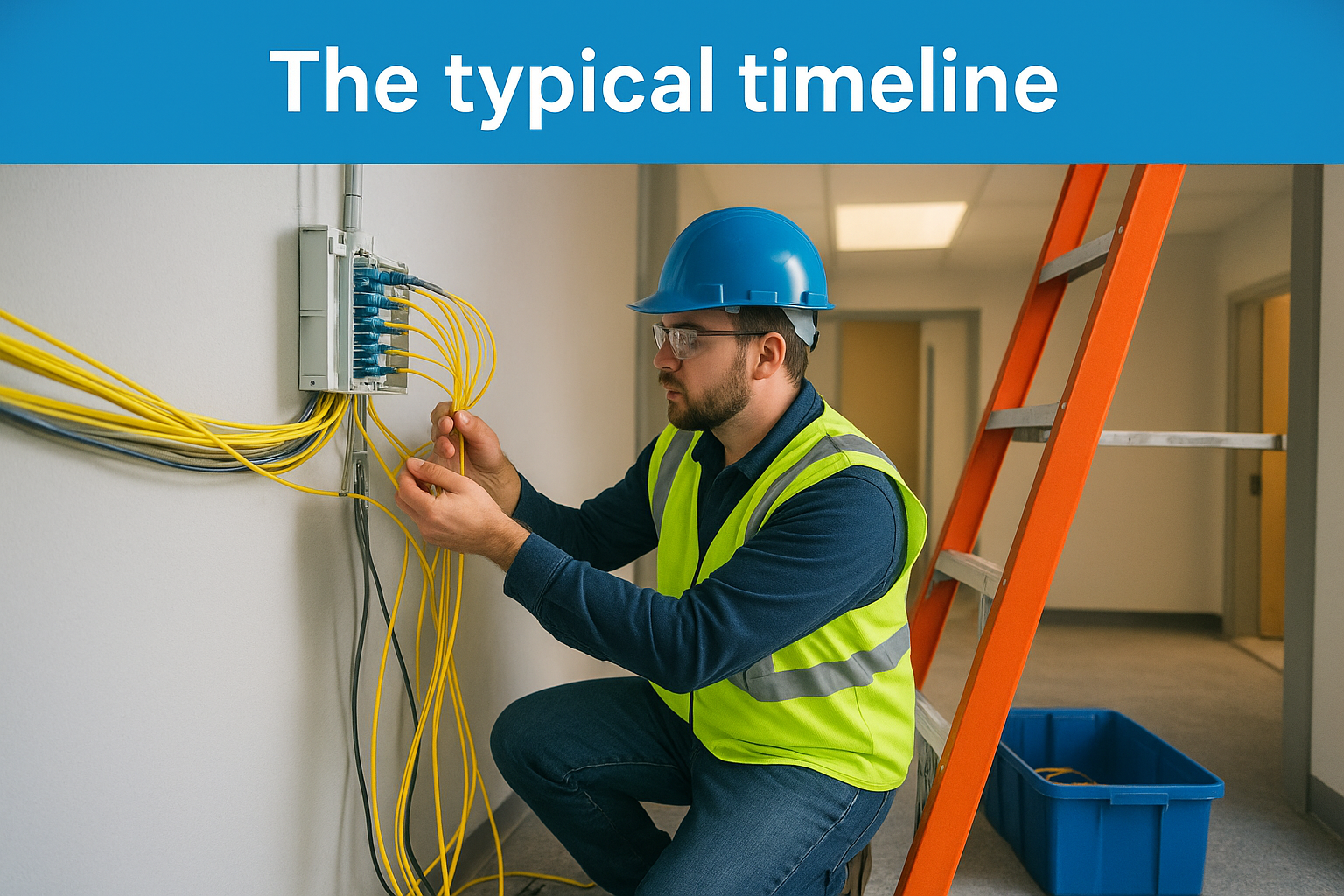
During active work, expect noise, temporary access restrictions to ceilings or telecom closets, and a crew that needs coordination with your staff if the building stays occupied. Hospitals and hotels in particular require phased work around patient care or guest hours, which a good contractor plans into the schedule up front rather than discovering mid-project.
A well-run installation feels boring, because the surprises got handled before they became problems.
Expect regular check-ins too. Weekly progress updates, photos of splice enclosures before they’re closed up, and a punch list before final payment are standard practice among established fiber optic installation contractors, not extras you should have to request. If your contractor goes quiet between kickoff and completion, that’s a signal worth acting on, not ignoring.
Common fiber installation scenarios by industry
Fiber installation looks different depending on who’s buying it. A hospital’s headend build carries different code requirements than a hotel’s guest network, and government contracts add procurement layers you won’t find in commercial work. Fiber optic cable installation services have to flex to match these environments, and fiber optic installation contractors who’ve worked across sectors catch requirements that industry newcomers miss entirely.
The environment dictates the install, not the other way around.
Healthcare facilities
Hospitals need redundant fiber paths to avoid downtime near critical care areas, plus infection-control protocols that dictate when and how crews can access ceilings above occupied wings. Trindom Global’s teams handling what medical equipment installation covers coordinate around patient care schedules and bring qualified technicians who understand clinical environments, not just cable pulls.
Commercial and hospitality properties
Hotels and office buildings lean on guest Wi-Fi and IPTV network installation work to support building management systems running over the same fiber backbone. Timing matters here too, since occupied guest floors limit when crews can work, and a contractor unfamiliar with hospitality operations tends to underestimate that constraint until it costs them a day.
Multifamily residential campuses
Multi-family properties need fiber that reaches every unit without disrupting residents mid-lease. That’s why Trindom Global runs multifamily high-speed ISP solutions through its sister service, Trintel, weighing PON vs active fiber for multifamily properties with more than 25 years of ISP-specific installation experience across residential campuses.
Government projects
Government agencies stack procurement rules, security clearances, and strict RFP compliance requirements on top of the technical scope, and who qualifies as a minority business enterprise or women-owned business often factors directly into award decisions on these contracts.
Getting your fiber project started
Every detail in this article comes down to one point: fiber optic cable installation services worth paying for cover the full path from site survey to closeout, not just a cable pull and a handshake. Know the phases, ask the five questions before signing, and match your contractor’s experience to your industry, whether that’s healthcare, hospitality, multifamily, or government work.
Getting the scope right up front saves you from change orders, failed inspections, and a network that underperforms the moment real traffic hits it. Now that you know what separates capable fiber optic installation contractors from crews that just show up with a splicer, you’re equipped to read proposals critically and push back where they fall short.
If you’re ready to scope a project with a team that folds design, permitting, and project management into one accountable service, explore Trindom Global’s design-build and installation services and start the conversation.


