

If you own a minority business and you’re bidding on government or corporate contracts, you’ve probably noticed how often MBE certification shows up as a requirement or a scoring advantage. Figuring out how to get MBE certified can feel confusing because the requirements shift depending on your state, your industry, and whether you’re pursuing certification through a local, state, or national body like the NMSDC.
This guide walks you through the actual process: who qualifies, what documentation you’ll need, and the application steps that take most businesses anywhere from 60 to 90 days to complete. You’ll learn how to check your eligibility requirements, gather ownership and control documentation, and avoid the common mistakes that cause applications to get bounced back or delayed for months.
We put this guide together because we work directly with organizations navigating procurement, including our own experience as a certified minority and women-owned business. We know firsthand what reviewers look for and where applicants trip up. Whether you’re a contractor, an IT services provider, or a supplier hoping to land more government or corporate work, this step-by-step process will help you get certified faster and with fewer headaches.
What is MBE certification and why it matters
MBE certification is a formal verification that your company is at least 51% owned, operated, and controlled by one or more individuals who belong to a recognized minority group, typically Black, Hispanic, Asian-Pacific, Asian-Indian, or Native American. A certifying agency reviews your ownership documents, your day-to-day management structure, and your financial records before granting the credential. Once you’re certified, your business appears in supplier diversity databases that corporations and government agencies actively search when they’re trying to meet diversity spending goals.
Who Actually Certifies MBEs
There’s no single national office handing out MBE status. Instead, you’ll choose between a handful of recognized certifying bodies depending on who you want to sell to. The National Minority Supplier Development Council (NMSDC) is the most widely recognized option for corporate contracts, while state and local agencies handle certification tied to public sector bids. Some businesses pursue more than one certification because different buyers only recognize specific credentials.
| Certifying Body | Best For | Typical Recognition |
|---|---|---|
| NMSDC (regional affiliate) | Corporate supplier diversity programs | Fortune 500 companies, private sector |
| State MBE/DBE agencies | State and local government contracts | State DOTs, municipal procurement offices |
| City-level certification programs | City contracts and RFPs | Local government agencies |
| SBA 8(a) Business Development Program | Federal set-aside contracts | Federal agencies (separate from MBE, but often pursued alongside it) |
Check the U.S. Small Business Administration’s guidance on contracting if you’re also considering federal set-aside programs, since the requirements and paperwork differ from standard MBE certification.
Why Certification Actually Matters
Getting certified opens doors that stay closed to uncertified competitors. Corporations with supplier diversity commitments often reserve a percentage of their procurement spend specifically for certified minority-owned vendors, and government RFPs frequently award extra scoring points to certified bidders. Beyond the direct contract access, certification connects you to matchmaking events, mentorship programs, and databases that buyers use when they’re actively looking to diversify their vendor pool.
Certification doesn’t guarantee contracts, but it puts your business in front of buyers who are actively looking for vendors like you.
Many businesses underestimate how much certification affects their bidding position until they see a competitor with the credential win a contract they were equally qualified for. Trindom Global holds MWBE certification ourselves, and it’s shaped conversations with clients who have formal diversity procurement requirements built into their vendor selection process. That firsthand experience is part of why we can walk you through the eligibility requirements and application steps without the guesswork that trips up first-time applicants.
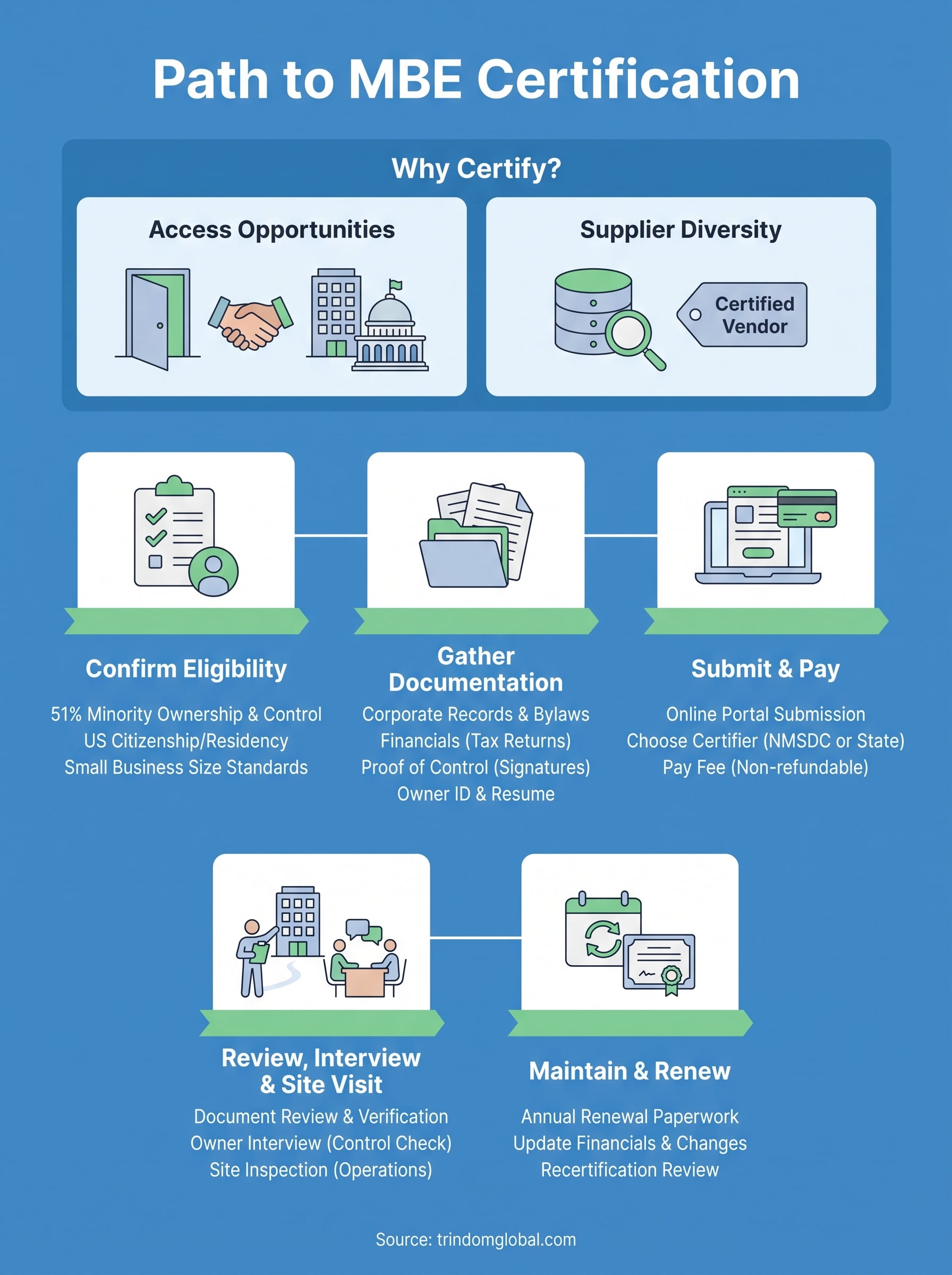
Step 1. Confirm your eligibility
Before you fill out a single form, verify that your business actually meets the baseline criteria. Certifying agencies check ownership percentage, day-to-day control, and citizenship status before they even schedule a review. Confirming eligibility upfront saves you from wasting weeks on paperwork that gets rejected on a technicality.
Ownership and Control Requirements
Your business needs at least 51% ownership by one or more individuals from a recognized minority group, and that owner must also control daily operations, not just hold the title. Reviewers look for real decision-making authority: who signs contracts, who manages payroll, who directs the company’s strategic direction. A minority owner listed on paper but absent from operations won’t pass the eligibility requirements check. Citizenship or lawful permanent residency status is also required for the qualifying owner in most jurisdictions.
Ownership on paper isn’t enough. Certifying agencies want proof that a minority owner actually runs the business day to day.
Business Size and Structure Checks
Most certifying bodies also apply size standards similar to those the U.S. Small Business Administration uses for its size standards program, so a business that’s grown past small-business thresholds may not qualify even if ownership checks out. Run through this list before you apply:

- Confirm the business is for-profit and legally registered in your state
- Verify the minority owner holds at least 51% equity, documented in formation records
- Confirm the same owner has final authority over hiring, contracts, and financial decisions
- Check that your business falls under applicable size standards for your industry
- Make sure the business has been operating long enough to show a track record, typically six months to a year depending on the certifying body
Once you’ve confirmed these boxes are checked, move on to gathering the paperwork that proves it.
Step 2. Gather your required documentation
Once you’ve confirmed you meet the baseline requirements, the next job is assembling the paperwork that proves it. Certifying agencies won’t take your word for ownership or control, they want documentation that backs up every claim on your application. Gathering documentation early is where most applicants either save themselves weeks or set themselves up for a rejection letter three months down the road.
Core Documents Every Applicant Needs
Start with the paperwork that establishes who legally owns and runs the company. Reviewers typically want articles of incorporation or organization, an operating agreement or bylaws, and a current business license. Financial records matter too, since they show the minority owner’s investment in the business and their financial exposure to its success.
- Articles of incorporation, organization, or partnership agreement
- Operating agreement or corporate bylaws showing ownership percentages
- Government-issued ID and proof of citizenship or lawful permanent residency for the qualifying owner
- Two to three years of business tax returns
- Personal financial statements or proof of capital contribution from the minority owner
- Resumes showing the owner’s relevant industry experience
- Lease agreements or proof of business location
- Organizational chart showing who reports to whom
Proving Day-to-Day Control
Ownership documents only tell half the story. Proving control requires evidence that the minority owner actually directs operations, not just holds equity on paper. Bring bank signature cards, payroll records showing who authorizes payment, and contracts or purchase orders signed by the qualifying owner. Some agencies also request a site visit questionnaire in advance, so it helps to photograph your workspace and note who occupies which role before the reviewer arrives.
If your paperwork can’t answer “who signs off on decisions here,” expect the certifying agency to ask again until it can.
Organize everything into a single digital folder before you start the application itself. Reviewers move faster when documents are labeled clearly, and a disorganized submission often triggers the exact follow-up requests that stretch your timeline from 60 days to 120.
Step 3. Submit your application and pay the fee
With your documentation organized, you’re ready to actually submit your application. Most certifying bodies now run this process online through a portal, where you’ll upload every document from Step 2, fill in ownership percentages, and answer questions about your business structure and revenue history. Double-check that file names match what the portal requests, since mismatched labels are a common reason applications bounce back for resubmission before a reviewer even looks at the content.
Choosing Where to Apply
Deciding which certifying body to apply through matters as much as the paperwork itself. If your target buyers are Fortune 500 companies, apply through your regional NMSDC affiliate. If you’re chasing state or municipal contracts, apply directly with the relevant state MBE/DBE office instead. Some businesses submit to both, but that means duplicating documentation and paying two separate fees, so confirm which credential your target clients actually recognize before you spend the money twice.
Fees and Processing Times
Application fees vary by agency and by your business’s annual revenue, and they’re rarely refundable if your application gets rejected.
| Certifying Body | Typical Fee Range | Renewal Frequency |
|---|---|---|
| NMSDC regional affiliate | $350 – $1,200 (scaled by revenue) | Annual |
| State MBE/DBE agency | $0 – $500 | Every 1-3 years |
| City certification program | $0 – $300 | Annual or biennial |
Paying the fee doesn’t guarantee approval, it only guarantees a reviewer will look at your file.
Payment usually happens at submission, so budget for the higher end of the range if your business posted strong revenue last year. Save your payment confirmation and application ID, since you’ll need both when you follow up on processing delays or schedule the next stage of review.
Step 4. Complete the review, interview, and site visit
After you submit your application, a case manager gets assigned to your file and starts the document review process. This stage typically takes 30 to 60 days, though it can stretch longer if your industry requires additional licensing checks or your ownership structure includes multiple entities. Expect the reviewer to cross-reference your tax returns against your stated revenue and flag any inconsistency between your operating agreement and what you listed on the application.
What Happens During Document Review
Reviewers work through your file line by line, checking that every claim about ownership and control matches the paperwork you submitted. Missing signatures or expired licenses are the most common reasons a certification review stalls at this stage. You’ll likely get at least one follow-up request for clarification, so respond quickly:
- Answer information requests within the deadline stated in the email, usually 5 to 10 business days
- Upload replacement documents through the same portal you used originally
- Keep a copy of every communication in case you need to reference it later
The Interview and Site Visit
Once the paperwork checks out, most agencies schedule an interview with the minority owner and a site visit to the business location. The site visit exists to confirm the business actually operates where and how you described it, not just on paper.

The site visit exists for one reason: to confirm the person who owns the business is the same person running it.
Expect the interviewer to ask who signs checks, who negotiates with vendors, and how decisions get made day to day. Site visits for office-based businesses usually take under an hour, while manufacturing or warehouse operations can run longer since the reviewer wants to see equipment and staff in action. Walk them through your workspace, introduce key employees, and have your organizational chart on hand to reinforce what you already submitted.
Step 5. Maintain and renew your certification
Getting the certificate isn’t the finish line. Most certifying bodies require annual renewal paperwork and a fresh look at your ownership structure, so treat the credential as something you maintain, not something you file away in a drawer. Skipping a renewal deadline can lapse your status entirely, which means starting the whole application over instead of a quicker update.
What Triggers a Recertification Review
Agencies typically ask for updated financials, a current business license, and confirmation that the same minority owner still controls day-to-day operations. Changes matter here: a new business partner, a shift in equity, or a move to a new location can all trigger a deeper look before your renewal gets approved. Keep this list handy each year:
- Submit updated tax returns and financial statements before the stated deadline
- Report any ownership or management changes as soon as they happen, not at renewal time
- Renew business licenses and registrations that expired during the certification period
- Confirm your NAICS codes and services offered still match what’s on file
Certification lapses quietly if you ignore renewal notices, and reinstating it often takes longer than renewing on time ever would.
Staying Active Between Renewals
Many agencies also conduct random or triggered site visits between renewal cycles, especially if a competitor files a complaint or your revenue jumps significantly. Responding promptly to any request for updated documentation keeps your file clean and avoids a suspension while an agency investigates. Set a calendar reminder 90 days before your renewal date so you’re not scrambling to pull together records at the last minute, and store every renewed document in the same organized folder you built during your original application. Businesses that treat certification maintenance as a routine task, rather than a once-a-year scramble, rarely face the delays that catch other applicants off guard.
Putting your certification to work
Earning MBE certification takes real effort, but the payoff shows up the moment you start bidding with a credential that opens doors competitors don’t have. You now know the eligibility requirements, the documentation reviewers expect, and the timeline from application to site visit to renewal. None of that guarantees a contract, but it puts your business in front of buyers who are actively looking for certified vendors and removes the excuse that kept you out of certain bids before.
Once you’re certified, the real work is using it well: keep your documentation current, respond fast to renewal notices, and lean on your status in every proposal where it applies. If you’re navigating IT infrastructure procurement and want to work with a team that’s been through this process firsthand, reach out to Trindom Global and see how our certified minority and women-owned status can strengthen your next project.


