

If you own a business and you’re not sure where to start with how to get minority business certification, you’re not alone. The process involves specific eligibility rules, a stack of paperwork, and review timelines that catch most applicants off guard. Get it wrong and you’ll spend months waiting on a rejection letter instead of landing contracts that require certified vendors.
This guide walks through exactly what certifying bodies like the NMSDC and SBA look for, what documents you need to have ready, and what the process actually costs in time and money. You’ll see the application steps in order, from confirming ownership percentage to submitting for site visits, so you know what to expect at each stage instead of guessing.
We wrote this from the perspective of a company that lives inside government and enterprise procurement every day. Trindom Global holds its own MWBE certification and has watched clients win and lose bids based on paperwork details. That experience shapes every step below, so you get practical guidance instead of generic advice, and a clear path to a certification that actually opens doors.
What minority business certification means for your company
Minority business certification is a formal recognition that your company is at least 51% owned, controlled, and operated by someone who belongs to a recognized minority group. It’s not a marketing badge. It’s a legal status verified by a third-party certifying body, and it opens access to set-aside contracts, supplier diversity programs, and procurement pipelines that stay closed to uncertified vendors. If you’re chasing government work or trying to get on an enterprise’s approved vendor list, this paperwork is often the first gate you have to pass through.
Why certification changes your contract access
Large corporations and government agencies track supplier diversity spending because federal and state programs require it. Certification gives buyers a documented reason to award you work without exposing themselves to audit risk. Trindom Global has seen this firsthand: our own MWBE status has opened doors in procurement rounds where uncertified competitors got screened out before anyone reviewed pricing or scope.
Certification isn’t a formality, it’s the ticket that gets your bid read in the first place.
Who typically qualifies
Most certifying bodies look for the same core traits, even though paperwork and fees differ:
- Ownership: at least 51% owned by one or more minority individuals
- Control: those owners manage day-to-day operations, not just hold equity
- Citizenship: owners are usually U.S. citizens or legal permanent residents
- Business structure: the company operates as a for-profit entity, not a nonprofit or shell
Recognized categories generally include Black, Hispanic, Asian-Pacific, Subcontinent Asian, and Native American ownership, though each certifying organization defines these groups with its own specific criteria and documentation standards.
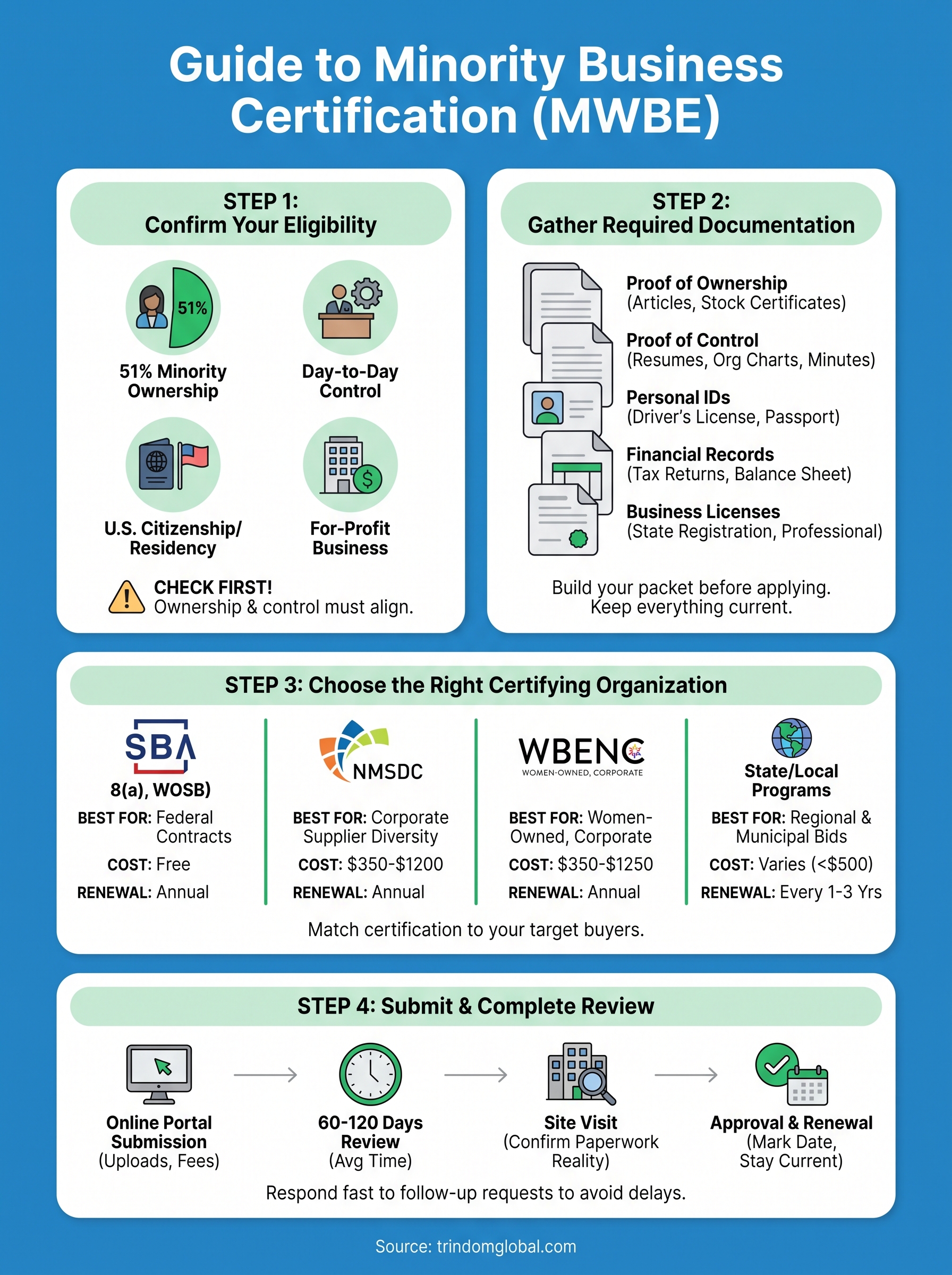
Step 1. Confirm your eligibility
Before you fill out a single form, check that your company actually meets the ownership and control tests certifying bodies enforce. Skipping this step wastes weeks, because reviewers reject applications the moment ownership percentages or control structures don’t line up with their standards.
Run through the baseline checklist
Start with these core requirements, since nearly every certifying organization, from the NMSDC to state-level MWBE programs, builds its eligibility screen around them:
- A minority owner (or owners) holds at least 51% of the business
- That owner makes the day-to-day operational decisions, not a silent partner or investor
- The business operates as a for-profit entity registered in your state
- The owner qualifies under a recognized minority category the certifying body accepts
- Company revenue and size fall within any caps the specific program sets
If ownership and control don’t match on paper, no amount of paperwork elsewhere will save your application.
Watch for structural red flags
Partnerships, multiple owners, or recent ownership transfers trip up applicants more than any other issue. If your minority owner took control less than six months ago, or if voting rights don’t match equity percentages, expect extra scrutiny or an outright denial until you fix the structure first.
Step 2. Gather your required documentation
Once you’ve confirmed eligibility, the next hurdle in how to get minority business certification is paperwork. Certifying bodies want proof, not statements, so pull together your records before you touch an application form. Missing documents are the single biggest reason applications stall past the first review round.
Build your document packet
Gather these items in one folder before you start any online portal:
- Proof of ownership: articles of incorporation, stock certificates, or partnership agreements showing the minority owner’s stake
- Proof of control: resumes, organizational charts, and board meeting minutes showing the owner runs daily operations
- Personal identification: driver’s license or passport confirming citizenship or residency status
- Financial records: business tax returns from the last two to three years, plus a current balance sheet
- Business licenses: state registration, professional licenses, and any DBA filings
Reviewers approve applications on documentation quality, not intent, so treat this folder as your case file.
Keep everything current
Stale documents create as many problems as missing ones. Verify that licenses haven’t expired and that ownership records reflect any recent changes, since a mismatch between your paperwork and your current structure triggers the exact red flags reviewers watch for during Step 1.
Step 3. Choose the right certifying organization
Not every certifying body opens the same doors, so match your choice to the contracts you actually want. Government work usually runs through the SBA’s 8(a) or WOSB programs, while corporate supply chains lean on the NMSDC or WBENC depending on ownership category. Applying to the wrong organization wastes months and fees on a certification buyers in your target market won’t recognize.

Compare your options before you apply
Check fees, renewal cycles, and who actually accepts the credential before committing your paperwork:
| Certifying Body | Best For | Typical Cost | Renewal |
|---|---|---|---|
| SBA (8(a), WOSB) | Federal contracts | Free to apply | Annual review |
| NMSDC | Corporate supplier diversity | $350–$1,200 | Annual |
| WBENC | Women-owned businesses, corporate buyers | $350–$1,250 | Annual |
| State/local MWBE programs | Regional and municipal bids | Varies, often under $500 | Every 1–3 years |
Pick the certifying body your target buyers actually screen for, not the one with the easiest application.
Ask buyers directly what they accept
Question your existing or prospective clients before you file anything. Procurement officers and supplier diversity managers will usually tell you straight which credential moves your bid forward, and that answer should drive your application more than convenience or cost.
Step 4. Submit your application and complete the review
Submitting your application is where the paperwork you gathered in Step 2 gets tested. Most certifying bodies now run everything through an online portal, where you’ll upload documents, pay the application fee, and answer detailed questions about ownership percentages and daily control. Expect the review to take 60 to 120 days depending on the organization, with the NMSDC and state MWBE programs often landing on the faster end and SBA programs sometimes stretching longer during busy filing seasons.

Prepare for the site visit
Almost every certifying body schedules a site visit before final approval. A reviewer will walk your office or job site, interview your minority owner about daily operations, and cross-check what they see against your submitted paperwork.
The site visit exists to confirm your paperwork matches reality, so don’t submit anything you can’t demonstrate in person.
Respond fast to follow-up requests
Reviewers frequently send follow-up requests for clarification, missing signatures, or updated financials. Treat these emails as urgent: applications that sit unanswered for more than two weeks often get pushed to the back of the queue or denied outright. Once approved, mark your renewal date immediately, since most certifications require annual or biennial recertification with fresh documentation.
Putting your certification to work
Getting certified is the starting line, not the finish. Once you hold that credential, list it on your capability statement, load it into every supplier diversity portal your target buyers use, and mention it in the first email you send a procurement officer. Certification without visibility just sits in a drawer, so treat it as a sales tool, not a trophy.
Buyers move fast when paperwork is clean and the vendor already understands their process. That’s the advantage a certified MWBE partner brings to a project, especially in IT infrastructure and equipment installation, where procurement requirements can be as complex as the technical scope itself.
Trindom Global has been on both sides of that paperwork, holding our own MWBE certification while helping clients navigate government and enterprise procurement daily. If you’re planning an infrastructure project and want a partner who already speaks that language, talk to Trindom Global about your next build.


