

Most organizations reach the same wall eventually. Your network can’t keep up, a new facility needs cabling from scratch, or a vendor recommends equipment nobody on staff knows how to integrate. That’s when the search for it and consulting services starts, usually under deadline pressure and without a clear picture of what these services actually cover.
At its core, business it consulting services combine two things: expert guidance on what technology fits your goals, and the hands-on work of designing, installing, and integrating that technology once you’ve decided. A good provider does both instead of just handing you a proposal and walking away. That distinction matters more than most buyers realize until they’ve hired the wrong kind of vendor.
This article breaks down what falls under it business consulting services, from initial planning through installation and long-term support, and explains who provides them across sectors like healthcare, hospitality, multi-family housing, and government. You’ll get a clear framework for evaluating providers before you sign a contract, based on what actually separates a consultant from a true design-build partner.
Why IT and consulting services matter for your business
Technology decisions rarely stay contained to the IT department. A weak network backbone slows down every clinical workflow in a hospital. A botched RF installation in a hotel means guests complain about dead zones instead of booking return stays. IT and consulting services exist because most organizations don’t have the in-house bandwidth to plan, install, and integrate infrastructure correctly on the first try, and the cost of getting it wrong compounds fast.
The real cost of getting it wrong
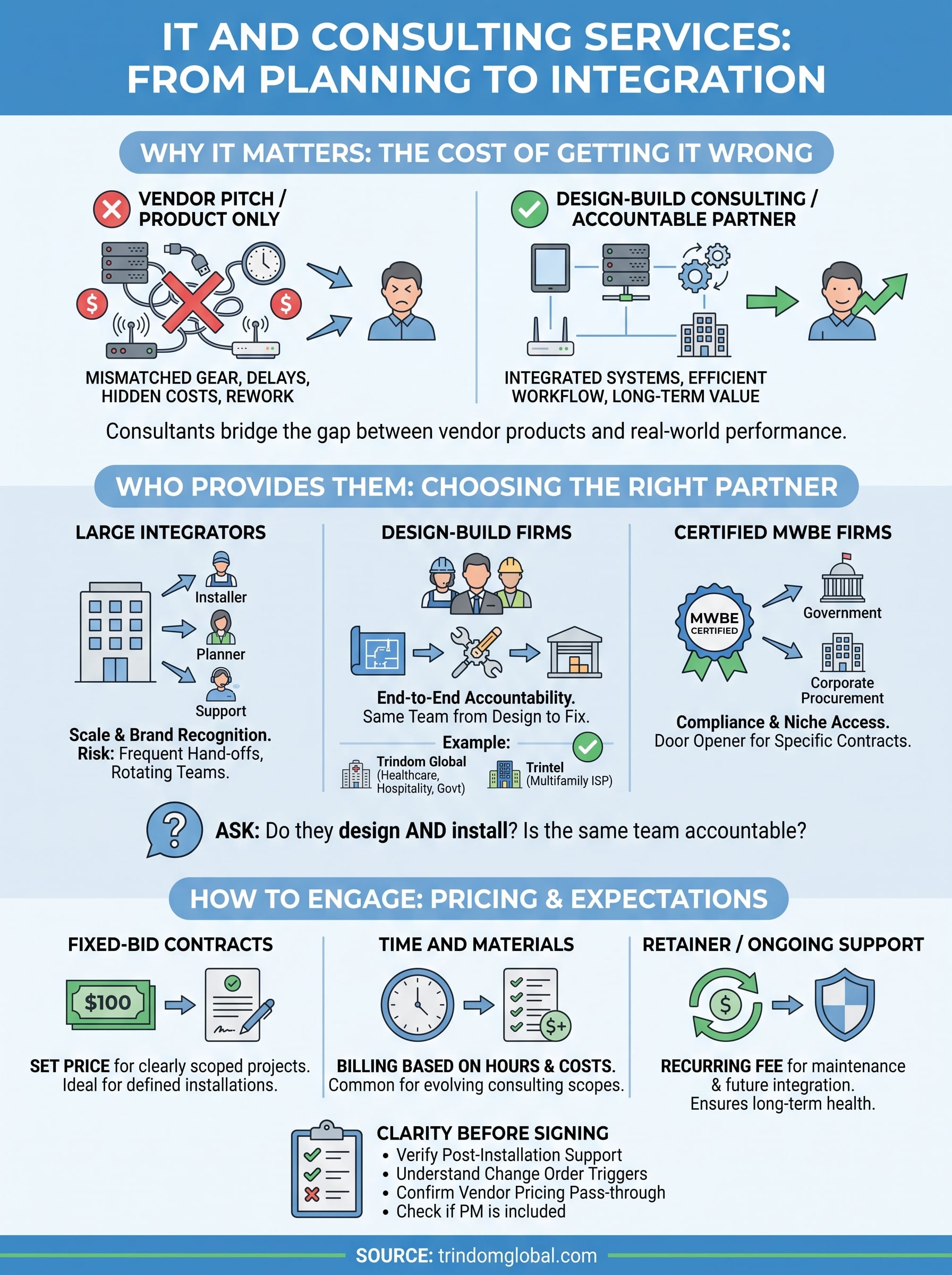
Consider what happens when a business skips proper planning and just buys equipment based on a vendor’s pitch. You end up with hardware that doesn’t talk to your existing systems, cabling that can’t support future bandwidth needs, and a project timeline that stretches three times longer than promised. Design-build consulting catches these problems before they become expensive change orders. A provider who understands both the strategic side and the physical installation side can spot a mismatch between what a vendor is selling and what your building, staff, or compliance requirements actually need.
The businesses that treat IT consulting as optional almost always pay more later fixing what a proper design phase would have prevented.
Consulting bridges the gap between vendors and reality
Vendors sell products. They rarely take responsibility for how those products perform once installed in your specific environment. That’s the gap IT services and IT consulting companies are built to close. A consultant who also handles installation has skin in the game: if the design doesn’t work in practice, they’re the ones who have to fix it. This accountability changes how a project gets scoped from day one, because the same team designing the solution is also the team standing behind it once it’s live.
Sector-specific stakes
Hospitals face different pressure than a multi-family housing operator, but both share the same underlying risk: infrastructure failures aren’t abstract, they hit revenue and reputation immediately.

| Sector | What’s at stake without proper IT consulting |
|---|---|
| Healthcare | Medical equipment downtime, HIPAA compliance gaps, delayed patient care |
| Hospitality | Guest complaints, negative reviews, lost bookings from poor connectivity |
| Multi-family residential | Tenant churn, competitive disadvantage against properties with better connectivity |
| Government | Failed audits, non-compliant procurement, project delays tied to public funding cycles |
Government agencies in particular face a layer most private businesses never deal with: procurement rules that dictate who can even bid on a project. The Small Business Administration outlines how certifications like minority and women-owned business status factor into federal contracting decisions, which is part of why agencies actively seek out certified providers rather than defaulting to the largest name in the market.
Money is the other reason this matters. Poorly planned infrastructure doesn’t just cost more upfront, it costs more every year it stays in place. A network built without room to scale means another disruptive overhaul in three years instead of five or ten. Equipment installed without proper integration means staff time wasted on workarounds instead of the systems actually working the way they were bought to work. None of these costs show up on the original invoice, but they show up eventually, usually at the worst possible time.
Smart organizations stop treating IT infrastructure as a one-time purchase and start treating it as an ongoing relationship with a provider who understands both the technology and their specific operating environment. That shift in mindset, from buying equipment to building a partnership, is the real reason IT business consulting services exist in the first place.
How to choose the right IT and consulting services provider
Finding a provider isn’t about picking the biggest name in your area code. It’s about matching a company’s actual capabilities to your project’s specific demands, whether that’s a hospital wing full of medical equipment or a 300-unit apartment complex that needs high-speed connectivity in every unit. Rushing this decision is how businesses end up with the mismatched vendors described earlier in this article.
Ask about the design-build track record
Start by asking any prospective IT and consulting services provider to walk you through a past project similar to yours, start to finish. You want specifics: who did the planning, who pulled the permits, who handled the physical installation, and who troubleshot the integration once everything was live. Vague answers or a hand-off between three different subcontractors is a warning sign. A true design-build partner keeps the same team accountable from the first site visit to the final walkthrough.
The best sign of a reliable provider isn’t their sales pitch, it’s whether the same people who designed your system are the ones who show up to fix it.
Verify certifications and vendor partnerships
Certifications matter for two reasons. First, they signal technical competence with the specific equipment your project requires, whether that’s structured cabling standards or medical-grade network infrastructure. Second, for government and many corporate contracts, certifications like minority and women-owned business status can directly affect procurement eligibility. Confirm the provider’s status is current, not just listed on their website from three years ago.
Match experience to your sector
Experience in hospitality doesn’t automatically translate to hospital-grade installations, and vice versa. Ask for references specifically within your industry, and call them. A provider who’s done dozens of healthcare installs will ask different questions and anticipate different problems than one whose background is mostly commercial office buildouts.
Use this checklist when comparing it services and it consulting companies:
- Do they handle both consultation and physical installation, or only one?
- Can they name specific vendor partnerships relevant to your equipment needs?
- Do they have documented experience in your sector, not just adjacent ones?
- Is their MWBE or other certification status current and verifiable?
- Will the same project team stay assigned from design through completion?
- Do they offer ongoing support after installation, or disappear once the invoice clears?
Getting these answers before signing anything saves you from discovering the gaps mid-project, when fixing them costs far more than asking upfront ever would.
Core types of IT and consulting services explained
Not every project needs the same mix of services. Some organizations just need a network redesigned. Others need everything from cabling to equipment integration handled under one contract. Breaking down the categories helps you figure out exactly what to ask for when you call a provider.
Design-build consultation and planning
This is the front end of any project: assessing your current infrastructure, mapping out what your goals actually require, and producing a plan that accounts for budget, timeline, and future scaling. Design-build consultation is where a provider catches mismatches between what you think you need and what your building or compliance requirements actually demand. Skipping this step is the single most common reason projects run over budget.
A plan built without a site walkthrough is a guess dressed up as a proposal.
Structured cabling and headend buildout
Every network, telecom, or TV system depends on the physical cabling underneath it. Structured cabling work includes running the backbone, terminating connections correctly, and building out the headend equipment that manages signal distribution across a facility. Get this wrong and every device connected to it inherits the problem.
Specialized installations by sector
Some installations demand equipment and technicians specific to an industry. Medical equipment installs in hospitals require qualified technicians who understand clinical workflows and compliance constraints. RF and network installation in hotels and commercial spaces requires a different skill set entirely, one built around guest experience and coverage density.

| Service type | Typical setting | Primary goal |
|---|---|---|
| Design-build consultation | Any sector, project start | Align technology plan with goals and budget |
| Structured cabling and headend buildout | Offices, hospitality, campuses | Reliable network, telecom, and TV backbone |
| Medical equipment installation | Hospitals, clinics | Compliant, functional clinical equipment integration |
| RF and network installation | Hotels, commercial venues | Consistent coverage and guest connectivity |
| Multifamily ISP solutions | Residential campuses | High-speed internet across every unit |
| Government project services | Public agencies | RFP-compliant procurement and delivery |
Multifamily and government-specific services
Multifamily properties have their own category: high-speed ISP solutions built for entire residential campuses rather than single buildings, often delivered through a dedicated ISP partner rather than a general contractor. Government projects add another layer entirely, since they require navigating RFP requirements and procurement rules that don’t apply to private-sector work. A provider comfortable moving between these categories, instead of specializing in just one, is usually the one worth calling first.
Who provides IT and consulting services
The market for it services and it consulting companies splits into a few distinct categories, and knowing which one you’re talking to changes what you should expect from a contract. Some providers only advise. Some only install. Fewer do both under one roof, and that combination is what separates a design-build partner from a middleman who subcontracts the actual work.
Large integrators versus specialized design-build firms
National integrators bring scale and brand recognition, but they often route your project through call centers and rotating subcontractors, so the team that scopes your job isn’t the team that shows up to run cable. Specialized design-build firms, by contrast, tend to keep the same technicians and project managers involved from the first site visit through final integration. That continuity matters most on complex jobs, like a hospital wing installation or a multi-building apartment campus, where losing institutional knowledge mid-project causes rework and delays.
A provider that only advises and a provider that only installs are both missing half of what a real design-build partner delivers.
Certified minority and women-owned firms
MWBE-certified providers occupy a specific niche that matters beyond compliance checkboxes. Government agencies and many corporations set procurement goals tied to supplier diversity, which means a certified firm can open doors that a larger, uncertified competitor simply can’t access on certain contracts. The Small Business Administration documents how these certifications factor into federal contracting eligibility, and the same logic often carries over into corporate supplier diversity programs. Certification alone doesn’t guarantee quality, but paired with a strong installation track record, it gives clients an added layer of accountability and access.
Sister companies and vendor partnerships
Organizations sometimes need one provider for general IT infrastructure and another for a specialized vertical, like multifamily internet service. Trindom Global’s approach reflects this reality: the core company handles design-build, structured cabling, and equipment integration across healthcare, hospitality, and government sectors, while its sister service, Trintel, focuses specifically on high-speed ISP solutions for multi-family residential campuses. This structure lets clients get deep, sector-specific expertise without juggling three unrelated vendors for what is really one connected infrastructure project.
What to look for regardless of provider type
Whatever category a provider falls into, the same fundamentals apply. Confirm they hold direct vendor partnerships rather than relying entirely on resellers, ask how long their core project team has worked together, and check whether they manage projects internally or hand oversight off to a third party once the contract is signed. Those answers tell you more than any marketing brochure will.
What to expect from pricing and engagement models
Pricing for it and consulting services varies more than most first-time buyers expect, because the scope of work shifts so much between a small cabling job and a full hospital wing installation. Understanding the common engagement models before you request quotes helps you compare proposals accurately instead of just chasing the lowest number on a page.
Common pricing structures
Providers generally price projects one of three ways, and each fits a different kind of engagement:
- Fixed-bid contracts: A set price for a clearly scoped project, common for structured cabling or a defined equipment installation where the requirements won’t change mid-project.
- Time and materials: Billing based on hours worked plus equipment costs, typical for consulting-heavy engagements where the scope may evolve as the design phase uncovers new requirements.
- Retainer or ongoing support agreements: A recurring fee covering maintenance, troubleshooting, and future small-scale integrations after the initial installation wraps up.
Hospitals and government agencies tend to favor fixed-bid contracts because budget approvals depend on a known number upfront. Commercial and hospitality clients sometimes prefer time and materials when the project involves phased renovations.
Fixed pricing without a detailed scope document is just a guess with a dollar sign attached.
What drives the actual cost
Several factors push pricing up or down beyond the basic labor and materials. Site accessibility matters a lot: running cable through an occupied hospital floor costs more than an empty new-construction building. Equipment specifications matter too, since medical-grade or hospitality-grade hardware carries different price points than standard commercial gear. Timeline compression also adds cost, since rushing a project usually means overtime labor and expedited shipping fees.
Requesting a detailed breakdown before signing protects you from surprise change orders later. Ask specifically what’s included in design, what’s included in installation, and what falls under a separate support agreement.
Questions to ask before signing
Getting clarity on the financial structure upfront prevents disputes once the project is underway. Bring these questions to any proposal review:
- Does this quote include post-installation support, or is that a separate agreement?
- What triggers a change order, and how are those priced?
- Are vendor equipment costs passed through at cost, or marked up?
- Is project management time billed separately or built into the overall quote?
Consulting engagements that only cover planning, without installation, typically price lower upfront but shift the execution risk onto whoever you hire next. Weighing that tradeoff against a single design-build contract is worth doing before you commit to either path.
Where to go from here
Getting it and consulting services right comes down to one decision: hire a provider who only advises or plans, or hire a design-build partner who stays accountable from the first site walkthrough through the final integration. The second option costs more upfront in some cases, but it removes the handoff gaps that cause budget overruns, mismatched equipment, and rework six months later. Whether you’re planning a hospital wing, a multifamily connectivity upgrade, or a government project bound by procurement rules, the fundamentals covered here apply the same way: verify certifications, confirm the same team handles design and installation, and get pricing structures in writing before you sign anything.
Trindom Global builds this accountability into every project across healthcare, hospitality, and government sectors, with Trintel handling multifamily ISP work under the same standard. If you’re ready to talk through your specific infrastructure needs, get in touch with Trindom Global and start with a real conversation instead of another generic quote.


