

Most businesses hit a point where they’re not sure if their network, cabling, or equipment setup can support what they’re trying to do next. That’s usually the moment someone starts searching for IT consulting & services and finds a wall of vague marketing language instead of straight answers. This article skips that.
At its core, IT consulting and services means getting expert help to plan, design, install, and integrate the technology infrastructure your organization actually runs on, not just software advice from a call center. It covers everything from structured cabling and headend buildout to medical equipment installation in hospital environments, RF and network builds for hospitality properties, and infrastructure work tied to government procurement. If you’re trying to figure out what these services include and who actually delivers them well, that’s exactly what you’ll find here.
We’ll break down the different types of IT consulting and services, explain why they matter beyond just keeping systems online, and walk through what to look for in a design-build partner. We work in this space daily at Trindom Global, so expect practical detail, not generic checklists.
Why IT consulting & services matter for your organization
Infrastructure decisions made without expert input tend to surface as expensive problems two or three years later, not immediately. A hospital that installs medical equipment without proper network capacity planning ends up with dropped connections during critical procedures. A hotel that skips professional RF design gets guest complaints about dead zones in half the rooms. The cost of a bad infrastructure decision rarely shows up on day one. It shows up as downtime, rework, or a system that can’t scale when your organization grows.
Good infrastructure planning is invisible when it works and expensive when it’s missing.
Organizations also underestimate how much specialized knowledge goes into different environments. Structured cabling for a corporate office looks nothing like headend buildout for a multifamily property, and neither resembles what’s required for RF installation in a hospitality setting. Each one has its own code requirements, vendor ecosystems, and failure points. A generalist IT provider might handle basic network setup fine, but ask them to manage a hospital equipment installation with biomedical compliance requirements, and gaps start showing fast.
Where in-house teams typically fall short
Even well-staffed IT departments usually don’t have bandwidth for large infrastructure projects on top of daily operations. Most in-house teams are built to maintain systems, not to design and build new ones from scratch. That gap is exactly where IT consulting and services engagements add value: bringing in a team that’s done dozens of similar builds instead of learning on your project.
- Design-build projects require coordination across electrical, structural, and network trades
- Government and healthcare projects carry compliance and procurement requirements most internal teams rarely touch
- Vendor relationships built over years get you better pricing and faster equipment turnaround
- Project management for multi-site rollouts needs dedicated staffing most companies don’t keep on payroll
The procurement angle matters too
Specifically for government agencies and organizations with MWBE requirements, working with a certified minority business enterprise isn’t just a compliance checkbox. It can be the difference between a bid that qualifies and one that doesn’t. Trindom Global holds that certification, which gives government clients and organizations with supplier diversity goals a qualified partner without sacrificing technical capability.
Ultimately, the organizations that treat infrastructure planning as a strategic decision, not an afterthought, avoid the costly retrofits that come from rushed installs. That’s the real value of bringing in expert IT consulting and services before a project starts, not after something breaks.
How to choose the right IT consulting & services provider
Picking a design build company near you isn’t about finding the biggest name in the market. It’s about matching specific project experience to your exact environment. A firm that’s great at corporate office cabling won’t necessarily know the compliance requirements for a hospital equipment install or the RF planning a hospitality property needs. Ask for project references in your exact sector, not a general portfolio, and actually call those references before you sign anything.
The right IT consulting partner has already solved your specific problem somewhere else.
Ask about hands-on experience, not just certifications
Certifications matter, but they don’t tell you whether a team has actually managed a design-build project at your scale. Before committing, ask direct questions and pay attention to how specific the answers are:
- How many similar installations has your team completed in the last two years?
- Who manages the project on-site, and what’s their background?
- Which vendor partnerships do you hold, and how does that affect equipment lead times?
- What happens if the timeline slips, who absorbs that cost?
Vague or rehearsed answers are a signal to keep looking elsewhere.
Watch for scope creep and vague pricing
Underneath every proposal, check how clearly the project scope is defined. Line items like “network setup” without specifics on cable counts, drop locations, or equipment models usually mean pricing will shift once work starts. Good providers document scope in enough detail that you could hand it to a second contractor and get a comparable bid. That transparency, more than any sales pitch, tells you whether a provider is built for long-term partnerships or just chasing one-off jobs.
Common types of IT consulting & services engagements
Engagements in this field rarely look the same twice, because the infrastructure needs of a hospital, a hotel, and a government building have almost nothing in common. Knowing the common categories helps you describe your project accurately when you’re requesting quotes, which speeds up the entire process. Below is a breakdown of the engagement types we see most often at Trindom Global.
| Engagement type | Typical client | Core work involved |
|---|---|---|
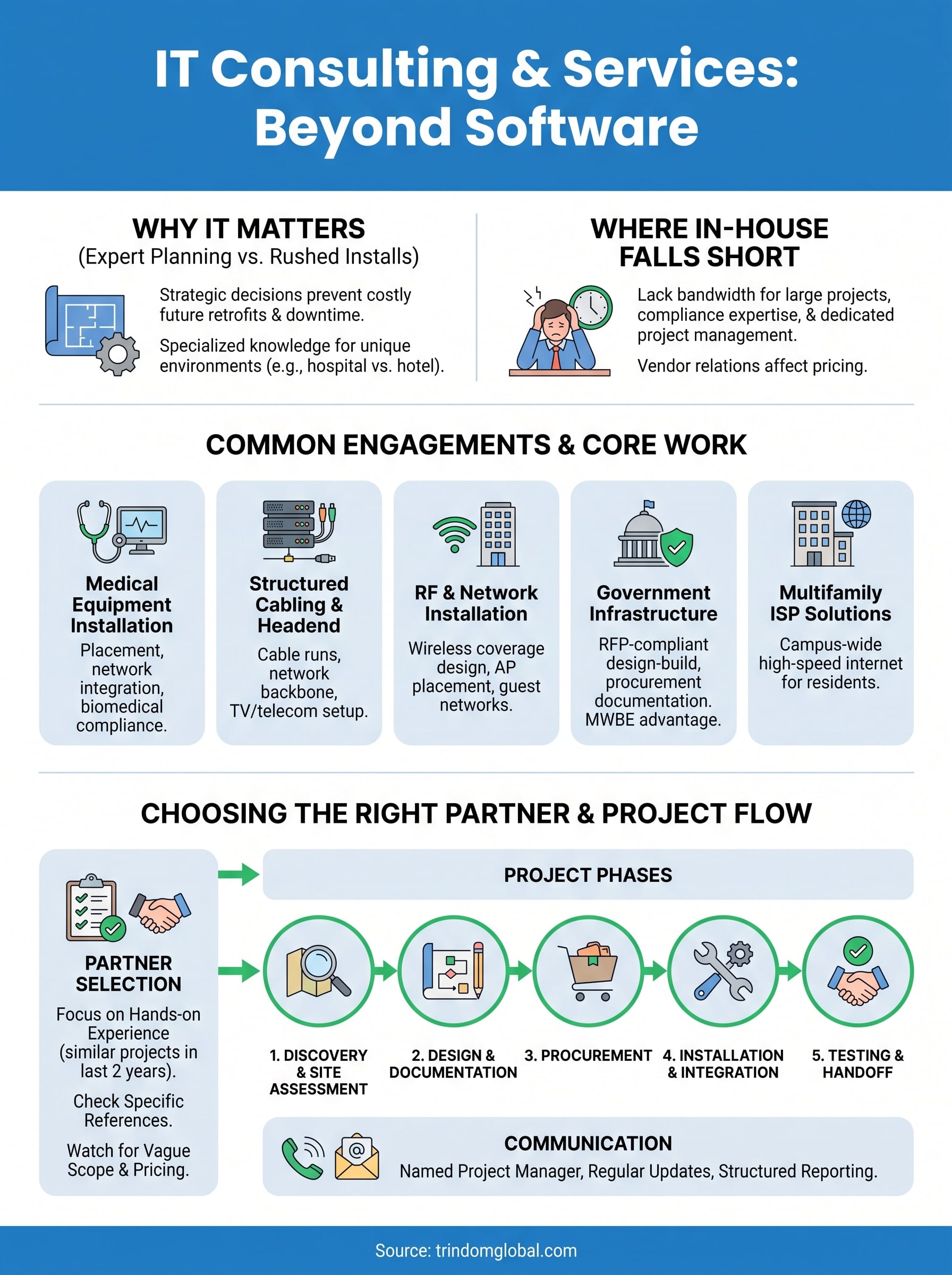
| Medical equipment installation | Hospitals, healthcare systems | Equipment placement, network integration, biomedical compliance |
| Structured cabling & headend buildout | Commercial buildings, multifamily properties | Cable runs, network backbone, TV/telecom headend setup |
| RF and network installation | Hotels, hospitality venues | Wireless coverage design, access point placement, guest network builds |
| Government infrastructure projects | Federal, state, local agencies | RFP-compliant design-build, procurement documentation |
| Multifamily ISP solutions | Residential property operators | Campus-wide high-speed internet through Trintel |
Healthcare and hospitality carry the strictest requirements
Hospital medical equipment installation demands coordinated scheduling around patient care, plus documentation that satisfies biomedical and safety standards most general contractors never encounter. Hospitality RF installation comes with its own pressure: guests notice a dead Wi-Fi zone immediately, and a botched RF plan turns into review complaints within days.
The stricter the environment, the less room there is for a generalist contractor to learn on the job.
Government and multifamily work follow different rules entirely
Qualifying for government contracts as a women-owned business means matching RFP language precisely and often holding specific certifications, which is where an MWBE-certified partner has a real advantage. Multifamily ISP projects operate on a different timeline altogether, since property owners need connectivity live before move-in dates, not after. Recognizing which category your project falls into before you start requesting proposals saves you from providers who quote confidently but have never actually built in your specific environment.
What to expect when working with an IT consulting partner
Working with a real IT consulting and services provider follows a predictable rhythm once you know what to look for. The relationship should start with a site assessment, not a sales pitch, because no one can accurately scope a hospital equipment install or a hospitality RF build without walking the space first. From there, expect a written proposal that separates design, procurement, and installation phases, each with its own timeline and cost breakdown.
A partner who won’t walk your site before quoting a price isn’t ready to build there.
The typical project phases
Projects generally move through the same sequence, though timelines shift depending on complexity and site access:

- Discovery and site assessment: walkthrough, existing infrastructure review, stakeholder interviews
- Design and documentation: network diagrams, equipment specs, compliance documentation for regulated environments
- Procurement: ordering equipment through vendor partnerships, which affects lead times significantly
- Installation and integration: on-site work coordinated around your operating schedule
- Testing and handoff: performance validation before the project is considered complete
Communication you should expect throughout
Regular updates, and the other practices that keep an IT project on schedule, separate a professional engagement from one that goes sideways halfway through. You should get a named project manager, not a rotating cast of subcontractors, and scheduled check-ins that flag problems before they become delays. Ask upfront how often you’ll hear from the team and in what format, whether that’s weekly calls, written status reports, or a shared project dashboard.
Anything less structured than that usually signals a provider stretched thin across too many jobs at once. At Trindom Global, that named point of contact and phased documentation are standard on every project, whether it’s a single-site cabling job or a multi-property rollout, because clients shouldn’t have to guess where their project stands.
Putting IT consulting into practice
Getting infrastructure right the first time comes down to matching the provider to the project, not just picking the lowest bid. Hospitals, hotels, government agencies, and multifamily operators each face different code requirements and failure points, and generalist contractors rarely catch that until something breaks. The organizations that treat design-build planning as a strategic decision, rather than a reaction to a problem, end up with systems that scale instead of systems that need constant patching.
Real IT consulting & services work starts with a site walkthrough, moves through documented design and procurement phases, and ends with a named project manager keeping you informed the whole way. That structure is what separates a partner from a subcontractor chasing a single job.
If you’re planning a medical equipment install, a structured cabling project, or a government infrastructure build, see Trindom Global’s design-build and IT infrastructure services and talk to us about scoping it right from the start.


