

Most IT infrastructure projects go sideways before a single cable gets pulled. Someone picks a vendor based on price, skips the planning phase, and ends up with a network that can’t support next year’s equipment upgrade or a hospital wing that’s already outgrown its bandwidth. If you’re trying to figure out what it infrastructure consulting services actually cover before you sign a contract, you’re asking the right question at the right time.
In plain terms, IT infrastructure consulting means bringing in a team to assess your current systems, map out the consulting IT services you actually need, and design a build that matches your budget, timeline, and compliance requirements. It covers everything from structured cabling and network backbone design to RF installation and equipment integration, done by people who’ve solved these problems before instead of learning on your dime.
This article breaks down exactly what these services include, how the design-build process works in practice, and what separates capable it infrastructure consulting firms from ones that will leave you with a half-finished system. We’ll also cover how to evaluate it infrastructure consulting companies, including what certifications and vendor partnerships actually matter for your project.
Why IT infrastructure consulting matters for your organization
Every organization eventually hits a moment where its network, cabling, or equipment integration can’t keep pace with what the business actually needs. IT infrastructure consulting services exist to catch that gap before it turns into an emergency. Instead of reacting to outages, failed inspections, or a vendor who oversold a system that never quite worked, you get a team that maps your actual requirements against your budget and builds toward them deliberately. That difference, planning versus patching, is what separates organizations that scale smoothly from ones that rebuild the same system twice.
The real cost of skipping the planning phase
Skipping upfront planning almost always costs more than the consulting fee would have. A hospital that installs medical equipment without mapping power and network capacity ends up ripping out walls a year later to add capacity it should have built in from day one. A hospitality property that wires RF and network drops without a headend plan discovers its guest bandwidth collapses the first time occupancy spikes. Rework costs on infrastructure projects routinely run two to three times the original installation price, because you’re now paying to remove old work, not just add new work.
The cheapest infrastructure quote almost always becomes the most expensive project.
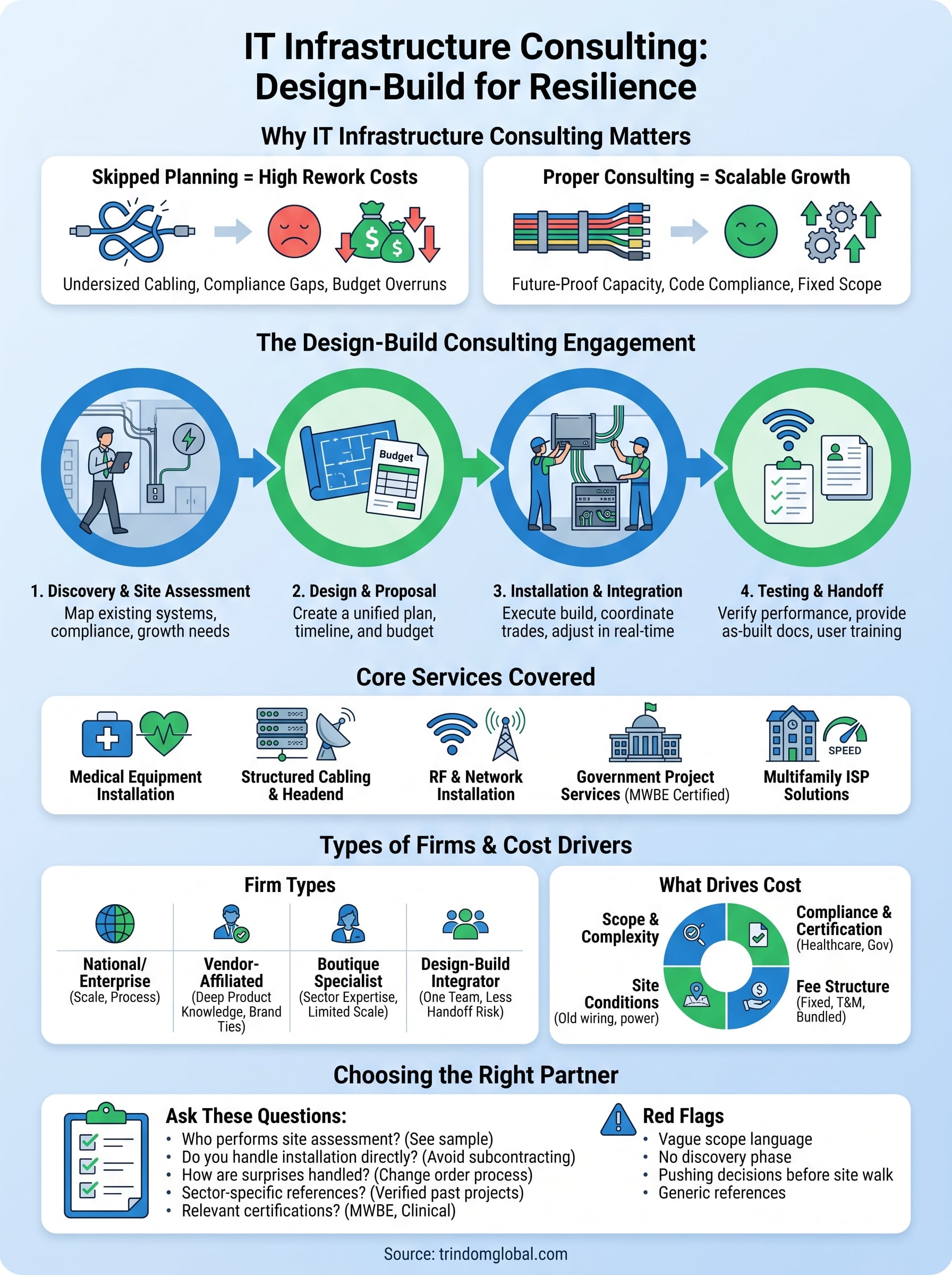
Here’s a quick look at what tends to go wrong when planning gets skipped, and what proper consulting catches instead:
| Skipped planning leads to | Proper consulting catches |
|---|---|
| Undersized cabling that can’t support future equipment | Capacity built for 5-10 year growth |
| Vendors working from mismatched specs | One design-build plan all trades follow |
| Compliance gaps discovered during inspection | Code and regulatory review before install |
| Budget overruns from mid-project changes | Fixed scope agreed before work starts |
Compliance and procurement requirements you can’t ignore
Compliance is where DIY infrastructure planning falls apart fastest. Hospital environments carry strict requirements around clinical workflows, electrical isolation, and infection control zones that most general contractors simply don’t work with often enough to get right. Government agencies add another layer entirely: RFP requirements, procurement rules, and often a preference or mandate for minority and women-owned business enterprise (MWBE) vendors. Trindom Global’s certified MWBE status isn’t a marketing line, it’s a real advantage for agencies that need to meet procurement goals while still getting qualified technical work. If your project touches government projects or hospital installs, working with a firm that already understands these requirements saves you months of back-and-forth with compliance officers.
Scaling for growth without overbuilding
Organizations that grow fast tend to overcorrect on infrastructure. They either underspec to save money now, then pay for emergency upgrades later, or they overbuild capacity they won’t use for a decade, tying up capital that could go elsewhere. Good infrastructure consulting finds the middle ground: designing for realistic growth curves based on your actual occupancy, equipment roadmap, or patient volume projections rather than guesswork. Multi-family property operators face this constantly with high-speed ISP demand, where guest expectations shift every couple of years and the cabling backbone needs to handle it without a full rebuild.
Coordinating multiple vendors and trades
Infrastructure projects rarely involve just one trade. A single hospital wing might need structured cabling, RF installation, medical equipment integration, and network backbone work happening on overlapping timelines. Without a single team managing that coordination, you end up with electricians, cabling techs, and equipment vendors working from different assumptions, and someone has to catch the conflicts before they become change orders. Structured cabling and headend buildout projects in particular suffer when trades aren’t sequenced correctly, since network infrastructure often needs to go in before finish work covers the walls. Consulting firms that also handle installation, like Trindom Global does across structured cabling and headend buildout, remove that coordination risk because one team owns the design and the execution end to end.

How an IT infrastructure consulting engagement works
A real IT infrastructure consulting engagement follows a predictable arc, even though every project looks different once you’re in it. You move from assessment to design, then design to build, and finally to testing and handoff. Skipping a phase, or letting a vendor collapse two phases into one rushed meeting, is usually where projects start drifting off budget and off timeline. Knowing what each phase should actually include lets you hold a consulting firm accountable to a real process instead of a sales pitch.
Discovery and site assessment
Before anyone talks about equipment or cabling runs, a competent consultant walks your site and documents what’s already there, the groundwork for planning network infrastructure properly. This means physically inspecting existing cabling, network closets, power capacity, and any legacy equipment that has to stay in service during the transition. Good discovery work also pulls in the people who’ll actually use the system, clinical staff, IT managers, property operators, so the final design matches how the space really operates, not just how it looks on a blueprint.
A thorough discovery phase typically covers:
- Current network topology and cabling condition
- Power and space capacity for new equipment
- Compliance and code requirements specific to the facility type
- Growth projections for the next 5 to 10 years
- Existing vendor contracts and equipment that must integrate with the new build
A consulting engagement that skips a real site assessment is guessing, not designing.
Design and proposal
Once discovery wraps, the consultant translates what they found into an actual design, following the steps for designing network infrastructure, complete with a scope of work, timeline, and budget. This is where design-build consultation earns its name, and where the five phases of the design-build process show their value: the same team that assessed your site now produces the plan, rather than handing findings off to a separate design shop that never saw the building. A solid proposal spells out materials, labor, project milestones, and any long-lead equipment that needs ordering early, so there are no surprises once installation starts.
Installation and integration
Execution is where most of the visible work happens, and where the phases of IT project management matter most. Installers run cabling, mount equipment, configure RF and network gear, and integrate everything into your existing systems on a sequenced schedule that avoids the vendor conflicts covered earlier. Firms that handle both the design and the installation and integration themselves can adjust in real time when something on-site doesn’t match the original plan, instead of stopping work to renegotiate scope with a separate contractor.
Testing, documentation, and handoff
Testing confirms the system performs the way the design promised, not just that it’s physically installed. This includes signal testing on RF and network drops, load testing on new equipment integrations, and a walkthrough with your team to confirm everything works as expected. Handoff should also include as-built documentation and network diagrams, since that paperwork is what your internal IT staff or future vendors will rely on years after the original consulting team has moved on to the next project.
Core services covered under IT infrastructure consulting
Most people picture cabling and Wi-Fi when they hear IT infrastructure consulting, but the actual scope runs much wider once you’re working across healthcare, hospitality, government, and residential properties. Each sector has its own equipment, regulations, and failure points, which is why a consulting firm that only knows office networks will struggle the moment a project touches clinical equipment or multi-family bandwidth demand. Understanding the full range of services helps you spot whether a firm can actually handle your project end to end or whether you’ll need to stitch together multiple vendors yourself.
Medical equipment installation and integration
Hospitals need more than cabling. Medical equipment installation and integration services require technicians who understand clinical workflows, electrical isolation requirements, and infection control zones, along with project managers who can coordinate installs around live patient care schedules. Getting this wrong doesn’t just mean a redo, it can mean a failed inspection or a delayed unit opening. Medical equipment installation companies working in hospital environments need qualified technicians on-site, not general contractors learning healthcare compliance as they go.
Structured cabling and headend buildout
Network, telecom, and TV infrastructure all run through the same backbone, and that backbone has to be planned before finish work covers the walls. Structured cabling and headend buildout projects include everything from horizontal and backbone cabling to the headend equipment that distributes signal across a building or campus. Skipping proper headend planning is one of the most common reasons hospitality properties and multi-tenant buildings end up with bandwidth bottlenecks within a year or two of opening.

RF and network installation
Commercial and hospitality environments depend on reliable RF coverage for guest Wi-Fi, point-of-sale systems, and increasingly, IoT devices scattered across a property. RF coverage and network installation services cover access point placement, signal testing, and integration with the property’s existing network hardware, done in a way that survives occupancy spikes instead of buckling under them.
Infrastructure that only works at half capacity isn’t finished, it’s a liability waiting for its busiest day.
Government project services
Government work runs on a different clock than private sector projects. RFP requirements, procurement timelines, and compliance documentation all shape how a project gets scoped and bid. Firms handling government projects need to understand these processes cold, and certified minority and women-owned status can be a real procurement advantage for agencies working toward diversity spending goals, which is why it helps to know how women-owned businesses qualify for government contracts.
Multifamily high-speed ISP solutions
Residential campuses face a specific version of the bandwidth problem: hundreds of units expecting reliable internet on infrastructure that often predates current demand. Trintel, Trindom Global’s sister service, focuses specifically on high-speed ISP solutions for multi-family properties, drawing on over 25 years of ISP experience to design networks that scale with resident expectations rather than fighting them every renewal cycle.
Here’s a quick reference for how these services map to the industries that need them most:
| Service | Primary industry |
|---|---|
| Medical equipment installation | Hospitals and healthcare systems |
| Structured cabling and headend buildout | Commercial, hospitality, telecom |
| RF and network installation | Hospitality, retail, commercial |
| Government project services | Government agencies and contractors |
| High-speed ISP solutions | Multi-family residential operators |
The common thread across all five is design-build consultation up front. Consulting without installation leaves you managing a separate contractor to execute someone else’s plan, and that handoff is exactly where scope gaps and change orders tend to show up.
Types of IT infrastructure consulting firms and companies
Not every firm calling itself an IT infrastructure consulting provider does the same work. The market splits roughly into four categories: large national consulting shops, vendor-affiliated resellers, boutique sector specialists, and design-build integrators that handle both planning and installation. Knowing which category a firm falls into tells you a lot about how they’ll bid your project, what they’ll push you toward, and whether they’ll still be around once the cabling is in the wall and something needs adjusting.
Large national and enterprise consulting firms
The best-known IT services and consulting companies typically serve enterprise clients with multi-site rollouts and standardized IT environments, offices, data centers, retail chains. They bring process discipline and deep bench strength, but that scale often comes with layers of account managers between you and the person actually doing the work. Healthcare and hospitality projects with unusual compliance or regulatory demands sometimes get treated as a variation of a generic template rather than a build designed around the specific facility.

Vendor-affiliated resellers and integrators
Some firms exist primarily to sell and deploy a specific manufacturer’s hardware, whether that’s networking gear, RF equipment, or medical device systems. They know their product line cold, which helps on straightforward deployments, but their recommendations tend to steer toward whatever they’re contracted to sell rather than the best fit for your building.
A firm that only sells one brand’s hardware will always find a reason that brand fits your project.
That conflict of interest doesn’t make vendor-affiliated integrators useless. It just means you should ask directly whether their design recommendation would change if they weren’t tied to that vendor relationship.
Boutique and sector-specialized firms
Smaller firms that focus on one or two sectors, hospital installs, hospitality RF, government contracting, tend to bring the deepest working knowledge of that sector’s specific failure points. The medical device integration companies that only install clinical equipment know exactly how infection control zones affect cable routing without needing it explained. The tradeoff is scale: a highly specialized firm may not have the bench to handle a large multi-building rollout on a tight timeline.
Design-build integrators
Design-build firms combine the consulting and installation roles into one team, which removes the handoff risk that shows up whenever a separate design shop hands blueprints to a separate installation contractor, and it’s worth understanding what design-build services include before you bid a project this way. Trindom Global operates this way across structured cabling, medical equipment, and government infrastructure projects, pairing certified minority and women-owned business status with hands-on installation crews rather than outsourcing execution to a third party.
Here’s how the four types generally compare:
| Firm type | Strength | Watch for |
|---|---|---|
| National/enterprise firms | Scale, process discipline | Generic templates, account layers |
| Vendor-affiliated resellers | Deep product knowledge | Recommendations tied to one brand |
| Boutique specialists | Sector-specific expertise | Limited capacity for large rollouts |
| Design-build integrators | One team owns plan and execution | Fewer firms operate this way |
Matching the firm type to your project matters more than picking the biggest name on the list. A government agency issuing an RFP has different needs than a hospitality property planning a headend buildout, and the right it infrastructure consulting firms for one job aren’t always the right fit for the other.
What drives the cost of IT infrastructure consulting
Pricing for IT infrastructure consulting services varies more than most buyers expect, and the gap usually comes down to scope, site conditions, and how a firm structures its fees rather than any hidden markup. A single-building network refresh and a multi-site hospital rollout aren’t priced on the same scale, and neither should be. Understanding what actually drives the number on a proposal helps you compare quotes on substance instead of just picking whoever came in cheapest, which we already covered is a losing bet.
Scope and complexity of the project
Complexity multiplies cost faster than square footage does. A straightforward office network with standard cabling runs at a predictable rate per drop, but a hospital wing with medical equipment integration, infection control zones, and live patient care schedules to work around takes more planning hours and more skilled labor per foot of cable installed. Structured cabling across a large campus adds headend equipment and backbone runs that a single-building project never touches, where fiber optic cable installation costs start to dominate the budget. The more moving parts a project has, whether that’s multiple trades, multiple buildings, or multiple compliance regimes, the more consulting hours it takes to design something that actually holds up.
Complexity, not square footage, is what actually drives an infrastructure consulting bill.
Site conditions and existing infrastructure
Older buildings almost always cost more to wire than new construction, and it’s rarely obvious until someone’s inside the walls. Legacy cabling that has to be removed, power capacity that needs upgrading before new equipment can go in, and asbestos or other hazardous material considerations in older facilities all add cost that a proposal based on square footage alone will miss. Government buildings and older hospital wings carry this risk more than most, which is exactly why the discovery phase we described earlier matters so much before pricing gets finalized.
Compliance and certification requirements
Regulatory requirements add real cost, and skipping them isn’t actually cheaper, it just moves the expense to a failed inspection later. Hospital installs require technicians trained on clinical workflows and electrical isolation, which commands a different labor rate than general commercial cabling work. Government contracts add procurement documentation, RFP compliance, and often prevailing wage requirements that shape the final bid. Firms certified as minority and women-owned business enterprises, like Trindom Global, can also help agencies meet procurement goals without sacrificing technical quality, which sometimes offsets costs elsewhere in a government budget.
How consulting firms structure their fees
Most it infrastructure consulting firms price engagements one of a few standard ways, and it’s worth asking upfront which model a proposal uses before comparing numbers.
| Fee structure | How it works | Best fit |
|---|---|---|
| Fixed project scope | One price for defined design and install | Well-defined projects with clear specs |
| Time and materials | Billed hourly plus equipment costs | Projects with unknowns discovered mid-build |
| Design-build bundled | One contract covers consulting and installation | Projects wanting single-team accountability |
| Per-unit or per-drop | Priced by cabling run or equipment unit | Large rollouts with repeatable scope |
Design-build bundled pricing tends to reduce surprise costs the most, since the same team that scoped the project also executes it and has less incentive to pad hours for problems a separate contractor introduced. Whatever structure a firm uses, get it in writing before work starts, along with what triggers a change order, so a fixed-scope project doesn’t quietly turn into time and materials halfway through.
Consulting vs managed IT services vs an in-house hire
Organizations comparing their options often assume IT infrastructure consulting and managed IT services solve the same problem, just at different price points. They don’t. Consulting designs and builds the physical and network infrastructure itself, cabling, RF, equipment integration, headend systems, while managed services keep an already-built environment running day to day: patching servers, monitoring uptime, fielding help desk tickets. An in-house hire sits somewhere between the two, depending on who you hire and what you expect them to own. Picking the wrong category for your actual need is how projects stall before they start.
What managed IT services actually cover
Managed IT providers typically take over ongoing operations rather than one-time builds. They monitor networks, apply security patches, manage backups, and handle user support on a monthly retainer. That model works well once infrastructure is already in place and stable, but it assumes someone already designed and installed the systems being managed. A managed services contract won’t spec out a hospital’s medical equipment integration or plan a headend buildout for a new property, because that’s not what the retainer covers.

Why an in-house hire struggles with infrastructure builds
Hiring a full-time IT infrastructure specialist gives you direct oversight, and for organizations running a stable environment with predictable needs, that can work fine. But a single hire, or even a small internal team, rarely has hands-on experience across cabling, RF, medical equipment, and compliance requirements at the same depth a specialized firm does. You’re also paying a full salary and benefits for expertise you may only need intensively during a build, then far less afterward.
An in-house hire can run your network, but rarely has the breadth to design and build one from scratch.
Where consulting fits differently
Consulting engagements exist for the build itself, the assessment, design, installation, and testing phases covered earlier in this article. Once that infrastructure is live, the organization typically shifts to either an in-house team or a managed services provider for daily upkeep. Trindom Global operates in that first category, handling the design-build consulting and installation work rather than ongoing managed operations, which is worth knowing upfront if you’re expecting a single vendor to cover both phases.
| Option | Best for | Not built for |
|---|---|---|
| IT infrastructure consulting | Designing and building new or upgraded systems | Day-to-day monitoring after handoff |
| Managed IT services | Maintaining an already-built environment | Physical builds, cabling, equipment integration |
| In-house hire | Ongoing internal oversight and vendor management | Specialized, infrequent build expertise |
Combining these makes more sense than choosing one permanently. Bring in a consulting and design-build firm for the infrastructure project itself, then hand daily operations to either an in-house hire or a managed services provider once the system is tested and documented. Treating consulting as a replacement for either ongoing role, or vice versa, is usually where organizations end up paying twice for work that should have been scoped correctly the first time.
How to choose the right infrastructure consulting partner
Picking the right firm comes down to matching their actual capabilities to your project, not their pitch deck. Every firm you talk to will claim deep experience and a client-first approach, so the work is in verifying which claims hold up under specific questions. IT infrastructure consulting services live or die on execution details that a sales call rarely surfaces on its own, which is why you need a short list of questions built to expose gaps before a contract gets signed.
Questions to ask before signing anything
Ask direct questions that force a firm to show its actual process rather than describe it in general terms. Specific answers separate firms that have run your type of project before from ones improvising a pitch.
- Who performs the site assessment, and can we see a sample report from a past project?
- Does your team handle installation directly, or do you subcontract that piece out?
- What happens if site conditions don’t match the original scope?
- Can you provide references from a project in our specific sector, healthcare, hospitality, government, or multi-family?
- What certifications does your team carry for our facility type?
A firm that hesitates on the second question, whether they install what they design, is worth flagging immediately. Subcontracted installation reintroduces the coordination risk that design-build consulting is supposed to eliminate in the first place.
If a consulting firm can’t answer how they’d handle a site surprise, they haven’t managed enough real projects.
Red flags that signal trouble ahead
Beware of proposals that read like they were generated before anyone set foot on your site. A quote with no line-item breakdown, no mention of a discovery phase, or a timeline that seems too fast for the stated scope usually means corners get cut once work starts. Vague scope language, phrases like “industry standard cabling” without specifying cable category, count, or routing, gives a firm room to substitute cheaper materials later without technically breaking the contract. If a firm pushes you toward a decision before they’ve walked the building, that’s a sign they’re selling a template rather than designing for your actual space.
Certifications and vendor partnerships that actually matter
Certifications should map to your project, not just pad a website. Hospital work needs technicians trained on clinical environments and electrical isolation. Government contracts benefit from certified minority and women-owned business enterprise (MWBE) status, which helps agencies meet procurement goals while still getting qualified technical work, and how to get MBE certified shows what earning that status actually involves, something Trindom Global’s certification directly supports for government projects. Vendor partnerships matter too, since a firm with established relationships across major networking and RF manufacturers can source equipment faster and troubleshoot compatibility issues that a generalist wouldn’t catch.
Checking references the right way
Generic references rarely tell you much. Instead, ask for a reference from a project in your specific sector and ask that contact pointed questions: did the timeline hold, did the budget change mid-project, and would they hire the same firm again for a second building. Trindom Global’s work across structured cabling, medical equipment installation, and RF network integration gives prospective clients sector-specific references to check rather than a generic list, which is exactly the kind of verification you should expect when comparing top structured cabling installation providers before you commit budget to a build.
Finding the right fit for your infrastructure goals
Good infrastructure never announces itself. Nobody notices the cabling that was sized right the first time or the RF coverage that holds up during a sold-out weekend. You only notice the projects that got planned properly by their absence of problems, not by the fanfare. That’s the real payoff of hiring the right it infrastructure consulting partner instead of the cheapest bid.
Throughout this article, one theme keeps surfacing: firms that own both design and installation remove the handoff risk that trips up so many builds. Whether you’re planning a hospital wing, a government contract, or a multi-family property refresh, that combination matters more than a polished pitch deck.
Trindom Global brings design-build consulting, certified MWBE status, and hands-on installation crews to exactly these projects. If you’re ready to stop guessing and start planning, look at Trindom Global’s design-build and IT infrastructure services and reach out to talk through your next build.


