

Picking the wrong vendor for a structured cabling job or a hospital equipment rollout doesn’t just cost money, it costs months. You end up with rework, missed deadlines, and a network backbone that can’t handle what you actually need three years from now. That’s why so many facilities managers, IT directors, and procurement teams spend weeks vetting an IT infrastructure solutions provider before signing anything.
This list answers the question directly: which companies actually deliver on design-build, installation, and integration work across healthcare, hospitality, multifamily housing, and government projects. We looked at track record, certifications, vendor partnerships, and how each firm handles the messy realities of it infrastructure technology solutions, from headend buildouts to RF network installs in occupied buildings.
Below you’ll find nine providers worth putting on your shortlist in 2026, including what each one does best and where they fit. Trindom Global, a certified minority and women-owned firm with decades of combined experience in structured cabling, medical equipment installation, and government procurement, is among them. Use this as a starting point for your own evaluation, not the final word.
1. Trindom Global
Trindom Global built its reputation on the hard jobs other vendors turn down: hospital wings that can’t go offline, apartment campuses that need fiber optic cable installation without disturbing tenants, government contracts with procurement rules that trip up less experienced firms. As a certified minority and women-owned business enterprise, the company handles design-build, installation, and integration work for clients who need an it infrastructure solutions provider capable of managing both the technical and the paperwork side of a project.

Key services
Trindom’s work splits across four main lanes, each backed by qualified technicians and project management that keeps a build on schedule:
- Medical equipment installation services in active hospital environments, coordinated around clinical schedules
- Structured cabling installation and headend buildout for network, telecom, and TV infrastructure
- RF and network cabling installation for commercial and hospitality properties
- Government project support, built around RFP requirements and procurement compliance
The company also runs Trintel, a sister service focused on high-speed ISP solutions for multifamily residential campuses, drawing on more than 25 years of ISP-specific experience.
Best for
Organizations that need a partner comfortable working inside occupied, regulated, or procurement-heavy environments. Hospitals expanding imaging suites, property managers wiring new phases of a residential campus, and government agencies that require MWBE participation all find a natural fit here. Trindom’s proprietary design-build approach means one team owns the project from initial consultation through final integration, rather than handing you off between subcontractors.
A single accountable team from design through integration is what keeps hospital and government projects on schedule.
Commercial and hospitality operators looking for RF and network installs without the usual back-and-forth between separate design and install crews also do well here. If your project touches multiple systems, cabling, RF, and equipment integration, in one build, that’s exactly the kind of scope Trindom is set up to handle.
Pricing considerations
Trindom prices projects individually based on site conditions, equipment scope, and timeline rather than publishing flat rates, which is standard for design-build firms handling custom installations. Expect a consultation and site assessment before you get a firm number. Because the company qualifies as a certified MWBE, government and enterprise clients with supplier diversity requirements can often apply the spend toward procurement goals, which adds value beyond the invoice itself. For a detailed quote, reach out directly through Trindom Global’s project inquiry page to discuss your specific infrastructure needs.
2. Amazon Web Services (AWS)
Amazon Web Services dominates the public cloud market, and most enterprise IT roadmaps run through it somewhere, whether that’s storage, compute, or disaster recovery. Unlike Trindom’s on-site design-build model, AWS delivers cloud infrastructure services you provision remotely, making it a natural complement rather than a substitute for physical network buildouts.
Key services
AWS offers over 200 services, but most organizations lean on a core set:
- EC2 compute instances for scalable server capacity
- S3 storage for backup, archiving, and data lakes
- VPC networking to extend or replace on-premises infrastructure
- Direct Connect for dedicated links between data centers and the cloud
Best for
Companies migrating workloads off legacy servers or building hybrid environments that pair cloud compute with physical infrastructure on-site benefit most here. Enterprises with unpredictable traffic, like hospitality groups running seasonal booking systems, use AWS’s elasticity to scale without overbuilding local hardware. It’s less suited to hands-on work like medical equipment installs or structured cabling, where you need technicians physically on-site.
Cloud scale solves capacity problems; it doesn’t pull a single cable or mount a single access point.
Pricing considerations
Pricing runs on a pay-as-you-go model, billed by usage across compute hours, storage volume, and data transfer, which can get unpredictable without active cost management. Reserved instances and savings plans cut costs for steady workloads, but they require upfront commitment. Budget-conscious teams should model expected usage with the AWS Pricing Calculator before committing, since bills can climb fast once data egress and premium support tiers enter the picture.
3. Microsoft Azure
Microsoft Azure runs deep in any organization already standing on Windows Server, Active Directory, or Office 365, since it plugs into that stack with less friction than competitors ask for. For hospitals and government agencies juggling compliance requirements, Azure’s built-in certifications often matter more than raw compute power when picking an it infrastructure solutions provider for the cloud side of a hybrid deployment.
Key services
Azure’s catalog covers most of what enterprise IT teams need to extend on-premises systems into the cloud:
- Azure Virtual Machines for scalable compute workloads
- Azure Active Directory for identity and access management tied to existing Windows environments
- ExpressRoute for private, dedicated connections between data centers and Azure
- Azure Arc for managing hybrid infrastructure across on-site and cloud resources from one console
Best for
Healthcare systems and government agencies already invested in Microsoft’s ecosystem gain the most, particularly where HIPAA or FedRAMP compliance shapes vendor selection. Enterprises running hybrid setups, part cloud, part physical hardware, use Azure Arc to keep visibility across both without juggling separate management tools.
Azure wins on compliance paperwork and Windows integration, not on being the cheapest cloud option.
Organizations without existing Microsoft licensing may find better value elsewhere, since Azure’s advantages compound when you’re already paying for the ecosystem around it.
Pricing considerations
Azure uses consumption-based billing similar to AWS, with costs tied to compute hours, storage, and outbound data transfer. Hybrid Benefit licensing can meaningfully cut costs for organizations that already own Windows Server or SQL Server licenses. Use the Azure Pricing Calculator to model workloads before signing a contract, since reserved capacity discounts require multi-year commitments that don’t suit every budget cycle.
4. Google Cloud Platform
Google Cloud Platform trails AWS and Azure in market share, but it leads in data analytics and machine learning tooling, which matters if your infrastructure roadmap includes anything beyond basic hosting. Facilities generating heavy sensor or imaging data, think large hospital networks or connected building systems, often turn to GCP specifically for its big data infrastructure strengths rather than general-purpose compute.
Key services
Google’s platform centers on a handful of standout tools rather than a sprawling catalog:
- BigQuery for large-scale data warehousing and analytics
- Compute Engine for virtual machine workloads
- Kubernetes Engine (GKE), since Google built and still leads development of the Kubernetes standard
- Cloud Interconnect for private links between on-premises networks and Google’s cloud
Best for
Organizations with heavy data science or AI workloads get the most value here, particularly research hospitals and universities running analytics on large datasets. Teams already committed to Kubernetes for container orchestration also gravitate toward GCP, since Google’s implementation stays closest to the open-source original.
Choose GCP when your bottleneck is data analysis, not raw server count.
Smaller operations without dedicated data engineering staff usually find AWS or Azure easier to staff for.
Pricing considerations
Google’s per-second billing and automatic sustained-use discounts often undercut AWS and Azure for steady, always-on workloads without requiring upfront reserved commitments. Committed use contracts push savings further for predictable, long-term compute needs. Check the Google Cloud Pricing Calculator before migrating, since egress fees for moving data out of GCP can offset early savings if you switch providers later.
5. Infoblox
Infoblox handles a problem most IT infrastructure providers on this list don’t touch directly: keeping DNS, DHCP, and IP address management (DDI) organized as networks grow past a few hundred devices. Hospitals adding connected equipment, multifamily campuses expanding unit by unit, and government networks with strict audit trails all hit a point where spreadsheets and manual IP tracking break down. That’s where Infoblox’s network automation platform steps in as a specialized layer rather than a full-stack it infrastructure solutions provider.
Key services
Infoblox built its name on core network services that most organizations underinvest in until something breaks:
- DDI (DNS, DHCP, IPAM) management from a single unified platform
- NIOS for on-premises and hybrid network control
- BloxOne Threat Defense for DNS-layer security
- Network automation tools that cut manual configuration errors
Best for
Large, distributed networks with thousands of endpoints benefit most, particularly healthcare systems and government agencies where an IP conflict or DNS outage carries real operational risk. Teams managing rapid device growth, like a multifamily property adding smart access controls building by building, use Infoblox to avoid the address-management chaos that comes with scale.
Infoblox doesn’t build your network, it keeps the one you already have from collapsing under its own growth.
Organizations still running small, single-site networks likely don’t need this level of DDI sophistication yet.
Pricing considerations
Infoblox sells through subscription licensing tied to the number of managed IP addresses or appliances, with enterprise contracts typically requiring a sales conversation rather than self-service checkout. Costs scale with network size, so expect a formal quote process and implementation planning before signing.
6. ServiceNow Discovery
ServiceNow Discovery tackles a different piece of the puzzle than the cloud providers above: it maps what’s actually running on your network instead of adding more infrastructure to manage. Facilities that inherited undocumented cabling runs, legacy servers nobody remembers installing, or a patchwork of vendor equipment from years of piecemeal upgrades use Discovery to build an accurate IT asset inventory before making any bigger infrastructure decisions.
Key services
ServiceNow’s platform centers on visibility and workflow automation rather than hosting or hardware:
- Automated discovery scans that identify servers, network devices, and applications across on-premises and cloud environments
- Configuration Management Database (CMDB) integration for a single source of truth on asset relationships
- Service mapping that shows how infrastructure components connect to business applications
- Change management workflows tied directly to discovered assets
Best for
Organizations with sprawling, multi-site infrastructure benefit most, particularly hospital systems merging equipment inventories after an acquisition or government agencies facing an audit requirement. Enterprises planning a major migration or a structured cabling overhaul often run Discovery first to avoid ripping out equipment they didn’t know was load-bearing.
You can’t design a smart infrastructure upgrade around a network you don’t fully understand.
Teams without a dedicated ServiceNow administrator may find the platform’s learning curve steeper than the payoff justifies for smaller environments.
Pricing considerations
ServiceNow licenses Discovery as part of its broader IT Operations Management suite, priced per node or per managed device rather than as a standalone flat fee. Expect a sales-driven quote process, and factor in implementation time, since configuring accurate discovery rules across a large, heterogeneous network takes real setup effort before it delivers value.
7. Atos
Atos operates as a global IT services giant out of France, running managed infrastructure and cybersecurity contracts for governments and large enterprises across dozens of countries. Where the cloud platforms above sell you compute and storage directly, Atos positions itself as a full-scope managed infrastructure provider that designs, operates, and secures your environment on an ongoing contract basis rather than a one-time build.
Key services
Atos structures its offering around long-term operational contracts rather than discrete projects:
- Managed data center services covering hardware, hosting, and day-to-day operations
- Cybersecurity and threat monitoring through dedicated security operations centers
- Hybrid cloud integration connecting legacy systems to public cloud platforms
- Decarbonization and sustainability consulting tied to infrastructure modernization
Best for
Large multinational enterprises and government bodies with multi-year IT operations contracts get the most value, particularly agencies that need a single vendor accountable for infrastructure across several countries. Atos suits organizations that want to hand off day-to-day network and data center management entirely rather than keep it in-house.
Atos works best as a long-term operational partner, not a vendor you call for a single installation.
Smaller regional projects, hospital wings, or single-property multifamily buildouts rarely justify the overhead that comes with Atos’s contract structure, and organizations should also weigh the company’s recent financial restructuring when evaluating long-term contract stability.
Pricing considerations
Atos negotiates pricing through formal RFP and contract processes tailored to scope, headcount, and service level agreements, with no published rate card. Expect multi-year commitments and enterprise-level procurement timelines rather than a quick quote, which fits large institutions but slows things down for anyone needing infrastructure work on a shorter horizon.
8. Rackspace
Rackspace built its business on managed hosting before "cloud" became the default word, and it still leans on that operational depth today. Where AWS, Azure, and GCP hand you a console and expect your team to run it, Rackspace positions itself as a managed multicloud provider that operates infrastructure on your behalf across whichever platform you’ve already chosen. For organizations that bought into public cloud but never staffed up to manage it properly, that gap is exactly what Rackspace fills.
Key services
Rackspace’s catalog centers on managing infrastructure other vendors built, rather than building from scratch:
- Managed AWS, Azure, and Google Cloud services for teams that lack in-house cloud operations staff
- Private cloud and dedicated hosting for workloads that can’t move to public cloud
- Security and compliance management layered on top of existing infrastructure
- Application modernization consulting for legacy systems moving toward cloud-native architecture
Best for
Midsize enterprises that adopted public cloud but lack the internal headcount to manage it day-to-day get the most value here. Hospital IT departments and multifamily property groups running lean teams often outsource ongoing cloud operations to Rackspace rather than hire dedicated cloud engineers.
Rackspace sells expertise you’d otherwise have to hire, not new hardware or a data center.
Organizations needing physical, on-site work should still compare design-build IT infrastructure installation firms instead.
Pricing considerations
Rackspace prices managed services through custom contracts based on cloud spend, workload complexity, and support tier, so expect a consultation rather than a published rate card before signing anything.
Choosing the right infrastructure partner
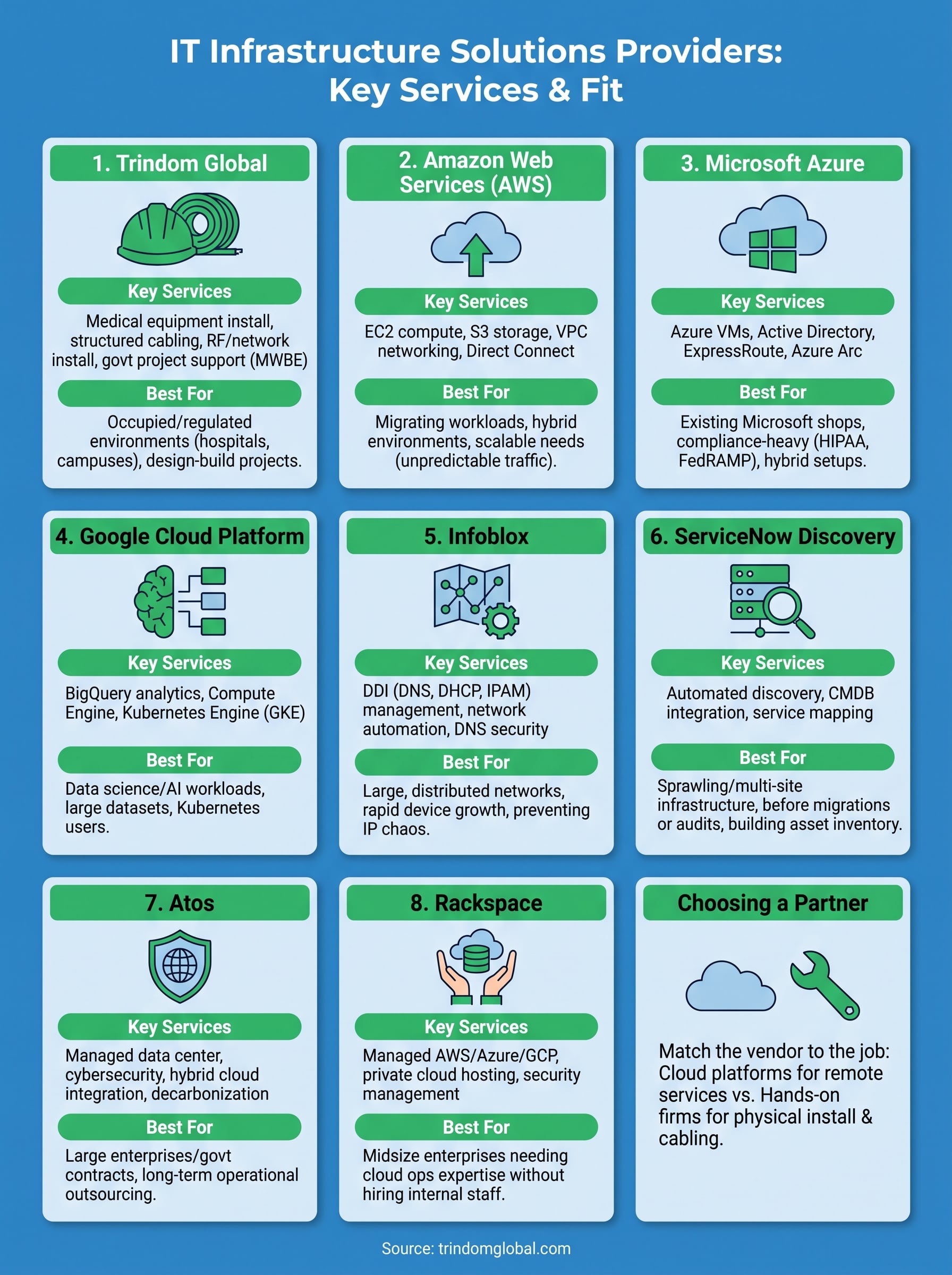
The nine names above split into two camps: cloud platforms and managed service giants that handle infrastructure remotely, and hands-on firms that show up with technicians and pull cable. Your project decides which camp you need. A hospital wing needing imaging equipment mounted or a multifamily campus needing fiber run building by building can’t be solved from a console in Seattle or Redmond. That work needs boots on the ground and a project manager who answers the phone.
Matching the vendor to the actual job, not the buzziest name on the list, is what keeps a build on schedule and on budget. If your next project involves physical installation, structured cabling, or government procurement requirements, see which network cabling services near you to call and talk with Trindom Global before you sign with anyone else. A single accountable team, from design through final integration, still beats juggling five vendors.


