

Your network goes down for an hour and suddenly a hospital wing can’t pull patient records, a hotel loses guest WiFi, or a government office misses a compliance deadline. That’s what happens when nobody has a clear answer to a basic question: what exactly are IT infrastructure solutions, and who’s responsible for keeping them running? A lot of facility managers and procurement officers get pulled into vendor conversations without a solid grasp of what they’re actually buying.
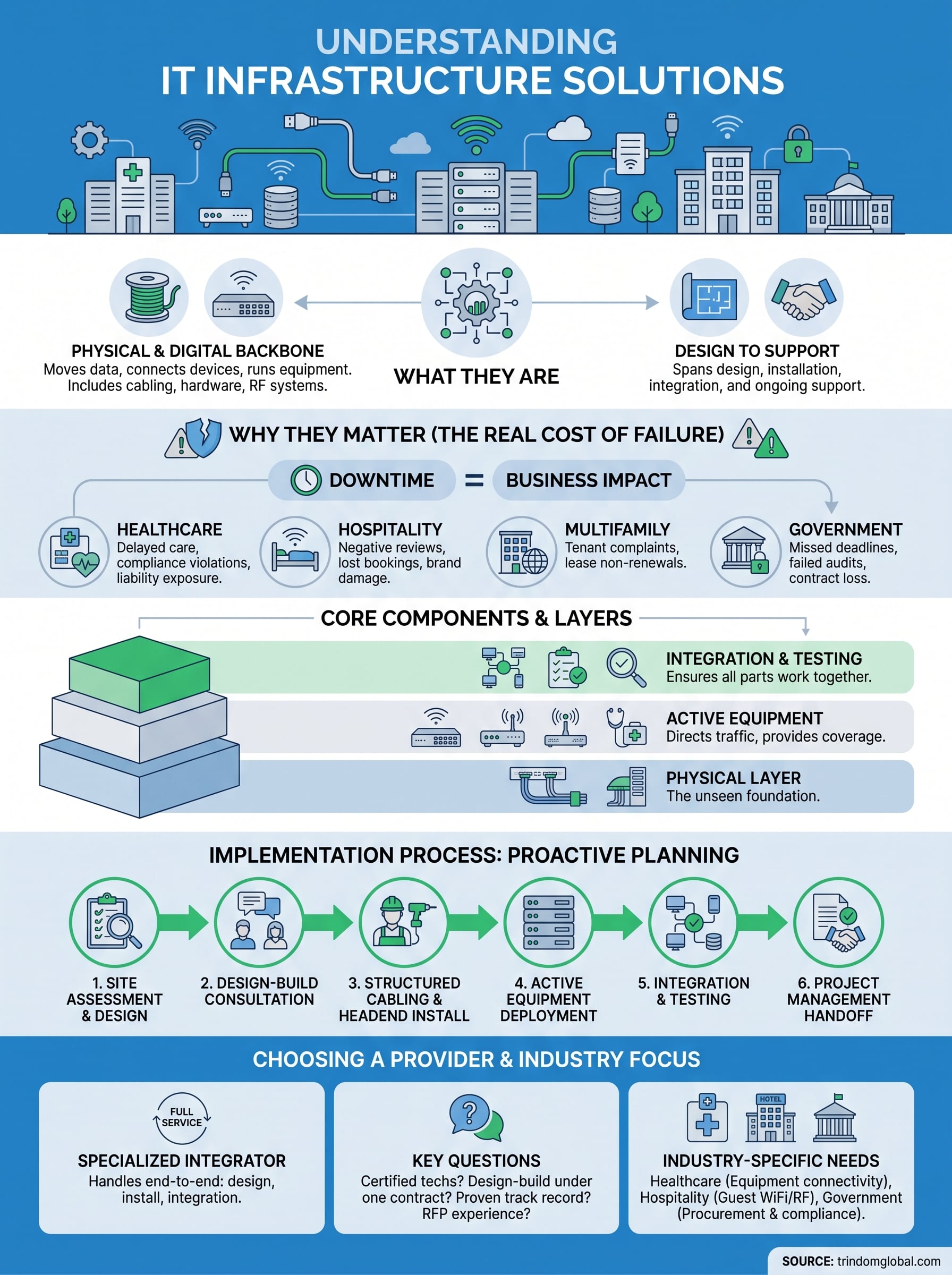
In plain terms, infrastructure IT solutions cover everything physical and digital that lets your organization move data, connect devices, and run equipment reliably: cabling, network hardware, RF systems, headend buildouts, and the integration work that ties it all together. IT infrastructure solutions and services span design, installation, and ongoing support, not just the hardware sitting in a server room.
This article breaks down what these solutions actually include, the different types you’ll encounter depending on your industry, and how to evaluate the companies that provide them. Whether you’re planning a hospital equipment rollout, a multifamily property upgrade, or a government IT contract, you’ll walk away knowing exactly what to ask for and why it matters.
Why IT infrastructure solutions matter for your business
Weak infrastructure doesn’t announce itself until it fails. A hospital’s imaging equipment loses connectivity mid-scan, a hotel’s guest network drops during a sold-out weekend, or a government office can’t submit a report before a federal deadline. IT infrastructure solutions exist precisely to prevent these moments, because the physical and digital backbone of an organization determines whether every other system on top of it actually works. Skimping here doesn’t save money. It just delays the bill and adds interest.
Reliable infrastructure is invisible when it works and catastrophic when it doesn’t.
The real cost of unreliable infrastructure
Downtime hits different industries in different ways, but the financial and operational damage adds up fast. Consider what’s actually at stake when infrastructure fails:

| Industry | What breaks first | Business impact |
|---|---|---|
| Healthcare | Medical equipment connectivity, patient records access | Delayed care, compliance violations, liability exposure |
| Hospitality | Guest WiFi, RF/network systems | Negative reviews, lost bookings, brand damage |
| Multifamily residential | Property-wide internet service | Tenant complaints, lease non-renewals |
| Government | Secure data transfer, RFP compliance systems | Missed deadlines, failed audits, contract loss |
Government agencies in particular face strict procurement standards, and a provider that doesn’t understand government projects requirements can cost an agency far more than a delayed installation. Missed RFP milestones or noncompliant cabling work can trigger audit findings that follow a facility for years.
Why proactive planning beats reactive fixes
Hospitals and healthcare systems face some of the highest stakes here. A medical equipment installation that isn’t planned around clinical workflows and integration requirements can delay patient care and create liability issues that outlast the warranty on the equipment itself. Facilities that bring in qualified technicians and project management from the start avoid the scramble of retrofitting cabling or network paths after the fact.
Multifamily property operators run into a version of this same problem when tenants expect hotel-grade internet but the property was wired for a different era of demand. Retrofitting a campus after residents move in costs far more than designing the network backbone correctly during construction or renovation. That’s the logic behind infrastructure it solutions built around design-build models: you plan for the load you’ll actually carry, not the load you had five years ago.
Organizations that treat infrastructure as an afterthought end up paying twice, once for the rushed original install and again for the emergency fix. Planning ahead with a provider who understands your sector’s specific compliance and performance demands is cheaper every single time.
Core components and types of IT infrastructure
Every IT infrastructure setup rests on the same basic layers, whether you’re outfitting a hospital wing or a hotel tower. Core components include how a structured cabling system is built, network hardware, RF systems, and the headend equipment that ties video, data, and telecom signals together. Strip away the industry-specific labels and you’re left with a simple stack: physical pathways, active equipment, and the integration work that makes everything talk to each other. Understanding what are IT infrastructure solutions at this component level helps you ask better questions when a vendor pitches you a proposal.
The physical layer: cabling and headend buildout
Structured cabling and headend buildout services form the foundation of nearly every project, since network hardware and RF systems are useless without a properly designed pathway underneath them. Facilities that underinvest here end up with bottlenecks that no amount of expensive equipment upstream can fix.
A network is only as fast as the cabling nobody sees.
Active equipment and integration
Hardware and integration are where the physical layer becomes functional. This layer typically includes:
- Network switches and routers that direct data traffic across the building or campus
- RF distribution systems for hospitality and commercial WiFi coverage
- Medical equipment integration hardware that links imaging and monitoring systems to hospital networks
- ISP and telecom infrastructure for multifamily properties needing property-wide internet
- Project management and installation services that tie design to execution
Integration is the piece organizations underestimate most often. A switch and a cable run don’t automatically produce a working system, someone has to configure, test, and document how each piece connects to the next. Vendors who separate installation from integration tend to leave gaps that surface months later, usually during an audit, a tenant complaint, or a failed equipment check in a patient room.
How to implement IT infrastructure solutions successfully
Getting infrastructure right isn’t about buying the best hardware on the market. It’s about sequencing the work so design, installation, and integration build on each other instead of fighting each other. Organizations that skip steps or rush the planning phase almost always end up paying for rework, and rework on cabling or headend systems is far more disruptive than getting it right the first time.
Start with a real assessment, not a wish list
Before anyone pulls cable or mounts a switch, network infrastructure planning has to give you a clear picture of current load, expected growth, and compliance requirements specific to your industry. A hospital’s assessment looks nothing like a hotel’s, and a government facility adds procurement rules on top of both. Skipping this step is the single most common reason IT infrastructure solutions underperform once they’re live.
Infrastructure planned around next year’s demand outlasts infrastructure planned around last year’s budget.
Follow a sequence that avoids costly rework
A disciplined rollout generally follows this order:
- Site assessment and design based on current use and projected growth
- Design-build consultation to align infrastructure with operational goals and budget
- Structured cabling and headend installation as the physical foundation
- Active equipment deployment, including network hardware and RF systems
- Integration and testing to confirm every component works with the others
- Project management handoff with documentation for future maintenance
Teams that jump straight to step three, skipping the design work, often discover mid-installation that the cabling path doesn’t support the equipment load they actually need.
Working with a partner experienced in the design-build process keeps these steps from happening in isolation. Since one team owns the process from planning through integration, there’s no finger-pointing when something doesn’t connect the way it should, and no gap between what was designed and what actually gets installed on site.
Who provides IT infrastructure solutions and how to choose one
General contractors, telecom carriers, and specialized integrators all claim to offer IT infrastructure solutions, but the overlap in marketing language hides real differences in capability. A general contractor might handle the building shell and leave cabling to a sub, while a telecom carrier focuses on the connection point at the curb and stops there. A specialized integrator, by contrast, is one of the providers that handle IT infrastructure installation end to end, owning design, installation, and integration under one roof, which matters most when your project spans multiple systems like medical equipment, network hardware, and RF distribution.
What separates a specialized integrator from a general contractor
Look for a provider who can speak to your specific sector, not just infrastructure in general. Ask candidates these questions before signing anything:
- Do you have qualified technicians certified for our specific equipment or vendor requirements?
- Can you manage design-build consultation and installation under one contract?
- What’s your track record with projects our size, in our industry?
- Who handles project management on an infrastructure build if something goes wrong mid-installation?
- Can you meet our procurement or RFP documentation requirements?
The right provider owns the whole project, not just the piece that’s easiest to bill.
Why MWBE certification matters for procurement
Government agencies and many healthcare systems now require or prioritize minority and women-owned business enterprise vendors, so how MWBE certification is earned and maintained can determine which bids even get considered. Trindom Global holds this certification and pairs it with vendor partnerships built over 25-plus years, which lets clients meet procurement goals without sacrificing technical capability. Choosing a certified provider isn’t just a compliance checkbox, it often signals a company that’s built processes around documentation and accountability from the start, since that’s exactly what certification audits demand. If you’re evaluating government projects work specifically, confirm the provider has actually navigated RFP requirements before, not just infrastructure installs in general.
IT infrastructure solutions in action across industries
Theory only goes so far. Seeing how IT infrastructure solutions play out in real facilities shows why the planning and component choices covered above actually matter once equipment goes live. Every sector applies the same core building blocks, cabling, hardware, RF systems, integration, but the priorities shift depending on what’s at stake if something fails.
Healthcare: keeping equipment and records connected
Hospitals depend on what medical equipment installation involves, connecting imaging machines, monitors, and patient record systems without a single dropped signal during a procedure. A qualified technician team handles the physical mounting and cabling, but the real value shows up in the integration testing firms that integrate medical devices run to confirm every device talks to the hospital network correctly before a patient ever enters the room. Get this wrong, and you’re not just fixing a switch, you’re explaining a delayed diagnosis to a compliance officer.

The stakes in a hospital network aren’t measured in downtime, they’re measured in patient outcomes.
Hospitality and multifamily: keeping guests and tenants connected
Hotels and multifamily properties live or die on the quality of RF and network installation services, since guest satisfaction and lease renewals both hinge on WiFi that doesn’t drop during peak occupancy. Multifamily operators increasingly turn to dedicated ISP solutions built for campus-wide coverage rather than patchwork residential setups, because tenants now expect the same speed at home that they get anywhere else.
Government: meeting procurement and compliance demands
Government facilities add a layer most private clients never face: strict RFP documentation and procurement rules that shape every phase of the project. A provider experienced in government projects work builds compliance checkpoints into the installation schedule itself, so audits don’t surface surprises after the contract closes.
Putting the pieces together
IT infrastructure solutions aren’t a single purchase, they’re a sequence of decisions that either compound your advantage or your risk. Cabling without integration testing is a liability. Design without a real assessment of load and compliance is a guess dressed up as a plan. Every example in this article, hospitals, hotels, multifamily campuses, government offices, comes back to the same principle: the organizations that plan first and install second avoid the expensive rework that swallows budgets later.
Going forward, treat any vendor conversation as a chance to test what you’ve learned here. Ask who owns design, who owns integration, and who’s accountable when something doesn’t connect. Trindom Global builds its process around exactly those answers, backed by certified technicians and 25-plus years of vendor partnerships. If you’re ready to move past guesswork, see what IT infrastructure consulting services cover and talk to Trindom Global about a plan built around what your facility actually needs.


