

Your network is probably running on decisions made three or five years ago, patched together as the business grew. Now you’re dealing with slow throughput during peak hours, security gaps nobody’s tracked down, or a hospitality property that can’t handle guest device loads. That’s the point where most organizations start looking for it network consulting services, and it’s worth knowing what you’re actually buying before you sign a contract.
At its core, IT network consulting means bringing in outside experts to assess your current infrastructure, identify weak points, and design a network that matches where your business is headed, not where it was when the wiring went in. Good consultants don’t just recommend hardware. They map out structured cabling and headend equipment rooms, RF coverage, and integration with the equipment your team already relies on, then manage the installation so it doesn’t disrupt operations.
This article breaks down what these services actually cover, how the process typically runs from assessment to buildout, and the questions to ask before hiring a firm, whether you’re running a hospital, a hotel, a multifamily property, or a government facility with strict procurement rules.
Why IT network consulting services matter for your business
A network failure doesn’t announce itself politely. It shows up as a dropped patient monitor feed in a hospital wing, a hotel guest who can’t check in because the property management system lost connection, or a government audit that flags unsecured access points nobody knew existed. These aren’t hypothetical risks. They’re the daily reality for organizations running infrastructure that was never designed for current demand, and that’s exactly why network infrastructure consulting has become a standard line item rather than an afterthought.
The real cost of network problems
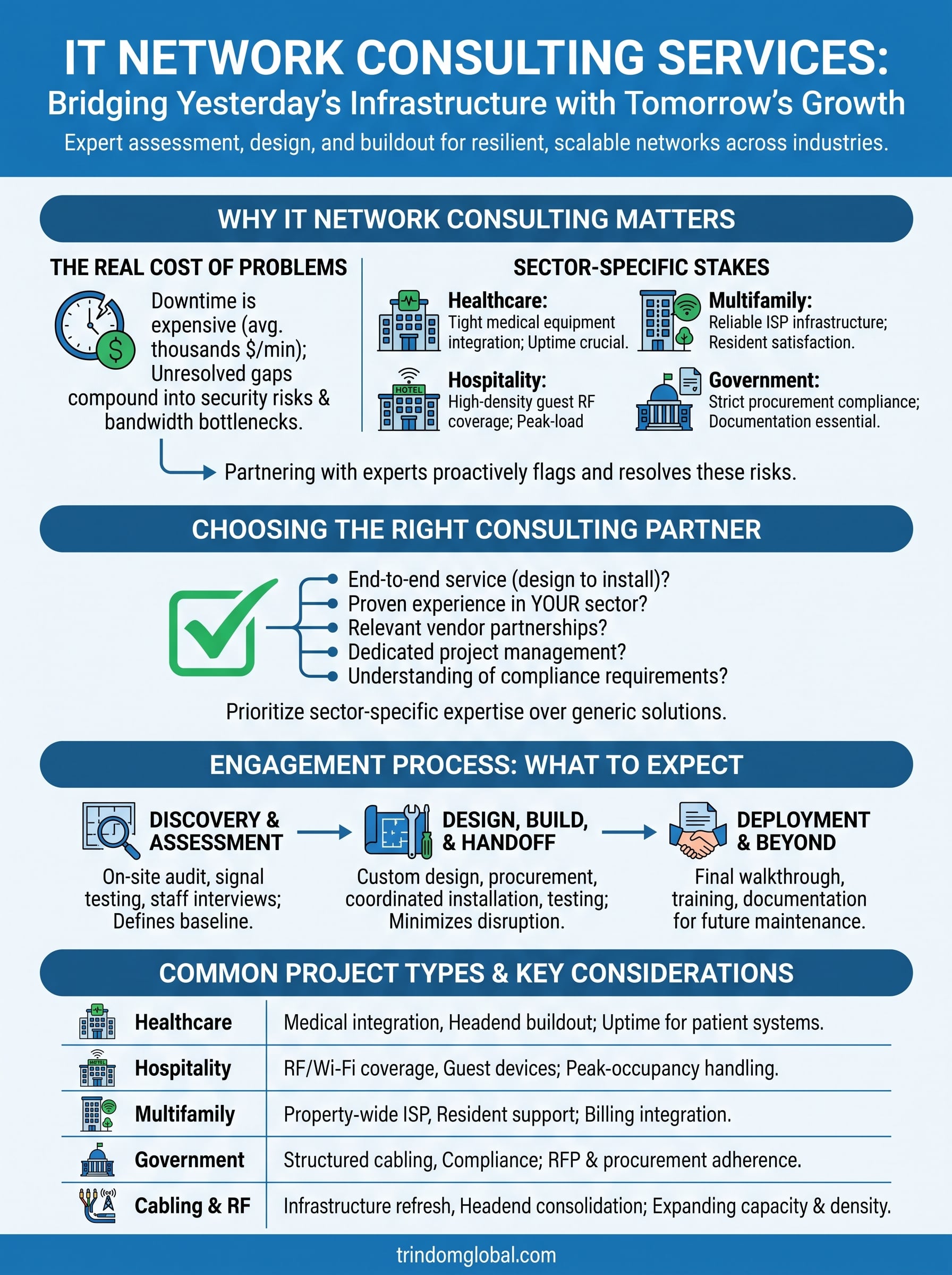
Downtime is expensive in ways that rarely show up until you’re already paying for them. Gartner has estimated the average cost of IT downtime in the thousands of dollars per minute for many organizations, and that figure climbs fast in healthcare or hospitality settings where an outage stops revenue and patient care at the same time. Beyond the immediate hit, unresolved network gaps tend to compound. A weak segment left unpatched becomes a security vulnerability, and a cabling shortcut taken during a fast buildout becomes the bottleneck that caps your bandwidth for years.
A network built for yesterday’s business will quietly cap tomorrow’s growth until someone forces the issue.
Sector-specific stakes
Every industry carries its own version of this problem. Hospitals need tight integration between medical equipment and the network backbone. Hospitality properties need RF coverage for guest devices that handles hundreds of connections without collapsing during peak occupancy. Multifamily operators need ISP infrastructure that keeps residents online without constant service calls. Government agencies need documentation and compliance built into every stage of the buildout, because procurement rules demand it.

Partnering with experienced consultants means these industry-specific risks get flagged before they become expensive failures, not after one forces your hand. It also means someone stays accountable for tying the design back to your actual goals, whether that’s supporting a hospital expansion, a new hotel wing, or a full multifamily campus rollout.
How to choose the right IT network consulting partner
Selecting a network consulting company comes down to more than a polished sales pitch. You want a firm that has actually installed the kind of infrastructure you need, not one that subcontracts the hard parts and manages the paperwork. Ask for references from projects in your industry. A firm that’s wired a hotel’s guest RF network handles very different challenges than one that’s built out hospital medical equipment integration, and you don’t want to be the training ground for their first attempt.
Credentials matter too, especially if your organization has procurement requirements. If you’re a government agency or work with one, a certified minority and women-owned business status can satisfy diversity spend goals while still delivering the technical depth you need. Beyond certifications, look at how the firm approaches the design-build project phases.
The right partner has already solved your specific problem for someone else, not just something adjacent to it.
Use this checklist before signing anything:
- Do they offer end-to-end service, from design through installation and integration?
- Can they show completed projects in your sector (healthcare, hospitality, multifamily, government)?
- Do they carry vendor partnerships that give you access to the right hardware?
- Will they provide dedicated project management for the buildout?
- Do they understand your compliance and procurement requirements upfront?
Getting straight answers to these questions early saves you from surprises once the cabling is already in the walls.
What to expect during a network consulting engagement
Engagements follow a fairly predictable arc once you’ve signed with a firm, though the timeline shifts depending on the size of your facility and how much rework the existing infrastructure needs. Most projects move through discovery, design, and deployment, with a project manager keeping the client looped in at each stage rather than disappearing until the final walkthrough.
Discovery and assessment
Expect a technical team on-site early, walking the property, testing signal strength, checking cabling condition, and interviewing your staff about pain points that don’t show up on a network diagram. This phase produces the baseline assessment that everything else gets built from, so rushing it usually costs you later.
Design, build, and handoff
Once the assessment wraps, the consultant proposes a design tied to your budget and growth plans, then moves into procurement and installation. A well-run engagement typically includes:
- A written scope of work with milestones and timelines
- Coordination that minimizes disruption to daily operations
- Testing and validation before final sign-off
- Documentation you keep for future maintenance or expansion
A network engagement that skips documentation leaves you blind the next time something breaks.
Throughout the build, integration with existing equipment gets prioritized so you’re not ripping out systems that still work. Handoff should include training for your internal staff, not just a folder of technical specs nobody reads.
Common types of IT network consulting projects
Projects range from a single-building network cabling refresh to a full campus rollout spanning dozens of buildings, and the scope shapes everything from timeline to budget. Most engagements fall into a handful of recognizable categories, each with its own technical demands and compliance requirements. Understanding which bucket your project falls into helps you scope the right team and avoid paying for expertise you don’t need.
Sector-driven builds
Healthcare, hospitality, and multifamily properties each drive a distinct kind of network installation, summarized below.

| Sector | Typical Project | Key Consideration |
|---|---|---|
| Healthcare | Medical equipment integration, headend buildout | Uptime for patient monitoring systems |
| Hospitality | RF and Wi-Fi coverage for guest devices | Peak-occupancy load handling |
| Multifamily | Property-wide ISP infrastructure | Resident support and billing integration |
| Government | Structured cabling with compliance documentation | RFP and procurement adherence |
The project type dictates the risk profile, and the risk profile should dictate who you hire.
Cabling, RF, and government-driven work
Structured cabling and headend buildout projects still make up a large share of requests, especially when a property is expanding or consolidating multiple vendors into one backbone. RF installation work often runs alongside these builds, particularly in hospitality settings where guest device density keeps climbing. Government projects add another layer entirely, since procurement requirements shape the paperwork as much as the technical design, and missing a compliance step can stall an otherwise ready buildout.
Finding the right fit for your network
Your network problems won’t fix themselves, and the longer a weak segment or outdated cabling run sits untouched, the more it costs to correct later. IT network consulting services exist to catch those issues early, whether you’re managing a hospital wing, a hotel property, a multifamily campus, or a government facility with strict procurement rules. The right partner brings design-build experience specific to your sector, not a generic playbook borrowed from a different industry.
Getting this right means asking pointed questions upfront, checking references in your own sector, and confirming the firm manages the full arc from assessment through installation and handoff. Skip any of that, and you’re gambling on a network that has to carry your business for years.
If you’re ready to talk through your infrastructure needs with a team that’s handled healthcare, hospitality, multifamily, and government builds, see what infrastructure consulting covers and who offers it, then reach out to Trindom Global and start with a real assessment, not a sales pitch.


