

Picking the wrong vendor for a network build or a medical equipment install doesn’t just waste money. It delays patient care, stalls occupancy on a residential property, or gets a government contract flagged for compliance issues. If you’re vetting a it services and consulting company right now, you already know the stakes are higher than a generic tech support contract.
This list answers a specific question: which firms actually deliver on design-build, installation, and integration work across healthcare, hospitality, multifamily, and government sectors, not just help desk tickets. We looked at project management capability, vendor partnerships, and track record in specialized environments like hospital equipment rooms and RF network buildouts, the kind of work that separates real professional it consulting services from companies that only sell software licenses.
Below you’ll find ten companies worth a serious look, including firms with deep experience in structured cabling, headend infrastructure, and multi-family ISP deployment. We’ve included what each one specializes in, who they serve best, and where they fit if you’re comparing it consulting services usa providers against your own procurement requirements, including MWBE certification needs.
1. Trindom Global
Trindom Global sits at the top of this list because it does the work most consulting firms subcontract out: physical design-build, installation, and integration for IT infrastructure and capital equipment. As a certified minority and women-owned small business bidding on government work, it also solves a procurement problem for organizations that need MWBE vendor participation on top of technical competence. This isn’t a firm selling strategy decks. It’s a firm running crews in hospital corridors and telecom headends.

Services offered
Trindom Global covers a specific but critical slice of it services and consulting work: hospital and healthcare medical equipment installation, structured cabling and headend buildout for network and TV infrastructure, RF and network installation for commercial and hospitality properties, government IT project delivery aligned to RFP requirements, and multifamily high-speed ISP deployment through its sister service, Trintel. Each service line pairs what design-build services actually cover with hands-on installation and project management, so clients aren’t stuck coordinating between a planning firm and a separate installation crew.
Who it’s best for
Healthcare systems installing or upgrading medical equipment, hospitality and commercial properties needing RF and network buildouts, multifamily operators wanting reliable ISP infrastructure across a residential campus, and government agencies that need a vendor who understands both technical delivery and compliance paperwork all fit well here. If your project involves physical infrastructure work in a regulated or high-occupancy environment, Trindom Global’s field experience matters more than a generic consulting bench.
The firms that actually finish infrastructure projects on schedule are the ones with crews and project managers on-site, not just consultants writing recommendations.
Notable strengths
Trindom Global’s biggest strength is vendor partnerships combined with real installation experience, including 25-plus years in ISP solutions through Trintel. That combination lets the company move from design to deployment without handing work off to a third party. Its MWBE certification is a genuine differentiator for government and enterprise clients with supplier diversity requirements, not just a checkbox. Dedicated IT project management is baked into every engagement, which reduces the coordination headaches common on multi-vendor infrastructure builds.
Pricing model
Trindom Global prices projects based on scope: equipment count, cabling footprint, site complexity, and integration requirements. There’s no published flat-rate card because installation and integration work varies too much project to project. You can request a scoped quote directly through Trindom Global’s site after describing your infrastructure goals and constraints.
2. Accenture
Accenture is the largest global player in this space, and most enterprise buyers already know the name before they start searching for it consulting services usa providers. The firm operates across strategy, technology, and operations, with a scale that lets it staff massive digital transformation programs for Fortune 500 clients. That scale is exactly why smaller organizations often find Accenture a mismatch for their needs.
Services offered
Accenture’s portfolio spans cloud migration, cybersecurity, data and AI implementation, enterprise application development, and large-scale digital transformation consulting. It also runs dedicated industry practices for healthcare, financial services, and the public sector, backed by partnerships with major cloud providers like Amazon Web Services and Microsoft Azure.
Who it’s best for
Enterprises with multi-year transformation budgets and global operations get the most value here. Organizations needing physical infrastructure work like structured cabling or medical equipment installs won’t find that expertise on Accenture’s bench.
Notable strengths
Global reach and deep technical benches across nearly every industry vertical stand out as Accenture’s core advantage. Its research arm publishes credible industry benchmarks that inform strategy work.
Bigger isn’t always better when your project needs boots on the ground, not a slide deck.
Pricing model
Pricing runs on time-and-materials or fixed-fee project contracts, typically negotiated at enterprise scale with minimum engagements often starting well into six figures. Smaller businesses should expect limited flexibility on contract size.
3. Deloitte Consulting
Deloitte Consulting built its reputation on audit and tax work, but its technology practice now rivals the biggest names in it services and consulting. The firm pairs strategy consulting with implementation, so clients get both the roadmap and the technical build in one contract. That combination appeals to organizations that don’t want to manage two separate vendors for planning and execution.
Services offered
Deloitte’s technology arm covers cloud transformation, cybersecurity risk assessments, ERP implementation, and AI strategy consulting, alongside its legacy strength in regulatory and financial systems work. Government and public sector clients also get dedicated teams familiar with federal compliance requirements, which overlaps with the kind of RFP-driven work smaller firms handle on the infrastructure side.
Who it’s best for
Large enterprises and public sector agencies with complex regulatory obligations get the most out of Deloitte’s bench. Companies needing physical build-out work, like network cabling installation or equipment installation, should look elsewhere since Deloitte’s strength sits in strategy and systems integration, not field installation.
A firm that writes the compliance strategy isn’t the same firm you want running cable through a hospital ceiling.
Notable strengths
Regulatory expertise sets Deloitte apart, particularly for financial services and government clients navigating strict compliance frameworks. Its consultants often bring Big Four audit backgrounds, which adds credibility when a project touches financial reporting or risk management.
Pricing model
Projects run on fixed-fee or time-and-materials contracts, usually scoped for enterprise budgets rather than small business engagements. Expect minimum project sizes that price out most mid-market buyers.
4. IBM Consulting
IBM Consulting leans on the company’s hardware and software legacy to sell enterprise IT consulting work that few competitors can match on infrastructure depth. The firm built its name on mainframes and now applies that same systems-level thinking to hybrid cloud, AI, and automation projects. Clients hire IBM Consulting when they need a partner who understands both the software layer and the underlying architecture it runs on.
Services offered
Core offerings include hybrid cloud architecture, AI and automation consulting through IBM’s Watson platform, cybersecurity services, and application modernization for legacy systems. IBM also runs a dedicated practice for supply chain and asset management consulting, which pulls in manufacturing and logistics clients alongside its traditional enterprise base.
Who it’s best for
Organizations already running IBM hardware or software, or those modernizing legacy mainframe systems, get the clearest value here. Companies needing physical infrastructure installation, like structured cabling or medical equipment integration, won’t find that capability on IBM’s roster.
A consulting firm’s software depth doesn’t translate to running conduit through a hospital wing.
Notable strengths
Hybrid cloud architecture and AI implementation stand out as IBM’s strongest offerings, backed by decades of enterprise systems experience. Its research division, IBM Research, feeds real technical innovation into client engagements rather than recycled industry trends.
Pricing model
Engagements typically run on fixed-fee or milestone-based contracts tied to project scope and duration. Enterprise clients should expect negotiated pricing scaled to system complexity, with limited options for smaller, one-off projects.
5. EPAM Systems
EPAM Systems built its reputation on software engineering talent, and it still leads with that strength even as it markets itself as a full it consulting services usa provider. The firm grew out of custom software development work in Eastern Europe and now runs a global engineering bench that competes with the biggest consulting names on technical execution. Clients hire EPAM when the project is code-heavy, not infrastructure-heavy.
Services offered
EPAM’s core services include custom software engineering, digital product design, cloud-native application development, and data engineering. It also runs dedicated practices in AI and machine learning integration, plus a growing consulting arm that advises on digital transformation strategy alongside the build work.
Who it’s best for
Software-driven companies building custom platforms or products get the most value from EPAM’s engineering depth. Organizations needing physical infrastructure work, like network cabling, RF installation, or medical equipment integration, should look to a firm with field installation crews instead.
Engineering talent builds great software, but it doesn’t run cable through a hospital ceiling.
Notable strengths
Engineering depth and speed of delivery set EPAM apart from consulting firms that outsource development work. Its global delivery model keeps costs competitive compared to US-only engineering shops, which matters for companies running large, ongoing software builds.
Pricing model
Projects typically run on time-and-materials contracts, with staff augmentation arrangements common for longer engagements. Rates vary by developer seniority and location, and EPAM rarely publishes fixed pricing since scope depends heavily on team composition.
6. Slalom
Slalom built its business on local delivery teams paired with big-firm capability, which sets it apart from the global giants on this list. Founded in Seattle, the company operates through regional offices across the US, so clients get consultants who show up in person rather than a rotating cast flown in from a distant hub. That local-first model appeals to mid-market companies that want enterprise IT consulting without the overhead of a massive multinational contract.

Services offered
Slalom’s practice covers cloud migration, data analytics, customer experience design, and change management consulting, with strong partnerships across Salesforce, AWS, and Microsoft. The firm also runs dedicated teams for business strategy work, blending technology implementation with organizational change advisory in the same engagement.
Who it’s best for
Mid-market and enterprise companies wanting a consulting partner with local presence and a collaborative delivery style fit Slalom well. Businesses needing physical infrastructure work, like structured cabling or RF installation, won’t find that capability here since Slalom’s bench is entirely software and strategy focused.
A local delivery team beats a distant one when your project needs someone who actually understands your market.
Notable strengths
Client relationships and delivery culture stand out as Slalom’s biggest differentiators, with consistently high satisfaction scores across industry surveys. Its regional structure lets teams build deeper familiarity with local vendor ecosystems and regulatory quirks than a purely centralized firm can match.
Pricing model
Engagements run on time-and-materials or fixed-fee contracts, scoped regionally rather than through a single national rate card. Smaller companies sometimes find more flexibility here than with the largest global consultancies, though pricing still targets mid-market and enterprise budgets.
7. TEKsystems
TEKsystems built its name on IT staffing before expanding into full IT services and consulting, and that staffing DNA still shapes how it operates today. The firm places technologists inside client organizations for both short-term projects and long-term talent gaps, then layers consulting services on top for companies that need more than warm bodies. Businesses that need to scale a technical team fast, without a six-month recruiting cycle, tend to land here first.
Services offered
TEKsystems covers IT staff augmentation, application development, cloud infrastructure support, and cybersecurity services, with a heavy emphasis on filling specific technical roles rather than running large transformation programs. It also offers managed services for ongoing IT operations, which appeals to companies wanting a single vendor for both project staffing and day-to-day support.
Who it’s best for
Companies facing a talent shortage, whether for a single project or an ongoing operational gap, get the clearest value from TEKsystems. Organizations needing physical infrastructure installation, like medical equipment setup or structured cabling, should look to a firm built around field deployment instead.
Staffing speed solves a talent gap, but it doesn’t install a network backbone.
Notable strengths
Speed of placement stands out as TEKsystems’ core strength, backed by a large recruiting network that spans most major US metro markets. Its parent company, Allegis Group, gives it staffing scale that smaller boutique firms can’t match.
Pricing model
Engagements typically run on hourly bill rates for staffed positions, with rates varying by role, skill level, and contract length. Managed services contracts run separately, usually priced on a monthly retainer tied to scope.
8. Protiviti
Protiviti built its practice on risk consulting and internal audit before expanding into IT services and consulting, and that risk-first mindset still shapes how it approaches technology projects. Owned by Robert Half, the firm pairs technical implementation with governance and compliance advisory, which appeals to organizations that can’t separate a tech upgrade from regulatory exposure. Clients hire Protiviti when the project touches both systems and audit trails.
Services offered
Protiviti’s technology practice covers IT risk management, cybersecurity assessments, data governance, and business continuity planning, alongside internal audit and controls testing. It also runs a dedicated technology consulting arm handling ERP implementation and digital transformation projects for regulated industries like financial services and healthcare.
Who it’s best for
Regulated organizations, particularly banks, insurers, and healthcare systems facing audit scrutiny, get the most value from Protiviti’s combined risk and technology bench. Companies needing physical infrastructure work, like structured cabling or medical equipment installation, won’t find that capability here since Protiviti’s strength sits entirely in advisory and compliance work.
A firm built for audit trails isn’t built for running conduit through a server room.
Notable strengths
Risk and compliance depth set Protiviti apart from consulting firms that treat governance as an afterthought. Its ties to Robert Half also give it access to a broad talent network for staffing specialized risk and technology roles quickly.
Pricing model
Engagements typically run on time-and-materials or fixed-fee contracts scoped to project complexity and regulatory requirements. Smaller organizations without ongoing compliance obligations may find pricing skewed toward larger, audit-heavy engagements.
9. HCLTech
HCLTech grew out of India’s engineering talent boom into one of the largest global IT services and consulting providers, and it competes directly with IBM and Accenture on enterprise contracts. The firm runs a global delivery model that blends offshore engineering teams with onshore client-facing consultants, which keeps costs lower than US-only competitors on large, multi-year programs. Organizations hire HCLTech when they need scale and a global bench more than a boutique, high-touch relationship.

Services offered
HCLTech’s practice covers cloud infrastructure management, enterprise application services, engineering and R&D outsourcing, and cybersecurity operations. It also runs dedicated practices for AI and automation, plus a growing digital business unit that handles product engineering for software-driven clients.
Who it’s best for
Large enterprises running global operations and needing offshore engineering scale get the clearest value from HCLTech. Companies needing on-site physical infrastructure work, like structured cabling, RF installation, or companies that integrate medical devices, should look to a firm with local field crews instead, since HCLTech’s delivery model is built around remote and offshore execution.
Offshore scale cuts costs on software work, but it can’t send a technician to your building.
Notable strengths
Cost efficiency at scale stands out as HCLTech’s core advantage, driven by its large offshore delivery centers and long-standing engineering outsourcing relationships. The firm also maintains deep partnerships with major cloud and software vendors, which helps clients running hybrid, multi-vendor environments.
Pricing model
Engagements typically run on time-and-materials or managed services contracts, often structured around offshore-to-onshore staffing ratios. Rates vary significantly based on delivery location and role seniority, with limited flexibility for smaller, one-off projects.
10. Dataprise
Dataprise rounds out this list as a managed IT services provider built for mid-market companies that need day-to-day support more than a strategy overhaul. The firm operates its own network operations centers across the US, staffing help desks and field technicians directly rather than subcontracting support tickets overseas. Companies that outgrew a one-person IT department but aren’t ready for an enterprise consultancy tend to land here.
Services offered
Dataprise covers managed IT support, cybersecurity monitoring, cloud infrastructure management, and help desk services, all delivered through 24/7 network operations centers. It also runs disaster recovery planning and IT strategy consulting for clients who want a single vendor handling both daily support and longer-term technology roadmaps.
Who it’s best for
Mid-market businesses without a large internal IT staff, especially those needing consistent help desk coverage and proactive security monitoring, get the most value here. Organizations needing physical infrastructure installation, like structured cabling or medical equipment integration, should pair Dataprise’s managed support with a firm that runs field crews.
Managed support keeps your systems running day to day, but it doesn’t build the network those systems run on.
Notable strengths
Responsiveness stands out as Dataprise’s core strength, with published service-level agreements around ticket response times that many boutique it consulting services shops can’t match. Its own operations centers, rather than outsourced call centers, keep support quality more consistent.
Pricing model
Contracts typically run on monthly per-user or per-device pricing for managed services, with project work billed separately. Smaller businesses often find this model more predictable than large-firm hourly rates.
11. How to choose the right IT consulting partner
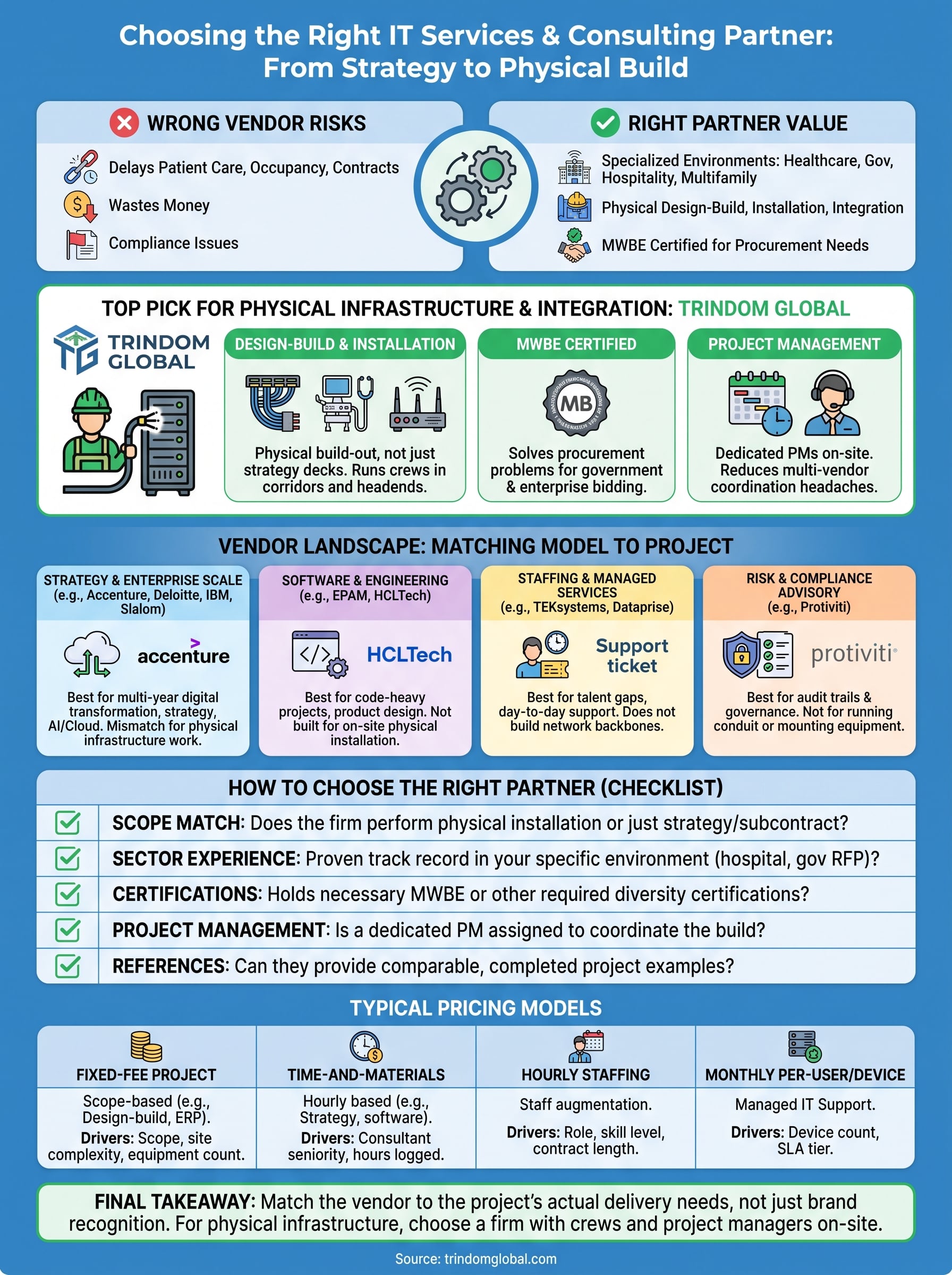
Selecting an it services and consulting company comes down to matching the vendor’s actual delivery model to your project type, not just its logo recognition. A firm with a brilliant strategy deck won’t help you if your project needs someone physically pulling cable or mounting medical equipment. Before you sign anything, map your project against the checklist below and cross off any vendor that can’t check most of the boxes.
- Scope match: Does the firm actually perform the work (installation, integration, field deployment) or does it subcontract the physical build to a third party?
- Sector experience: Has it delivered projects in your specific environment, whether that’s a hospital, a multifamily campus, or a government facility with strict RFP terms for IT consulting work?
- Certifications: Does it hold MWBE, minority-owned, or other supplier diversity certifications your procurement process requires?
- Project management: Is there a dedicated project manager assigned, or will you be coordinating between multiple vendors yourself?
- References: Can it point to completed, comparable projects with named clients you can call?
A firm that checks every box on strategy but none on field delivery isn’t the right partner for infrastructure work.
Teams searching for it consulting services in usa markets often default to brand recognition, but recognition doesn’t guarantee the crew shows up on your job site. Weigh vendor size against your actual project needs. A regional firm with hands-on installation experience frequently outperforms a global name that treats your contract as a rounding error on its books.
12. What IT consulting services typically cost
Pricing for professional it consulting services varies more than most buyers expect, and the range depends heavily on whether you’re paying for advisory work or hands-on IT services, staffing, or physical installation work. Enterprise consultancies like Accenture and Deloitte often set minimum engagements in the low six figures, while managed service providers like Dataprise price by the seat or device each month. Design-build and integration firms like Trindom Global typically quote per project, since equipment counts and site complexity swing costs too much for a flat rate card.
Government and healthcare buyers should also factor in compliance overhead since RFP-driven work often requires bonding, insurance minimums, and certified vendor status that adds cost on top of what a fiber or cabling install runs before the first cable gets pulled.
The cheapest hourly rate rarely wins if the project drags on because nobody assigned a real project manager.
| Pricing model | Typical users | What drives the cost |
|---|---|---|
| Fixed-fee project | Design-build, ERP implementation | Scope, site complexity, equipment count |
| Time-and-materials | Strategy consulting, software builds | Consultant seniority, hours logged |
| Hourly staffing rate | Staff augmentation | Role, skill level, contract length |
| Monthly per-user/device | Managed IT support | Device count, SLA tier |
Small businesses shopping for IT consulting and comparing it consulting services usa providers should ask for a written scope breakdown before signing anything. Vague proposals almost always turn into change orders once the actual site conditions surface.
Finding the right fit for your business
Narrowing down an it services and consulting company always comes back to one question: who actually shows up and does the work you need? Global names bring scale and brand recognition, but they rarely send crews to run cable through a hospital wing or wire up a multifamily campus. Boutique firms bring focus, but not every one of them can handle regulatory paperwork or MWBE requirements alongside the technical build.
Match the vendor to the project, not the other way around. If your work involves physical installation, integration, and project management in healthcare, hospitality, multifamily, or government settings, you need a partner built for that exact scope, not a strategy shop that outsources the hard parts.
If that’s where your project sits, compare the firms that handle IT infrastructure installation end to end and talk to Trindom Global about your goals to get a scoped quote before you sign with anyone else.


