

You need help with your IT infrastructure, but you’re not sure whether to call a consultant or an integrator. That confusion costs money. Hire the wrong partner and you end up paying for advice when you needed hands, or paying for installation when you needed a strategy first. The line between it services and it consulting gets blurry fast, especially when vendors use the terms interchangeably in their sales pitches.
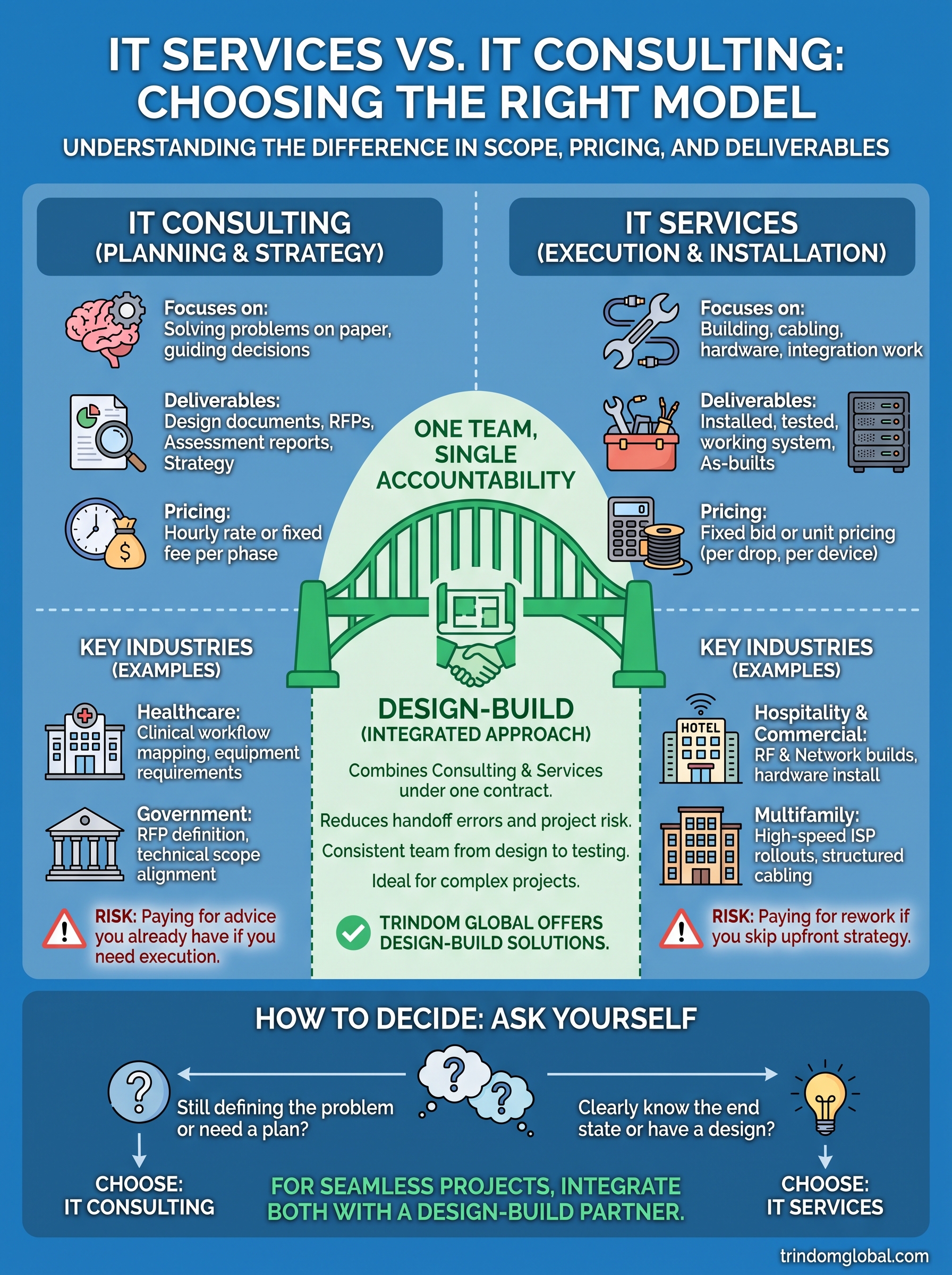
Here’s the short answer: IT consulting focuses on planning, guiding decisions, and solving problems on paper before anything gets built. IT services cover the execution, the cabling, the equipment installs, the integration work that turns a plan into a working system. Most projects, from hospital equipment rollouts to multifamily ISP buildouts, need both at different stages.
In this article, we break down what separates these two models, when you actually need a consultant versus a design-build partner, and how healthcare, hospitality, and government organizations typically combine them to avoid costly missteps. We’ll also cover how a company like Trindom Global fits into both categories, so you can figure out exactly what your project requires before you sign a contract.
Why the difference matters for your IT budget and goals
Money gets wasted when you mismatch the model to the problem. If you hire an IT consultant to draw up a network design and then pay them again to sit through your installation, you’re burning budget on advice you already have, so it helps to know the roles and skills a consultant actually brings. Flip it around, and you get an installer showing up with a truck full of cabling and no clear plan for how your headend should actually route traffic. Both mistakes happen constantly, and both cost more than getting the sequence right the first time.
The real cost of picking the wrong model
Hospitals feel this pain the most. A medical equipment installation project that skips proper planning can mean ripping out conduit after the fact because nobody accounted for infection-control zoning or equipment clearances. Government agencies run into a similar issue on the procurement side: an RFP written without input from someone who understands the technical scope invites bids that don’t match what the agency actually needs. In both cases, the fix costs far more than the upfront consulting fee would have.

Paying for the wrong service at the wrong stage always costs more than paying for the right one upfront.
Budget allocation: planning vs. execution
Separate your spend into two buckets before you talk to any vendor. Planning dollars go toward needs assessment, network design, vendor selection, and RFP support. Execution dollars go toward labor, materials, and the actual structured cabling or headend buildout. Property operators rolling out multifamily ISP infrastructure often skip the planning bucket entirely, assuming the installer will figure it out on-site. That approach works fine for a small job. It falls apart on a 400-unit campus where a wiring mistake on building one repeats itself forty times before anyone catches it.
| Budget category | What it covers | Who typically bills for it |
|---|---|---|
| Planning | Needs assessment, design, RFP support | IT consultants |
| Execution | Cabling, hardware, integration | Design-build / installation firms |
| Combined | Design-build with built-in project management | Firms like Trindom Global that offer both |
Aligning spend with your actual goals
Goals should drive the split, not the other way around. A hospitality property adding RF coverage to guest rooms has a fairly contained goal: better signal, faster Wi-Fi, minimal disruption to guests. That project might need light consulting and heavy execution. A hospital system planning a five-year equipment refresh across three campuses has a much bigger goal, one that demands serious upfront strategy before a single cable gets pulled. Skipping that strategy phase to save money almost always means paying for rework later, and rework never comes cheap when it involves live patient care areas or occupied residential units.
How to decide between IT consulting and IT services
Ask yourself one question before you call anyone: do you already know what needs to happen, or are you still trying to figure out what’s wrong? If you can describe your end state clearly, like "we need 200 patient rooms wired for nurse call and Wi-Fi," you’re ready for IT services. If you’re still asking "why does our network keep dropping" or "what’s the best way to structure this RFP," you need IT consulting first. Skipping that self-assessment is how projects end up half-planned and half-built.
Signs you need a consultant first
Certain situations almost always call for consulting before anything else. You need a consultant when you’re writing a government RFP and don’t have in-house technical staff who can define scope. You need one when a hospital is evaluating vendors for a new imaging suite and needs someone to map equipment requirements against existing infrastructure. You need one when a multifamily operator is comparing ISP models across a portfolio and has no baseline data on current network performance. In each case, the deliverable is a document or a decision, not a finished install.
If your project ends with a report instead of a working system, you need consulting, not installation.
Signs you’re ready for execution
Other situations point straight to services. A property with an approved network design just needs network cabling services to pull and terminate the structured cabling. A hospital with a signed equipment order just needs qualified technicians on-site for the install. A hospitality venue with a finalized RF plan just needs the hardware mounted and tested. Here, the thinking is done. What’s left is labor, materials, and project management to keep the timeline on track.
A simple checklist to use before you call anyone
Run through this list before requesting a quote from any vendor:
- Do you have a written scope of work or design document already?
- Can you name the specific equipment or infrastructure you’re installing?
- Has anyone assessed your current network or facility constraints?
- Do you need help writing procurement documents or RFP language?
- Is your timeline driven by a construction schedule you don’t control?
Companies like Trindom Global handle both sides under one roof, which matters most when your answers land somewhere in the middle.
Key differences in scope, pricing, and deliverables
Scope, pricing, and deliverables separate these two models more clearly than anything else, and mixing them up in a contract creates disputes later. IT consulting engagements are bounded by hours or milestones tied to a decision. IT services engagements are bounded by a physical result: cabling pulled, equipment mounted, a system that powers on and passes testing. Knowing which bucket your project falls into before you negotiate a contract keeps both sides honest about what "done" actually looks like.
Scope: advice versus output
Understanding scope starts with asking what gets handed over at the end. A consulting scope typically includes a needs assessment, a network or facility design, vendor comparisons, and RFP language. A services scope includes labor, materials, permits, testing, and often a warranty period. Vague scoping is where most change orders come from, especially on multifamily campuses where "install the network" means something different to every contractor bidding the job.
Pricing models compared
Pay for a plan by the hour and pay for a build by the deliverable, mixing the two invites disputes over what you actually owe.
Pricing structures reflect that same split, and vendors who blend them without explanation are worth a second look.
| Model | Common pricing structure | Typical deliverable |
|---|---|---|
| IT consulting | Hourly rate or fixed fee per phase | Design document, RFP, assessment report |
| IT services | Fixed bid or unit pricing (per drop, per device) | Installed, tested, working system |
| Design-build (combined) | Single contract covering both phases | Design plus installation under one warranty |
Deliverables you should expect in writing
Verifying deliverables in writing protects you more than any verbal promise ever will. From a consultant, expect a design document, a bill of materials, and often a written recommendation you can hand to a procurement team. From a services provider, expect as-built drawings, test results, and a punch list signed off before final payment. Government agencies especially should require both, since procurement audits often ask for the paper trail alongside the physical work. Trindom Global structures contracts around this same split, whether the project calls for design-build consulting or straight installation, so clients know exactly what they’re paying for at each stage.
How IT consulting and IT services work together
Most projects don’t split cleanly into one bucket or the other. A hospital expansion starts with IT consulting to map out network capacity and equipment placement, then shifts into IT services once the design gets approved and crews start pulling cable. Treating these as separate hires with separate vendors often means paying twice for the same discovery work, since the installer has to relearn the site before touching a single conduit.
A typical design-build sequence
Sequencing matters more than most clients realize going in. A well-run project moves through assessment, design, procurement, installation, and testing, with the same team carrying context across every phase instead of handing off a binder and hoping the next contractor reads it. Design-build firms exist specifically to close that gap: one contract, one point of contact, and a structured cabling or equipment plan that gets built by the people who designed it. That continuity is why hospitals and multifamily operators increasingly ask for design-build over splitting the work between a consultant and a separate installer.
The fewer handoffs between planning and building, the fewer details get lost along the way.
Where handoffs go wrong
Gaps show up right at the transition point between paper and hardware. A consultant hands off a network diagram, but the installer interprets a port count differently, or nobody flagged that a wall was load-bearing before the design called for a rack there. Government projects feel this acutely, since procurement rules sometimes force agencies to bid the design and the build separately, creating exactly the disconnect a combined vendor avoids.
Why one vendor for both phases reduces risk
Risk drops sharply when the same team owns the outcome from design through testing. Trindom Global runs projects this way, pairing design consultation and construction under one contract with the installation crews and project managers who execute it, so the same people who scoped a hospital’s equipment refresh are accountable for the punch list at the end. That accountability is the practical argument for combining IT services and IT consulting under one roof rather than treating them as competing categories.
Real-world examples across different industries
Seeing how IT consulting and IT services play out on actual projects makes the distinction easier to apply to your own situation. Each industry Trindom Global works in tends to lean on one model first, then bring in the other once the groundwork is set.
Healthcare: equipment installs that start with clinical workflow
Hospitals rarely start with a cabling crew. A medical equipment installation project usually opens with a consulting phase that maps clinical workflow, infection-control zoning, and equipment clearances before anyone touches a wall. Once that plan is approved, qualified technicians handle the physical install and integration of clinical equipment, working around live patient care areas on a schedule the clinical staff controls, not the contractor. Skipping the workflow mapping is exactly how hospitals end up relocating equipment mid-project.

Hospitality and commercial: RF and network builds with tight timelines
Hotels and commercial venues usually need less upfront strategy and more fast, clean execution. A property adding guest-room Wi-Fi or RF and network installation across common areas typically has a defined goal already, better coverage, faster speeds, minimal guest disruption. The consulting piece here is lighter: confirm access point placement, check for interference, then move straight into install and testing before the next guest checks in.
Multifamily: high-speed ISP rollouts across large campuses
Multifamily operators face the opposite risk. Skipping planning on a 400-unit campus means one wiring mistake in building one repeating forty times before anyone notices. Trintel, Trindom Global’s sister service, handles multifamily high-speed ISP solutions by pairing a step-by-step network infrastructure design with the headend buildout, so the same team that plans the backbone also terminates the drops in every unit.
Skipping the planning phase on a large campus doesn’t save money, it multiplies the same mistake across every building.
Government: RFPs that need technical scope before a bid goes out
Government agencies depend on consulting earlier than anyone else on this list. Writing a compliant government projects RFP requires someone who understands the technical scope well enough to prevent mismatched bids, long before installation crews ever get involved. Once the contract is awarded, execution follows procurement rules that a design-build partner familiar with government processes can navigate without losing time to avoidable change orders.
Questions to ask before choosing an IT partner
Vetting a vendor before you sign anything saves you from discovering gaps mid-project. Whether you’re weighing the top IT services and consulting firms, installation crews, or a design-build partner that claims to do both, the questions below expose whether they actually understand your project or are just reciting a sales script.
Questions about scope and deliverables
Start by pinning down exactly what you’ll receive. Ask whether the engagement produces a written design document, a bill of materials, or an as-built drawing set once work wraps up. Ask who owns the discovery data, like network assessments or facility walkthroughs, if you decide to switch vendors partway through. Confirm whether structured cabling or equipment installation falls under the same contract as the design phase, or whether you’ll need to rebid the work separately once planning finishes.
A vendor who can’t describe your final deliverable in one sentence probably hasn’t scoped your project correctly.
Questions about pricing and contracts
Getting pricing structure in writing prevents disputes once invoices start arriving. Ask whether you’re being billed hourly, per phase, or per unit, and whether change orders get pre-approved before work continues, since the habits that keep an IT project from slipping usually show up in the contract first. Ask what happens if the design phase reveals a bigger scope than expected, since that’s exactly where budgets blow past estimates. For government work, confirm the vendor understands procurement rules well enough to keep your RFP compliant from the start.
- What’s included in the base contract versus billed as an add-on?
- How are change orders priced and approved?
- Who signs off on final testing before payment releases?
- Does the warranty cover both design flaws and installation errors?
Questions about experience and credentials
Experience in your specific industry matters more than a generic IT resume. Hospitals should ask about prior medical equipment installation work and familiarity with infection-control zoning. Multifamily operators should ask how many units a vendor has wired on a single campus and whether they handle both network design and headend buildout. Government agencies should confirm the vendor’s certifications, including minority and women-owned business status, since that can affect procurement eligibility. Trindom Global fields these questions directly on its project pages, which is worth checking before you request a formal quote.
Finding the right fit for your technology needs
Deciding between it services and it consulting always comes back to one question: do you need a plan, or do you need something built? Most projects touch both stages eventually, whether that’s a hospital mapping clinical workflow before an equipment install or a multifamily operator designing a network before crews wire the first building. The mistake isn’t choosing wrong once, it’s treating planning and execution as unrelated purchases instead of one continuous project.
Working with a single design-build partner removes that risk. You get one team accountable from the first assessment through the final punch list, no handoffs, no relearning the site, no paying twice for discovery work. If your next project involves medical equipment, structured cabling, RF installation, or a government RFP, see how to pick design build services near you and talk to Trindom Global about scoping it the right way from day one.


