

You’ve probably got a network closet full of gear bought over five different budget cycles, no documented plan, and a growing list of projects nobody agreed on the priorities for. That’s the moment most organizations start searching for it strategy and consulting, and it’s usually a sign that technology decisions have been running ahead of business goals instead of supporting them.
At its core, it strategy consulting is the work of assessing where your infrastructure stands today, where your business needs to go, and building a practical roadmap to close that gap. A good consultant looks at your cabling, network backbone, equipment, and vendor relationships, then maps those against budget, growth plans, and compliance requirements. The goal isn’t a stack of recommendations that sits in a drawer. It’s a plan you can actually execute with a design-build approach.
In this article, we’ll break down what IT strategy and consulting actually involves, who typically needs it, and how the process moves from initial assessment to installation and integration. If you’re evaluating strategic it consulting services for a hospital, a commercial property, or a government project, you’ll walk away knowing exactly what to expect.
Why IT strategy and consulting matters for your business
Every organization we’ve worked with has a version of the same story: separate departments buy separate systems, each vendor promises compatibility, and two years later nobody can explain why the cabling doesn’t support the new equipment. IT strategy and consulting exists to stop that pattern before it starts, replacing ad hoc purchasing with a coordinated plan tied directly to what your business needs to accomplish.
The cost of decisions made in isolation
Purchasing decisions made department by department almost always cost more in the long run. A hospital might buy patient monitoring equipment without confirming the network backbone can handle the data load, then pay twice to retrofit the infrastructure a year later. A multifamily property might sign an ISP contract without accounting for headend space or future bandwidth demand. Fragmented IT decisions create rework, and rework is expensive. Consultants who understand both the technology and the procurement process catch these gaps before contracts get signed, not after.

Aligning technology with business goals
Growth plans, compliance requirements, and budget cycles rarely get discussed in the same room as network design, and that’s exactly where strategy consulting earns its keep. A consultant’s job is to translate business goals, opening three new clinics, passing a security audit, cutting operating costs, into technical specifications that vendors and installers can actually build against. Without that translation layer, IT spending tends to solve yesterday’s problem instead of preparing for next year’s.
Technology decisions made without a business plan behind them almost always cost more to fix than to prevent.
Compliance, risk, and procurement pressures
Government agencies, healthcare systems, and regulated industries carry extra weight here. An RFP that doesn’t specify the right infrastructure standards can disqualify bids or trigger a costly change order mid-project. Hospitals face additional scrutiny under HIPAA and Joint Commission requirements, where a poorly planned network can become a compliance liability, not just an inconvenience. Strategic IT consulting services account for these pressures from the start, building compliance and risk mitigation into the design rather than bolting it on afterward. Working with a certified minority and women-owned business enterprise, as many public sector contracts require, adds another layer that a good consulting partner should already understand rather than something you have to explain to them.
What reactive IT costs you versus what strategy saves
| Approach | Typical outcome |
|---|---|
| No documented strategy | Redundant purchases, retrofits, missed compliance deadlines |
| Strategy built after equipment is bought | Partial fixes, higher integration costs |
| Strategy built before procurement | Coordinated budget, fewer change orders, faster installation |
Numbers like these are why IT consulting strategy work pays for itself well before the first cable gets pulled. Organizations that invest in the planning phase consistently spend less on integration later, because the equipment, cabling, and vendor contracts were chosen to work together from day one. That’s the real value: not a report that sits in a drawer, but a foundation every future IT decision can build on.
How IT strategy consulting works in practice
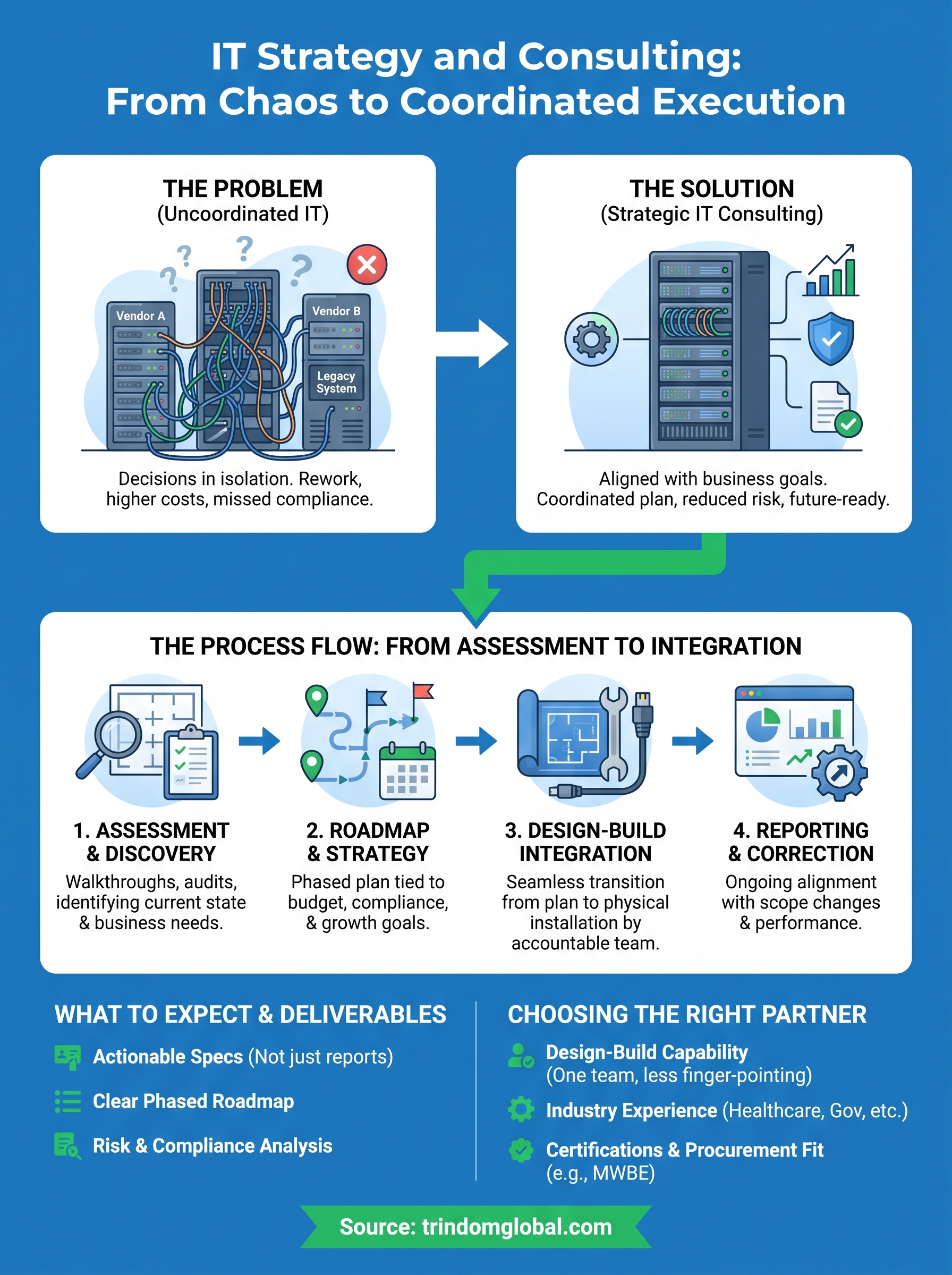
Most engagements follow a predictable arc, even though every site looks different once you’re standing in the network closet. IT strategy consulting starts with discovery, moves into design, and ends with a roadmap detailed enough that an installation crew can pick it up and execute without guessing. Knowing that sequence helps you set realistic expectations before you sign a contract.
Assessment comes before recommendations
Any consultant worth hiring starts by walking your facility, reviewing existing cabling and equipment, and asking hard questions about what’s actually being used versus what’s just installed. Skipping this step is the fastest way to end up with a plan built on assumptions instead of facts. A thorough assessment usually covers:
- Current network backbone capacity and age
- Existing vendor contracts and equipment warranties
- Compliance obligations tied to your industry
- Budget cycles and approved capital for the next 12 to 36 months
- Growth plans that will change bandwidth or space needs
A strategy built without a real site assessment is just a guess with a nice cover page.
Turning findings into a roadmap
Once the assessment is done, the consultant translates raw findings into a phased roadmap. This is where it consulting and strategy work separates itself from a generic audit report. Instead of a list of problems, you get a sequence: what gets fixed first, what gets bundled into the next capital cycle, and what can wait. Budget constraints, procurement timelines, and operational disruption all factor into that sequencing, especially in environments like hospitals where downtime isn’t an option.
Handing the plan to installation and integration
Afterward, the real test of a strategy is whether it survives contact with installers. A design-build approach keeps the same team, or at least the same accountability, from planning through installation, so nothing gets lost in translation between the consultant’s recommendations and the crew pulling cable. Consultants who also handle integration catch design flaws before they become change orders, because they’re the ones who have to make the plan work in the field.
Reporting and course correction
Finally, a good process includes checkpoints. Projects change scope, vendors slip timelines, and new compliance rules show up mid-build. Regular reporting keeps stakeholders aligned and gives you room to adjust the roadmap without abandoning the strategy behind it.
What to expect from an IT strategy consultant
Hiring an IT strategy consultant should feel less like bringing in an outside auditor and more like adding a technical partner who understands your budget cycle as well as your network diagram. Before you sign anything, you should know exactly what deliverables you’re paying for, how much access the consultant needs, and where their responsibility ends and your installation crew’s begins.
The deliverables you should actually receive
Good strategic it consulting services produce documents you can hand to a procurement officer, a facilities director, or a bidding vendor without translation. At minimum, expect:
- A current-state assessment of cabling, network backbone, and equipment condition
- A gap analysis tied to specific business or compliance goals
- A phased roadmap with rough timelines and budget ranges
- Vendor and equipment recommendations, not just brand names but specifications
- A risk section covering compliance exposure and procurement pitfalls
If a consultant can’t hand you a document a contractor could bid from, you haven’t gotten a strategy, you’ve gotten an opinion.
Access and cooperation the process requires
Assuming a consultant needs is unwise, so be ready to open doors, literally and figuratively. Expect requests for facility walkthroughs, network closet access, past vendor contracts, and honest answers about what equipment is actually failing versus what just looks outdated. Consultants working under it strategy and consulting engagements in regulated environments, hospitals especially, will also ask for compliance documentation upfront rather than discovering gaps mid-project. Withholding information here doesn’t protect you, it just delays the roadmap and increases the odds of a change order later.
Where the consultant’s job ends
Beyond, it matters to draw a clear line between strategy and execution. A consultant defines what needs to happen and in what order, but installation, cabling pulls, and integration are separate scopes of work, sometimes handled by the same firm, sometimes not. Clarify this before the contract is signed. Firms that offer both it consulting strategy and design-build installation under one roof tend to produce plans that survive the field, simply because the same team is accountable for both the paper plan and the physical result.
Timelines you can reasonably expect
Generally, a thorough assessment and roadmap for a mid-sized facility takes two to six weeks, depending on site complexity and how many stakeholders need to sign off. Rushed timelines usually mean a shallower assessment, which shows up later as gaps in the plan.
How to choose the right IT strategy consulting partner
Picking a consulting partner is where most of the value in it strategy and consulting gets won or lost. The wrong choice gives you a polished report and a handoff to installers who have never seen the plan before. The right choice gives you one accountable team from the first walkthrough to the final integration test.
Look for design-build capability, not just advice
Firms that stop at recommendations leave you to find installers, negotiate scope, and hope nothing gets lost in translation. A design-build approach keeps planning and execution under one roof, so the people writing the roadmap are the same people answerable for making it work in the field. Ask any prospective partner directly whether they install what they design or simply hand off a document and walk away.
The best test of a strategy firm is whether they’re still on the job once the cabling actually gets pulled.
Verify industry-specific experience
A firm that’s spent years on retail networks won’t automatically understand hospital compliance timelines or multifamily headend space constraints. Confirm the partner has handled projects in your sector, whether that’s medical equipment installation, RF and network work for hospitality, or ISP buildouts for residential campuses. Request references from similar projects, not just a general client list.
Check certifications and procurement fit
Government agencies and many corporate contracts require or prioritize vendors with specific certifications. If your procurement process favors minority and women-owned business enterprises, confirm that status upfront rather than discovering it’s missing after bids close. This single detail can determine whether a firm is even eligible to bid on your project.
Questions worth asking before you sign
- Do you handle installation and integration, or only strategy documents?
- Can you provide references from clients in our industry?
- Are you certified as an MWBE, and does that matter for our procurement rules?
- How do you structure vendor partnerships, and do we get to keep those relationships after the project?
- What happens if scope changes mid-project, and who absorbs that cost?
Weigh vendor relationships honestly
Strong strategic it consulting services come with established vendor partnerships that speed up procurement and often reduce equipment costs. Confirm those relationships are genuine and current, not a slide in a sales deck, by asking for recent examples of vendor-negotiated pricing or expedited lead times on real projects.
IT strategy consulting in action across industries
Abstractions only go so far, so here’s what it strategy and consulting looks like once it hits real facilities. Every sector Trindom Global works in has its own pressure points, and a consultant who’s actually done the work knows which details matter before the first cable gets pulled.
Healthcare: equipment that has to talk to the network
Hospitals need medical equipment installations that integrate with existing patient monitoring systems, not just plug into a wall outlet. A consultant reviewing a new imaging suite has to confirm the network backbone can carry the data load, that HIPAA-related access controls are built into the design, and that installation happens without shutting down a unit that can’t tolerate downtime. Qualified technicians and dedicated project management services are what separate a smooth rollout from a six-month scramble.
Commercial and hospitality: RF and network builds that scale
Hotels and commercial properties depend on RF and network installation that handles guest demand without dead zones or dropped connections. A strategy consultant maps coverage against building layout, projected occupancy, and future expansion, then sequences the buildout so guest-facing areas never go offline during construction. Get this wrong and you’re retrofitting access points after opening day, which costs more and annoys guests in the meantime.

The industries that benefit most from strategy work are the ones where downtime isn’t an option and retrofits are expensive.
Multifamily residential: bandwidth planning at scale
Property operators turn to multifamily high-speed ISP solutions, often delivered through Trintel, to plan headend space, backbone capacity, and resident bandwidth demand before a single unit is wired. Twenty-five years of ISP-specific experience matters here, because a campus-wide network built without room to grow becomes a bottleneck the moment resident expectations outpace the original design.
Government: procurement rules built into the plan
Agencies issuing RFPs need consultants who understand government projects requirements from day one, not vendors learning procurement rules mid-bid. Strategy work here means aligning technical specifications with RFP language, documenting MWBE status where it’s required, and building compliance checkpoints into the roadmap so a bid isn’t disqualified over a missed requirement.
| Industry | Primary strategy focus |
|---|---|
| Healthcare | Network capacity, HIPAA compliance, uptime |
| Commercial/hospitality | RF coverage, guest bandwidth, phased builds |
| Multifamily | Headend planning, ISP bandwidth scaling |
| Government | RFP alignment, MWBE certification, compliance |
Sectors differ, but the pattern holds everywhere: strategy built before procurement beats a plan bolted on after equipment already sits in a truck.
Where IT strategy meets execution
Good IT strategy and consulting work comes down to one test: does the plan survive contact with the field? Everything covered here, assessment, roadmap, vendor selection, procurement fit, exists to answer that question before money gets spent on equipment that doesn’t fit together. A roadmap that never gets installed is just paperwork, and installation without a roadmap is just guessing with expensive gear.
What separates a useful engagement from a wasted one is accountability that runs from the first walkthrough through the final integration test. When the same team plans and builds, gaps get caught before they become change orders, not after the cabling’s already behind drywall.
If your organization is staring down a network closet full of mismatched decisions, or a capital project that needs a plan before an RFP goes out, talk to Trindom Global about building a strategy your installers can actually execute.


