

Walk into any hospital, hotel, or apartment complex today and you’ll find miles of cable running behind walls and above ceilings that never touch a standard electrical outlet. That’s low voltage cabling, and if you’re planning a network buildout or trying to figure out what your contractor is quoting you for, you need to know what it actually does before you sign off on a design.
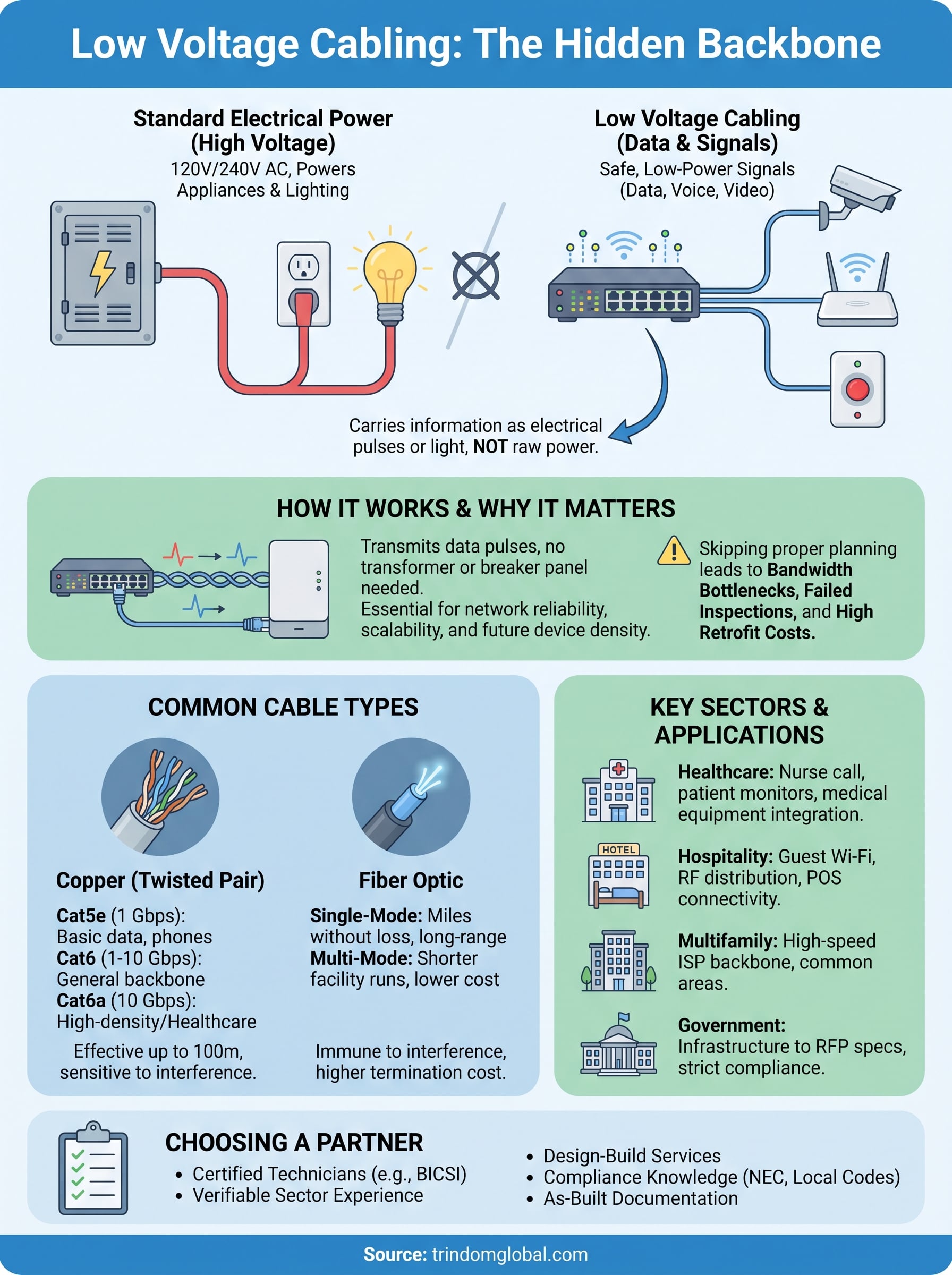
Low voltage cabling carries data and communication signals, not household power. It runs your network switches, security cameras, access control systems, nurse call stations, and TV headend equipment using safe, low-power signals instead of the 120 or 240 volts running your lights and outlets. That distinction changes everything about how it’s installed, coded, and inspected, which is exactly what causes headaches when the wrong crew handles it.
We’ve pulled cable through hospital ceilings, hotel corridors, and multifamily risers for years at Trindom Global, and we’ve seen what happens when this work is treated as an afterthought. This article breaks down what low voltage cabling actually is, how it works, the common cable types you’ll encounter, and where it shows up across commercial, healthcare, and residential infrastructure.
Why low voltage cabling matters for your building
Every device connected to your network, from a nurse call station to a hotel guest room TV, depends on a cabling backbone designed to handle its load. Get the design wrong and you’re not just dealing with a slow Wi-Fi signal, you’re looking at dropped security feeds, failed alerts, or a property that can’t support the bandwidth today’s guests and staff expect. Buildings wired even ten years ago often can’t handle current device density without a serious cabling overhaul, and that overhaul always costs more once walls and ceilings are already closed up.
A cabling plan that can’t scale with your building’s technology needs will cost you far more in emergency fixes than it would have cost to design correctly the first time.
The real cost of skipping the plan
Skipping proper planning shows up fast once a building opens for business. You’ll see technicians pulling extra cable runs after the fact, cutting into finished ceilings and walls that were never meant to be reopened. Common fallout includes:
- Bandwidth bottlenecks that throttle guest Wi-Fi or clinical data systems
- Failed inspections when cable runs don’t meet separation requirements from electrical conduit
- Retrofit costs that run two to three times higher than new construction pricing
Code compliance isn’t optional
Compliance sits at the center of why this work can’t be treated casually. The National Electrical Code, specifically Article 725, governs how low voltage circuits must be separated, supported, and terminated, and local jurisdictions layer on their own fire and building code requirements. A hospital or hotel that fails an inspection because of improperly rated cable or missing firestopping isn’t just delayed, it’s exposed to real liability. Getting this right from the start protects your building’s occupants, your timeline, and your budget.
How low voltage cabling works
Low voltage cabling moves information as electrical pulses instead of raw power. A network switch sends a signal through a copper pair or fiber strand at a fraction of the voltage running your outlets, and the receiving device (a camera, an access point, a nurse call panel) reads that pulse as data. No transformer or breaker panel stands between the source and the device the way it does with standard electrical wiring, because the signal was never meant to run appliances or lighting.
Signal transmission basics
Copper cable carries electrical signals, while fiber carries light pulses through a glass or plastic core. Distance and interference determine which one a technician specs for a given run:
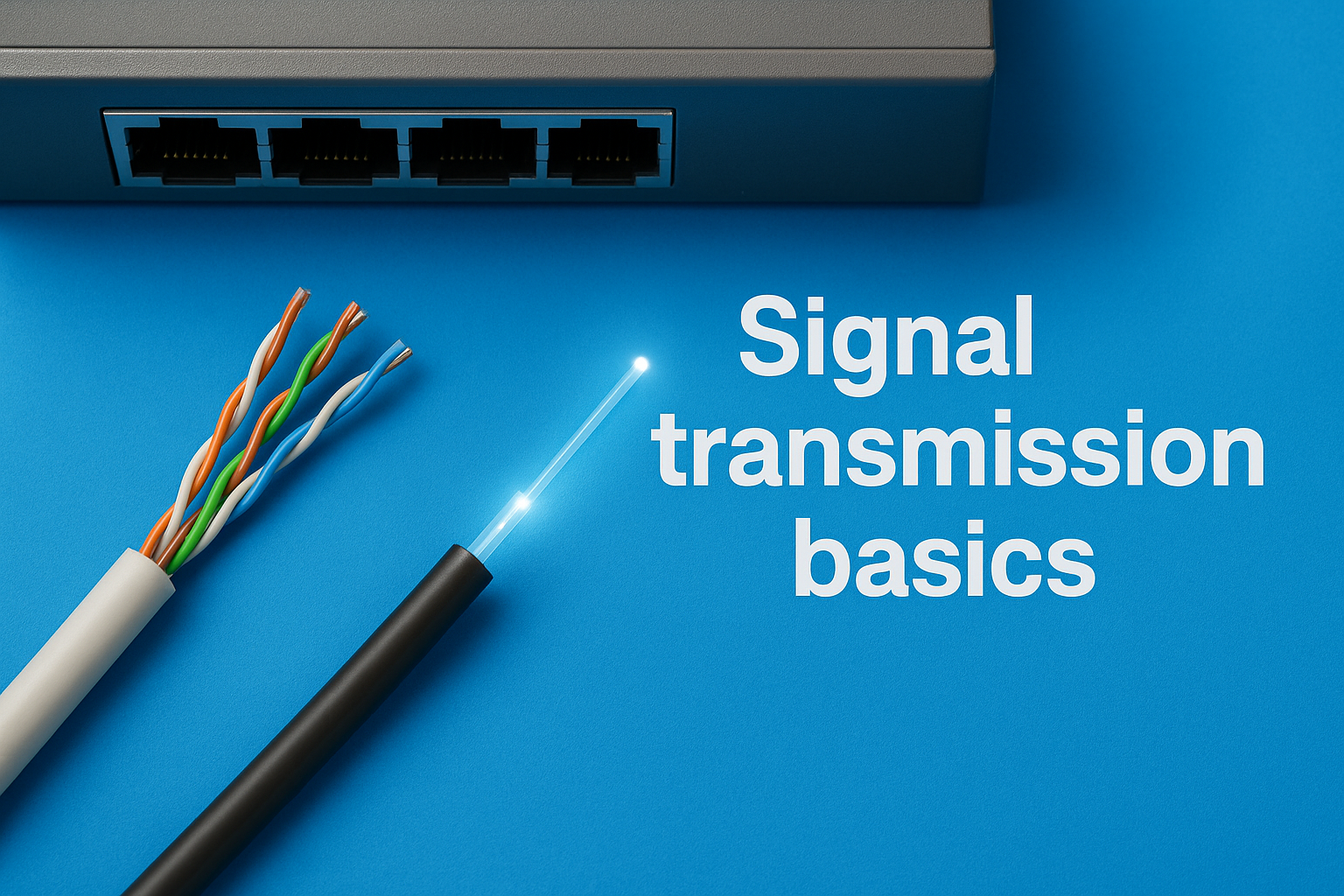
- Copper (twisted pair): effective up to 100 meters, sensitive to electromagnetic interference
- Fiber optic: runs miles without signal loss, immune to interference, costs more to terminate
The cable type you choose determines your building’s ceiling on speed and distance long before any device gets plugged in.
Power and data together
Many modern low voltage systems, like Power over Ethernet cameras, send both data and limited power through the same cable, cutting installation costs and points of failure.
Common types of low voltage cable
Contractors reach for a handful of standard cable types depending on the job, and picking the wrong one is one of the most common mistakes we see on older installs. Category-rated copper handles most data and voice runs, while fiber optic cable takes over when distance or interference makes copper impractical.
Copper cable categories
Each copper category supports a different bandwidth ceiling, so the spec sheet matters more than the price tag:
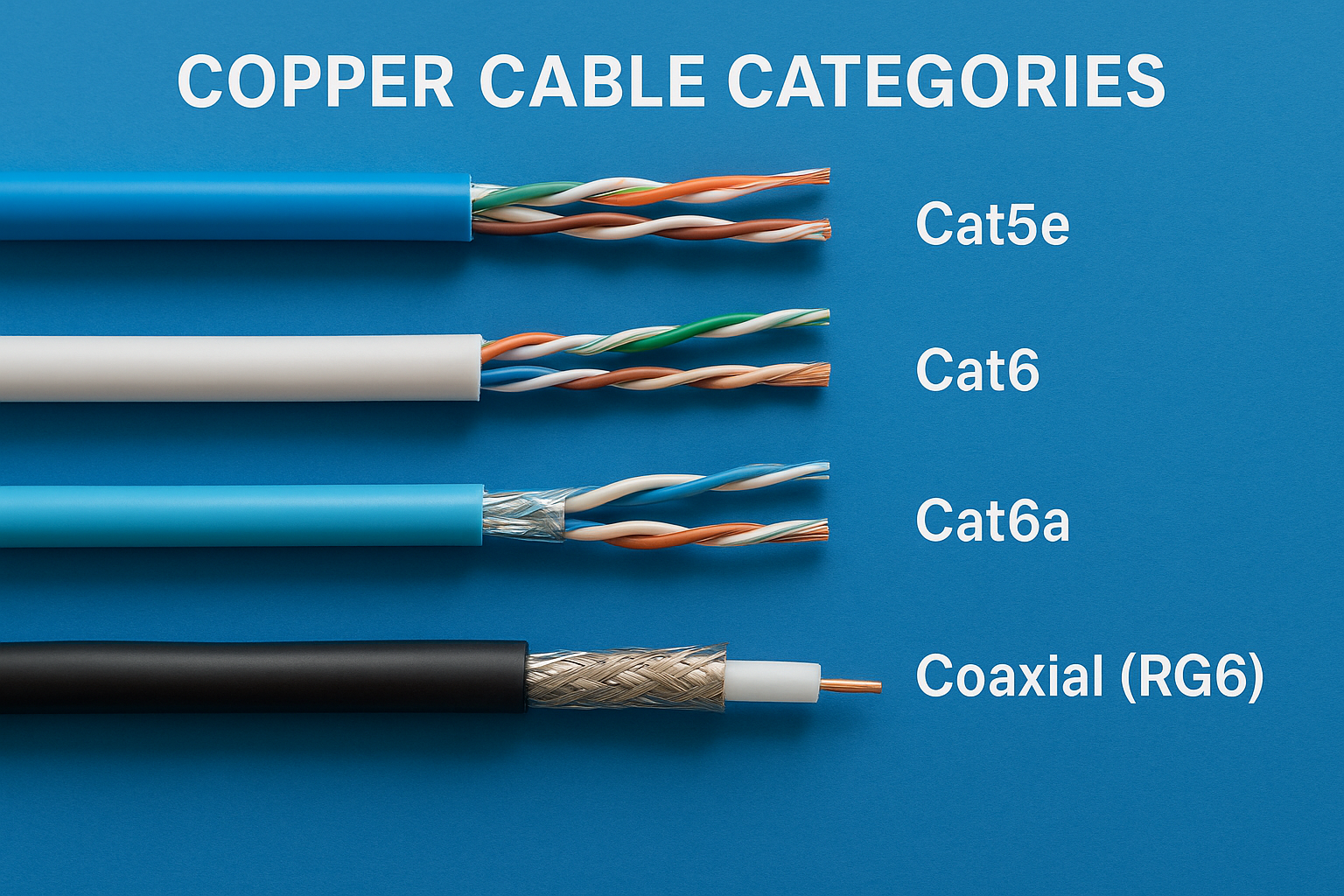
| Cable Type | Max Speed | Typical Use |
|---|---|---|
| Cat5e | 1 Gbps | Basic office data, phones |
| Cat6 | 1-10 Gbps (short runs) | General network backbone |
| Cat6a | 10 Gbps | High-density buildings, hospitals |
| Coaxial (RG6) | Varies | TV headend, CATV distribution |
Choosing a cable category by price instead of load requirements is how buildings end up rewiring within five years.
Fiber optic variants
Fiber comes in single-mode and multi-mode, and the choice depends entirely on distance. Single-mode fiber carries signals miles between buildings or risers, while multi-mode fiber handles shorter runs within a single facility at a lower installation cost.
Where low voltage cabling is used
Hospitals, hotels, apartment communities, and government buildings each lean on low voltage cabling for different reasons, but the underlying infrastructure looks remarkably similar once you’re behind the walls. Healthcare facilities run nurse call systems, patient monitors, and medical equipment integration over dedicated low voltage backbones that can’t tolerate downtime. Hospitality and commercial properties depend on it for guest Wi-Fi, RF distribution, and point-of-sale connectivity across every floor.
Wherever a building needs data, video, or voice to move reliably, low voltage cabling is doing the work behind the scenes.
Sector-specific applications
Different sectors demand different priorities from the same core technology:
- Healthcare: structured cabling for medical equipment, nurse call, and clinical data systems
- Hospitality: RF and network installation supporting guest devices and property management systems
- Multifamily housing: high-speed ISP backbone cabling across risers and common areas
- Government: infrastructure built to RFP specifications and procurement compliance standards
Government agencies in particular require documentation and vendor credentials that go beyond a standard commercial install, which is where certified experience becomes non-negotiable rather than a nice-to-have.
Choosing a low voltage cabling partner
Finding the right contractor for low voltage cabling comes down to credentials and track record, not just the lowest bid. A crew that’s never pulled cable through a live hospital corridor or a hotel occupied with paying guests will make mistakes that cost you downtime you can’t recover. Look for verifiable project history in your specific sector, whether that’s healthcare, hospitality, multifamily, or government work, because each of those environments has different access constraints and compliance demands.
The lowest bid on a cabling project almost never turns out to be the cheapest one once change orders start.
Questions to ask before you sign
Run any potential partner through a short checklist before committing to a scope of work:
- Do they carry BICSI-certified technicians or equivalent industry credentials?
- Can they provide references from projects in your building type?
- Do they offer design-build services, or just installation?
- Are they registered as an MWBE if your procurement process requires it?
- Will they document as-built drawings and test results at project close?
At Trindom Global, we’ve built our process around answering yes to every one of those questions, because a cabling partner who can’t clear that bar shouldn’t be behind your walls in the first place.
Bringing it all together
Low voltage cabling is the backbone behind every network, camera, and clinical device in your building, even though it never touches a standard outlet. Getting the design right up front, choosing the correct cable category, and hiring a crew that understands your sector’s compliance demands saves you from the retrofit costs and failed inspections we talked about earlier. Skipping that step doesn’t just slow down your project, it puts your budget and your building’s occupants at risk once walls close up around the wrong install.
Hospitals, hotels, multifamily properties, and government facilities all depend on the same core principle: a cabling backbone built to scale, not patched together after the fact. If you’re planning a buildout or upgrade and want a team that’s already proven itself in your building type, talk to Trindom Global about your project before the first cable gets pulled.


