

Certification paperwork takes time, and you want to know it pays off before you commit to it. Minority business enterprise benefits show up in real ways: access to set-aside government contracts, entry into corporate supplier diversity programs, and dedicated growth resources that non-certified competitors simply cannot tap into. If you’re weighing the application against your current workload, you need specifics, not vague promises.
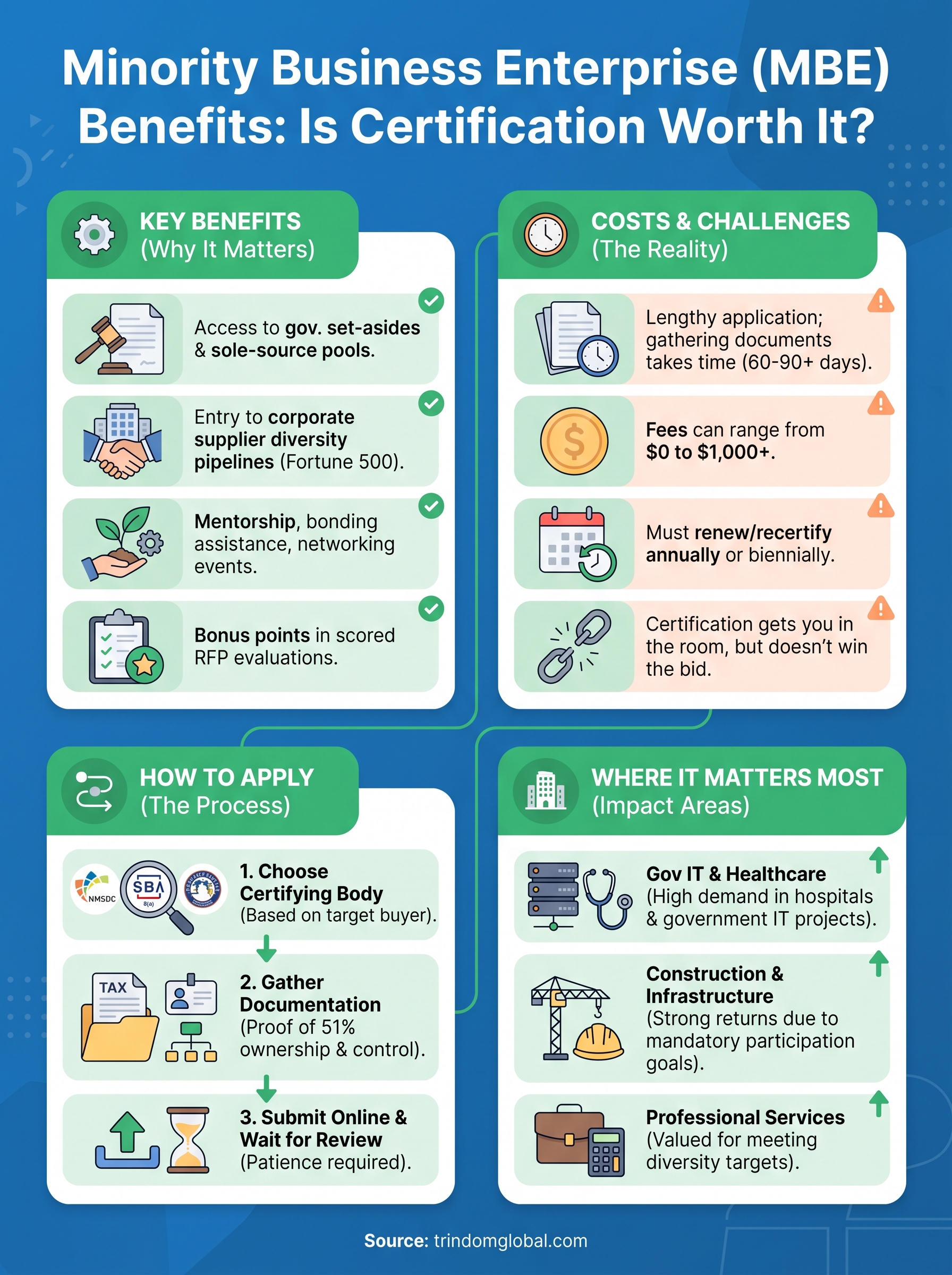
The short answer is that certification opens doors that stay closed to unregistered businesses. Federal and state agencies set aside a percentage of contracts for MBE-certified firms, and Fortune 500 companies run supplier diversity programs that actively seek out certified vendors for their procurement pipelines. Certification also unlocks mentorship programs, bonding assistance, and networking events built specifically for minority-owned firms.
We’ve built our own business, Trindom Global, as a certified minority and women-owned enterprise, and we compete for government IT contracts and hospital projects using that status daily. This article breaks down exactly what certification gets you, what it costs in time and paperwork, and how to decide if it’s worth pursuing for your business.
Why minority business enterprise certification matters
Certification changes who invites you to the table before you even bid. Federal agencies operate under a statutory goal of awarding at least 23% of prime contracting dollars to small disadvantaged businesses, and many of those set-asides specifically require MBE status. State and municipal governments run parallel programs, often layering on additional percentage targets for construction, IT, and professional services. Without certification, you’re bidding in the open pool against every contractor in the country. With it, you’re competing in a smaller, targeted pool where your minority ownership counts as a qualification, not just a footnote.
Government set-aside contracts
Government procurement officers track diversity spending the way sales teams track quota. That means your certified status becomes a line item they need to fill, not a favor they’re doing you. Trindom Global has won hospital infrastructure and IT installation work specifically because our MWBE status matched a diversity spending goal buried in the RFP requirements. Here’s what typically opens up once you’re certified:

- Access to sole-source and set-aside contract pools at federal, state, and local levels
- Priority consideration in scored RFP evaluations that award points for diversity status
- Eligibility for programs like the SBA’s 8(a) Business Development Program for further contracting advantages
- Inclusion in agency supplier databases that procurement teams search directly
Certification turns your minority ownership from a background fact into a scored advantage on every government bid you submit.
Corporate supplier diversity programs
Large corporations run their own version of set-asides, usually through formal supplier diversity programs tied to executive-level spending targets. Companies like Microsoft and Amazon publish supplier diversity commitments and actively recruit certified minority-owned vendors into their procurement pipelines, because their own corporate reporting depends on it. Getting certified means your business shows up in the databases these procurement teams search when they need to hit their diversity numbers, which puts you in contention for work you’d never see through a cold outreach email.
Growth resources beyond the contracts
Beyond contracts, certification unlocks resources that compound over time. Bonding assistance programs help you qualify for larger jobs you couldn’t bond on your own. Mentorship programs pair you with established firms or corporate buyers who walk you through their procurement process. Regional and national minority business councils host matchmaking events where certified firms meet actual buyers face to face, not through a submission portal. None of this shows up on a balance sheet immediately, but it builds the relationships that generate repeat work for years after your first certified contract closes.
How to apply for minority business enterprise certification
Applying for minority business enterprise certification takes patience more than difficulty. You’re proving ownership, control, and day-to-day management by a minority individual, usually at least 51%, through legal documents rather than a simple checkbox. Trindom Global went through this process with the National Minority Supplier Development Council, and the paperwork review took roughly 90 days from submission to approval letter.
Choose the right certifying body
Picking the right agency matters because each one opens different doors. NMSDC certification gets you into corporate supplier diversity databases, while SBA certification through the 8(a) program targets federal contracting specifically. State and local governments often run their own MBE registries too, and you may need more than one certification depending on who you want to bid for.
| Certifying body | Best for | Typical timeline |
|---|---|---|
| NMSDC | Corporate procurement, Fortune 500 vendors | 60-90 days |
| SBA 8(a) | Federal government contracts | Up to 90 days |
| State/local MBE registries | State and municipal RFPs | 30-60 days |
Pick your certifying body based on who actually buys what you sell, not on which application looks shortest.
Gather documentation and submit
Documentation is where most applications stall, so build your file before you start the online portal. Reviewers want proof of ownership percentage, control of daily operations, and business legitimacy, not just a signed affidavit.
- Articles of incorporation or organization
- Proof of citizenship or permanent residency for the minority owner
- Personal financial statements and tax returns
- Business licenses and resumes showing operational control
- Site visit availability, since most agencies require one
Submit everything together rather than piecemeal. Incomplete files get bounced back and restart your clock.
Weighing the costs and challenges of certification
Certification isn’t free, and pretending otherwise sets you up for disappointment. Application fees run anywhere from a few hundred dollars for a state MBE registry up to $1,000 or more for NMSDC certification, depending on your regional council. Add the hours your team spends pulling financial statements, tax returns, and operating agreements together, and you’re looking at a real cost before you win a single contract. Budget for it like you would any other business investment, not a formality.
Annual renewal and recertification
Renewal is where certified businesses get caught off guard. Most certifying bodies require annual or biennial recertification, which means resubmitting financial documents and sometimes hosting another site visit. Miss a deadline and your certification lapses, which can knock you out of active bid pools without warning. Set a calendar reminder the day you get approved, not the month before renewal is due.
Certification isn’t a one-time badge, it’s a recurring commitment you have to maintain to keep the advantages it unlocks.
Certification doesn’t guarantee contracts
Certification gets you into the room, but it doesn’t win the bid for you. Procurement teams still evaluate price, capability, and past performance alongside diversity status, so you need a competitive proposal regardless of your MBE status. Trindom Global has lost bids to certified competitors who simply priced better or had stronger references, and that’s the reality every certified firm faces.
Deciding whether the effort pays off depends on your industry and target buyers. Here’s a quick gut check:
- If you sell to government agencies or Fortune 500 companies, the fees and paperwork usually pay for themselves within one or two contracts.
- If your buyers are mostly small local businesses without formal diversity programs, the return takes longer to materialize.
- If you lack the staff time to manage renewals, factor that ongoing cost into your decision before applying.
Where MBE certification makes the biggest difference
Certification pays off unevenly across industries, so knowing where it lands hardest helps you set expectations. Construction, IT infrastructure, and professional services see the strongest returns because government agencies and hospitals track diversity spending closely in these categories, and RFPs in these sectors often score MBE status directly. Retail and consumer-facing businesses without a government or corporate buyer see far less lift, since there’s no formal procurement process rewarding certified status.
Healthcare and government IT projects
Hospitals and government agencies run some of the most active diversity spending programs in the country, and IT infrastructure work sits right in the middle of it. Trindom Global has landed medical equipment installation and structured cabling projects specifically because our MWBE status filled a diversity requirement written into the bid documents. Healthcare systems in particular face pressure from their own boards and regulators to hit supplier diversity targets, which makes certified vendors a priority search when procurement teams build their shortlist.
The industries with the most formal procurement structure are exactly where MBE certification delivers the clearest return.
Construction and infrastructure work
Construction contracts, especially publicly funded ones, almost always carry a minority participation goal written into the bid specifications. General contractors bidding on public projects need certified subcontractors to satisfy those goals, which means your certification becomes something other companies actively seek out rather than something you have to pitch. This dynamic repeats across highway projects, school construction, and municipal building work nationwide.

Multifamily and hospitality sectors
Property operators and hospitality businesses see a different kind of benefit. Fewer formal set-asides exist here, but corporate ownership groups increasingly track supplier diversity across their vendor list for ESG reporting purposes. If you install RF systems, network infrastructure, or ISP services for multifamily campuses, certification helps you get considered by ownership groups that publish annual diversity spending numbers, even without a government mandate driving the decision.
Deciding if certification is right for your business
Certification rewards businesses that sell into structured procurement processes, and it does little for those that don’t. If your buyers include government agencies, hospitals, or large corporations running supplier diversity programs, the paperwork and fees pay for themselves once you land your first set-aside contract. If your customer base skips formal procurement entirely, the return takes longer and may not justify the renewal work.
Weigh your industry, your target buyers, and your staff’s capacity to manage recertification before you apply. Minority business enterprise benefits are real, but they favor businesses positioned to use them, not businesses hoping certification alone will generate demand.
We built Trindom Global around this exact strategy, competing for government and healthcare IT contracts using our certified MWBE status every day. If you’re planning an infrastructure project and want a certified partner who knows how to navigate these procurement channels, get in touch with Trindom Global to talk through your next build.


