

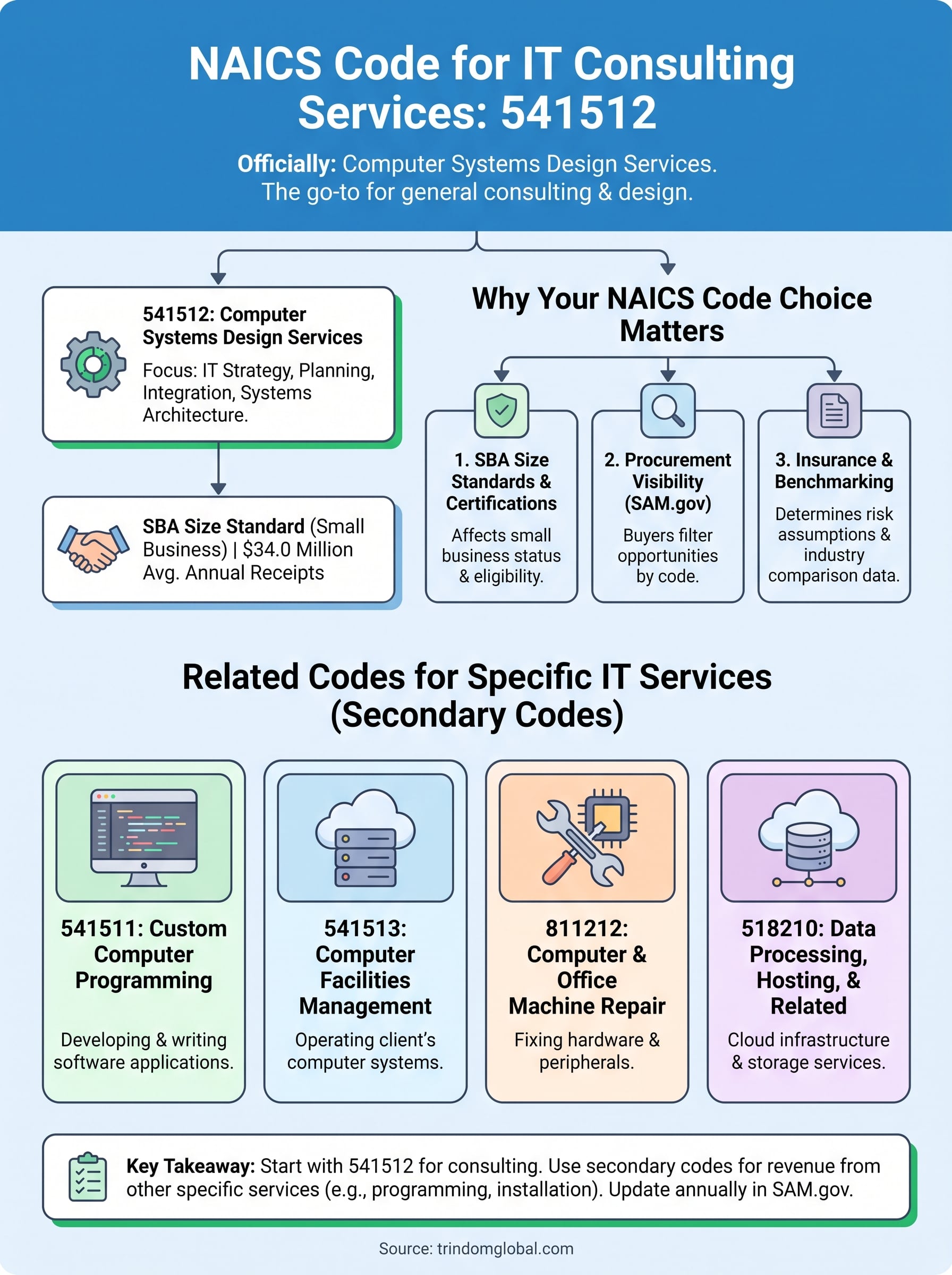
If you’re registering a business, bidding on a government contract, or filling out a SAM.gov profile, you need the right code fast. The naics code for it consulting services is 541512, officially labeled "Computer Systems Design Services," and it’s the one most firms delivering IT consulting and services end up using. But that number rarely tells the whole story, since IT work often spans multiple classifications depending on what you actually deliver.
So what is the naics code for it consulting services when your work overlaps with software, staffing, or hardware installation? The short answer: 541512 covers general systems design and consulting, but you may need a secondary code if you also handle custom programming, facilities management, or network installation. Getting this distinction right matters for SBA certifications, RFP eligibility, and even how procurement officers evaluate your capabilities statement.
In this article, we’ll break down 541512 in detail, cover the related NAICS codes for IT services you might also need, and explain how to choose correctly when your business does more than pure consulting. This matters directly to us at Trindom Global, since we work with government agencies and healthcare systems that scrutinize these classifications closely during procurement.
Why your NAICS code choice matters for IT consulting
Most business owners treat NAICS selection like a formality, something you type into a form once and never think about again. That’s a mistake if you’re chasing government work or trying to qualify for small business set-asides. The code you pick determines your SBA size standard, which sets the revenue or employee cap you can’t exceed while still counting as a "small business" for a given contract. Pick wrong, and you could either disqualify yourself from opportunities you’d otherwise win or, worse, misrepresent your size and risk a protest that unravels an award after the fact.

Size standards vary by code, and the differences matter more than people expect. Here’s how the common IT classifications compare:
| NAICS Code | Description | SBA Size Standard |
|---|---|---|
| 541512 | Computer Systems Design Services | $34.0 million average annual receipts |
| 541511 | Custom Computer Programming Services | $34.0 million average annual receipts |
| 541513 | Computer Facilities Management Services | $34.0 million average annual receipts |
| 541519 | Other Computer Related Services | $34.0 million average annual receipts |
| 541990 | All Other Professional, Scientific, and Technical Services | $19.5 million average annual receipts |
These figures shift periodically, so always confirm current thresholds on the SBA’s table of size standards before you certify anything.
Procurement officers use your code to filter opportunities
Government buyers search SAM.gov by NAICS code when they’re identifying potential bidders for a solicitation. If your registration lists 541990 instead of 541512, you might never show up in the search results for an IT consulting RFP, even if you’re perfectly qualified to do the work. This is one of the most common reasons small, capable firms get overlooked during outreach and market research phases, long before a solicitation is even posted.
The wrong NAICS code doesn’t just mislabel your business, it can make you invisible to the contracts you’re best suited to win.
Your code affects certifications and set-aside eligibility
For firms pursuing MWBE or 8(a) certification, the primary NAICS code you register under often becomes the anchor for what work you’re allowed to bid as a certified small business. Certifying agencies and prime contractors alike cross-reference your listed codes against the solicitation’s requirements, which is a big part of winning contracts as a minority-owned business. A mismatch can slow down certification renewals or, in some cases, get a bid thrown out on a technicality that has nothing to do with your actual capability to perform the work.
Taxes, insurance, and industry benchmarking also depend on it
Beyond contracting, your NAICS code shows up in places you might not expect. Insurance carriers use it to price liability coverage, since a firm classified under network installation carries different risk assumptions than one classified as pure consulting. The Census Bureau and Bureau of Labor Statistics use these codes to publish industry benchmarks, meaning your comparative data, average revenue per employee, wage surveys, growth trends, all gets pulled from whichever bucket you’re sitting in. If your code doesn’t reflect what you actually do, you’re comparing yourself against the wrong peer group, which can skew everything from loan applications to internal planning decisions.
How to choose the correct NAICS code for your business
Start by looking at where your revenue actually comes from, not what your business card says. If most of your billing comes from designing, planning, and integrating computer systems for clients, 541512 is almost certainly your primary code. But if a meaningful chunk of your revenue comes from writing custom software, managing a client’s IT facility, or installing network hardware, you’re likely looking at a secondary code, and possibly a different primary one depending on the split.
Ask what the client is actually paying you for
Picture two contracts. In the first, a hospital hires you to assess its network architecture and recommend a systems overhaul, that’s network consulting and design, squarely 541512. In the second, that same hospital hires you to pull cable, mount headend equipment, and physically install the network cabling you designed, that’s closer to construction or specialty trade contractor codes, not IT consulting at all. Trindom Global runs into this distinction constantly, since our work often spans both the design phase and the physical installation, which means we track revenue separately by activity type to keep our classifications accurate.
Use a simple decision checklist
Work through these questions before you commit to a code:
- Does the majority of your revenue come from advising, designing, or planning IT systems? If yes, start with 541512.
- Do you write or customize software as a standalone deliverable? Consider 541511 as a secondary code.
- Do you manage or operate a client’s computer facilities on an ongoing basis? Look at 541513.
- Do you install physical cabling, RF equipment, or network hardware as your main service? You may need a construction or telecom-related code instead.
- Does more than one of these apply in roughly equal measure? Register multiple codes and designate the one generating the most revenue as primary.
Following this order keeps your SAM.gov profile aligned with your actual capabilities statement, which matters when a contracting officer is scanning bidders for a specific scope of work.
Your primary NAICS code should match where most of your invoices come from, not where you’d like your business to grow someday.
Government contractors especially should revisit this decision annually. Revenue mixes shift, new service lines get added, and a code that fit two years ago might no longer reflect your business. SAM.gov allows updates, so there’s no reason to carry an outdated classification into a bid where it could work against you.
Related and alternative NAICS codes for IT services
Beyond the core 541512-541519 family, several other codes come up constantly for firms doing IT work, especially when your services stretch into hosting, telecom, or hardware support. Knowing these alternatives helps you answer the broader question of the naics code for it services and it consulting, and it helps to be clear on the difference between IT services and IT consulting, since "IT consulting" rarely lives in a vacuum on a real invoice.

Codes for data, hosting, and infrastructure work
Data centers and hosting providers typically fall under 518210, Data Processing, Hosting, and Related Services, which covers firms that provide computing infrastructure or storage as a service rather than advising clients on system design. This code matters if you resell cloud capacity, run colocation space, or manage backup and disaster recovery for clients on a subscription basis. Firms doing structured cabling installation work, headend buildout, or RF installation, work Trindom Global handles regularly for hospitality and healthcare clients, often need a telecommunications construction code like 517311 or a specialty trade contractor code instead of an IT services code, since the SBA and Census Bureau classify physical installation differently from advisory work.
If you’re getting paid to build or host infrastructure rather than design it, you’re probably in the wrong code family entirely.
Codes for equipment repair, security, and staffing
Another commonly missed classification is 811212, Computer and Office Machine Repair and Maintenance, which applies if a chunk of your revenue comes from fixing hardware rather than designing systems around it. Security-focused consultants sometimes register under 561621, Security Systems Services, particularly when access control or surveillance integration is a major line item. Staffing firms that place IT contractors with client organizations generally belong under 561330, Professional Employer Organizations, not any of the 541-series codes, since the nature of the service, supplying labor versus delivering a technical solution, is what the code is meant to capture.
Selecting from this wider set isn’t about hedging your bets. It’s about making sure a contracting officer or insurance underwriter sees an accurate picture of what you actually bill for. Layering in one or two of these alongside 541512 gives your SAM.gov profile the range it needs without diluting your primary classification, which should still reflect your biggest revenue driver.
Using multiple NAICS codes for government contracts
Registering on SAM.gov as a government vendor lets you list up to ten NAICS codes on a single business profile, and most established IT contractors use several. Registering multiple codes isn’t a workaround or a gray-area tactic, it’s how the system is designed to work when a business genuinely delivers more than one type of service. Trindom Global lists codes covering design-build contracting, structured cabling, and equipment installation, since a single hospital project can touch all three in one contract.
Understanding how the primary code functions matters more than the total number you register. Your primary NAICS code is the one tied to your SBA size standard certification and the one contracting officers weigh most heavily when checking your eligibility for a specific set-aside. Secondary codes signal additional capabilities but don’t carry the same certification weight, so listing ten codes doesn’t help you if the one tied to the solicitation isn’t your primary. Contracting officers pull bidder lists by matching the NAICS code on the solicitation to registered businesses, and they generally expect your primary code, not a buried secondary one, to align with the scope of work.
Registering more codes only helps if the one that matters for a given bid is the one procurement officers actually see first.
Teams bidding across multiple contract types benefit from a deliberate approach rather than registering everything that seems loosely relevant. Consider this order when building out your SAM.gov profile:
- Identify your single largest revenue-generating service and register that as your primary code, typically 541512 for consulting-heavy firms.
- Add secondary codes for services that generate meaningful revenue but aren’t your main line, such as 541511 for custom programming or 517311 for telecom construction.
- Skip codes for services you perform occasionally or as a favor to existing clients, since these dilute your profile without adding real bid opportunities.
- Review your code list annually, especially after adding a service line or losing one.
Verifying eligibility becomes especially important once you’re pursuing 8(a), HUBZone, set-aside contracts for women-owned firms, or other socioeconomic set-aside programs, since these programs certify you against your primary code’s size standard specifically. A firm certified under 541512 that suddenly wins most of its revenue from facilities management under 541513 could find its certification questioned at recertification time. Keeping your primary code current, and adjusting it the moment your revenue mix shifts, protects both your bid eligibility and your standing with certifying agencies like the SBA.
Getting your classification right from the start
Getting your NAICS code right isn’t paperwork you handle once and forget. It’s a decision that follows you into every SAM.gov search, every certification renewal, and every insurance quote you request. Start with 541512 if consulting and design drive most of your revenue, layer in secondary codes as your service mix demands, and revisit the whole list annually rather than letting it go stale. Businesses that treat this classification as a living part of their operations, not a box checked at formation, show up correctly for the contracts they’re actually built to win.
Trindom Global works through exactly this kind of classification complexity every day, spanning design-build consulting, structured cabling, and equipment installation across healthcare and government projects. If you’re navigating a similar mix of services and want a partner who understands how procurement officers actually read these codes, see what Trindom Global delivers across consulting, cabling, and installation and reach out to talk through your next project.


