

You typed "network cabling services near me" into Google because something needs to get fixed or built, and you need it done by people who actually show up on time and know what they’re doing. Maybe it’s a new office buildout, a hospital wing that needs data drops, or a hospitality property with dead Wi-Fi zones. Whatever the reason, a bad cabling job costs you months of headaches later, so picking the right contractor matters more than most people realize.
The short answer: you want a licensed, insured contractor with real project management experience, not just a guy with a punch-down tool. Look for a team that handles structured cabling design and installation, understands headend buildout, and can integrate with your existing network without downtime.
This article breaks down exactly who qualifies as a legitimate network cabling provider, what questions to ask before you sign a contract, and why certifications and vendor partnerships matter more than a low bid. We’ll also cover specialized situations, like healthcare facilities and multifamily properties, where standard cabling crews often fall short.
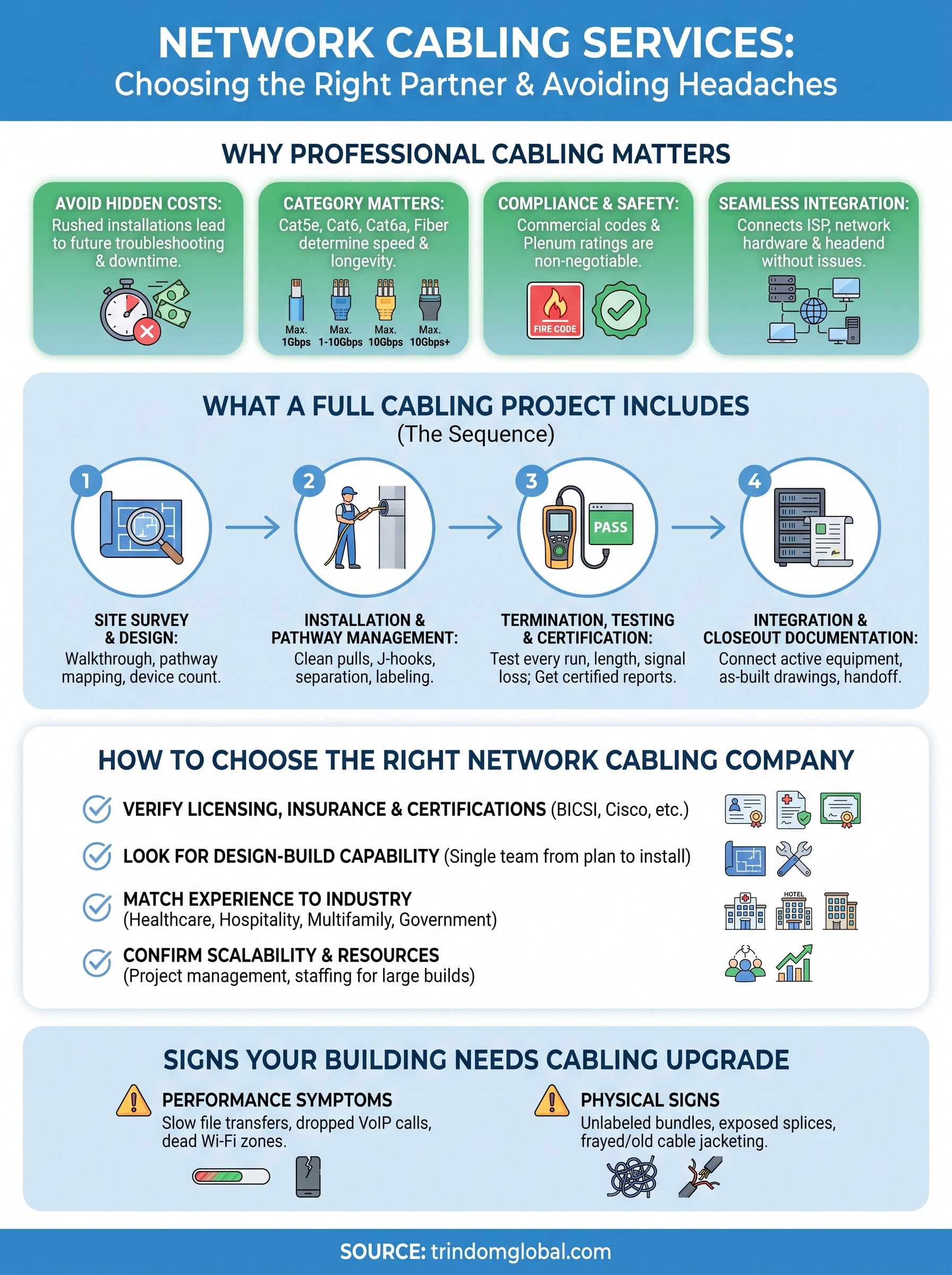
Why professional network cabling services matter
Bad cabling doesn’t announce itself right away. It shows up three months later as intermittent dropouts, a VoIP system that cuts out during calls, or a hospital monitor that loses connection at the worst possible moment. Structured cabling is the nervous system of any building, and when it’s installed wrong, every device that plugs into it inherits the problem. That’s why searching for network cabling services near me should lead you to a contractor who treats cabling as infrastructure, not an afterthought tacked onto a construction punch list, and it helps to know what network cabling services include before you call.
The hidden costs of a rushed installation
Corners cut during installation rarely show up on the invoice, they show up in your operating budget for years afterward. Poor cable management, mismatched connectors, and untested runs create failure points that are expensive to trace once walls are closed and ceilings are tiled. A technician who skips proper labeling might save two hours on install day, but that shortcut can cost your IT team a full afternoon every time they need to troubleshoot a dead port. Certified installation crews test every run before they leave the site, which means problems get caught when a wall is still open, not six months later when you’re paying overtime rates for an emergency fix.
A cabling job that passes inspection but fails under real load isn’t finished, it’s a problem with a delay timer.
Category matters more than most people think
Not all cable is created equal, and the data cable types and standards you install today determine what your network can handle for the next decade. This is one area where a professional cabling company earns its fee, because they’re speccing cable for your actual bandwidth needs, not just whatever’s cheapest at the supply house.

| Cable Type | Max Speed | Typical Use Case | Recommended For |
|---|---|---|---|
| Cat5e | 1 Gbps | Basic office networks | Small offices, low-density buildouts |
| Cat6 | 1-10 Gbps (limited distance) | Standard commercial buildings | Most modern offices, retail |
| Cat6a | 10 Gbps | High-density, high-throughput environments | Hospitals, data centers, hospitality |
| Fiber (single/multi-mode) | 10 Gbps+ | Backbone and long-distance runs | Headend buildouts, campus networks |
A contractor who defaults to Cat5e because it’s cheaper without asking about your growth plans isn’t doing you a favor. Ask what category they recommend and why, and expect a real answer tied to your device count and bandwidth needs, not just a price point.
Compliance and safety aren’t optional in commercial settings
Commercial buildings, and especially healthcare facilities, operate under codes that a residential handyman never has to think about. Plenum-rated cable is required in air handling spaces to prevent toxic smoke in a fire, and fire codes vary by jurisdiction and building type, which is exactly what cabling installation standards and codes spell out. Skipping this isn’t a minor oversight, it’s a liability that can shut down an inspection and delay your project by weeks. Licensed cabling contractors know these requirements because they’ve navigated them before, and they document their work in a way that survives an inspector’s scrutiny.
Hospitals add another layer entirely. Hospital medical equipment installation work often requires coordination with infection control protocols, interference-free RF zones near diagnostic equipment, and uptime guarantees that a standard office job never has to meet. Trindom Global’s work in hospital environments reflects this reality: qualified technicians and dedicated project management aren’t a luxury add-on there, they’re the baseline requirement.
Integration is where amateur crews fall apart
A cabling job rarely exists in isolation. It has to integrate with your existing network hardware, your ISP’s demarcation point, and whatever headend equipment handles your telecom and TV distribution. Reliable installers plan for this integration from day one, coordinating with your IT staff or managed service provider so the cutover happens without taking your building offline. That kind of coordination separates a professional network cabling company from someone who’s just good with a crimping tool. It’s the difference between a network that works on installation day and one that keeps working three years later when your business has doubled its device count.
How to choose the right network cabling company near you
Finding a local network cabling contractor takes more effort than scrolling through the first page of search results, whether you’re comparing low voltage cabling companies near me or national integrators. Anyone can slap "structured cabling" on a website, so compare structured cabling installation company picks and demand proof they’ve done the work in buildings like yours, whether that’s a hospital wing, a hotel, or a government office. Start by asking for references from projects similar in scope and industry, then actually call those references instead of just skimming testimonials on a landing page.
Verify licensing, insurance, and certifications
Before anything else, confirm the company carries proper licensing and liability insurance for commercial work in your state. Certifications from manufacturers like BICSI, Cisco, or Corning matter too, since they signal the crew has been trained on current standards rather than winging it based on habits from a decade ago. A contractor who hesitates to produce this paperwork isn’t someone you want running cable behind your walls.
If a contractor can’t produce license and insurance documents on request, don’t hire them.
Look for design-build capability, not just installation
Beyond installation, ask whether the company offers design-build consultation, the way design-build contractors near you operate, or if they only show up once someone else has already drawn the plans. A design-build model means the same team that plans your headend layout also pulls the cable and terminates the ports, which cuts down on finger-pointing when something doesn’t line up. Trindom Global structures projects this way specifically because handoffs between separate designers and installers create gaps where problems hide.
Match their experience to your industry
Healthcare, hospitality, multifamily housing, and government work each carry different rules, timelines, and inspection standards. A crew that’s great at wiring apartment buildings might struggle with the infection control protocols required in a hospital corridor. Ask directly: how many projects have you completed in my specific industry in the last two years? Vague answers here are a red flag.
Confirm they can scale with your project
Small crews sometimes overpromise on timeline because they don’t have the labor to run multiple work areas at once. A company with real project management resources can staff up for a large buildout without falling behind schedule. Before signing anything, run through this quick checklist:
- Do they carry current liability insurance and workers’ comp coverage?
- Can they provide three references from similar projects?
- Do they offer design-build services or only installation?
- Have they worked in your specific building type before?
- Do they test and document every cable run before project close-out?
Questioning a contractor this way up front saves you from discovering gaps in their capability halfway through a project, when switching teams gets expensive and delays your timeline even further.
What a full network cabling project typically includes
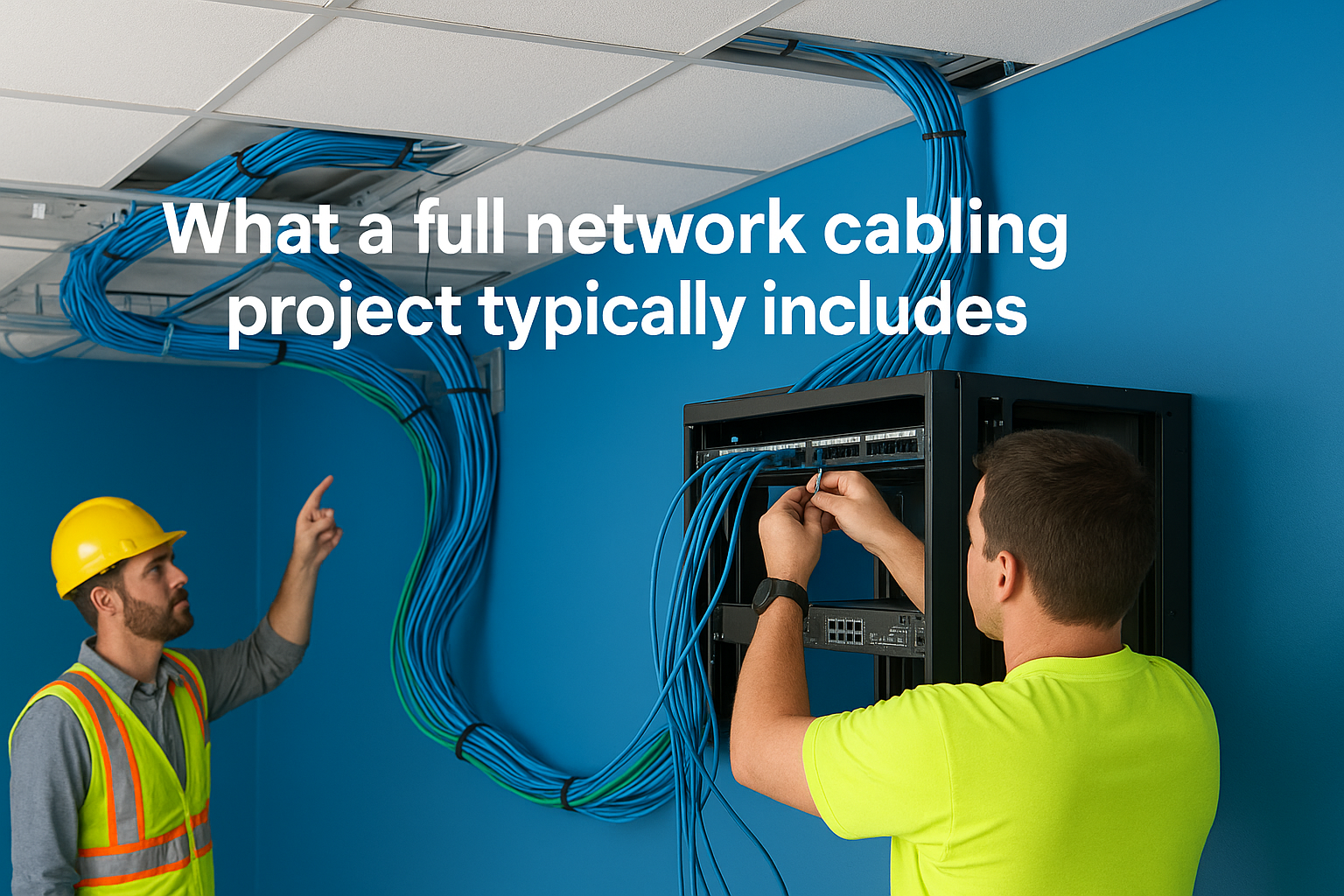
A legitimate cabling project moves through distinct phases, and skipping any one of them is how buildings end up with mystery dead ports two years down the road. Knowing these stages helps you evaluate a proposal and catch a contractor who’s trying to shortcut the process to win a low bid. Structured cabling installation isn’t just running wire from point A to point B, it’s a sequence of planning, execution, and verification that determines whether your network performs on day one and still performs on day one thousand.
Site survey and design
Every serious project starts with a walkthrough and a structured cabling design plan, not a quote pulled from a floor plan sent over email. A technician needs to see your ceiling space, identify where conduit already exists, and map out where telecom rooms and equipment racks will live. This is also when a cabling company should be asking about your device count, growth plans, and whether you need PoE for cameras or access points, since that changes the cable gauge and switch capacity required. Skipping this step is how you end up with runs that are too short, pathways that violate fire code, or a headend location nobody can actually service.
Cable installation and pathway management
Once the design is locked, crews pull cable through the pathways they mapped, following best practices for clean cable pulls with proper support systems like J-hooks or cable tray rather than draping wire over ceiling grid. Good installers separate data, power, and low-voltage runs to avoid interference, and they follow cable labeling best practices by marking every cable at both ends as it goes in, not as an afterthought before closeout. This phase is where most local cabling technicians either earn their reputation or lose it, since sloppy pulls here create problems that are invisible until someone opens a wall months later.
Termination, testing, and certification
Every run gets terminated at a patch panel and an outlet, then tested with a certification tool that checks for length, wire map errors, and signal loss against the telecommunications cabling standards for that category.
A cable that’s never been tested with a certification tool isn’t installed, it’s just plugged in.
A contractor should hand you a printed or digital test report for every single run, not a verbal assurance that "it all works." This documentation matters later if you ever need warranty support or have to troubleshoot a failure.
Integration and closeout documentation
The final phase covers connecting cabling to active equipment, whether that’s your switches, your ISP’s demarc, or headend gear for TV distribution, followed by as-built drawings that show exactly where every cable runs. A full project typically includes:
- Site survey and cable pathway design
- Cable pulling and termination
- Testing and certification of every run
- Labeling at both ends of each cable
- Integration with existing network hardware
- As-built documentation handed off at closeout
A project missing any of these items isn’t complete, no matter what the invoice says.
How much network cabling services cost
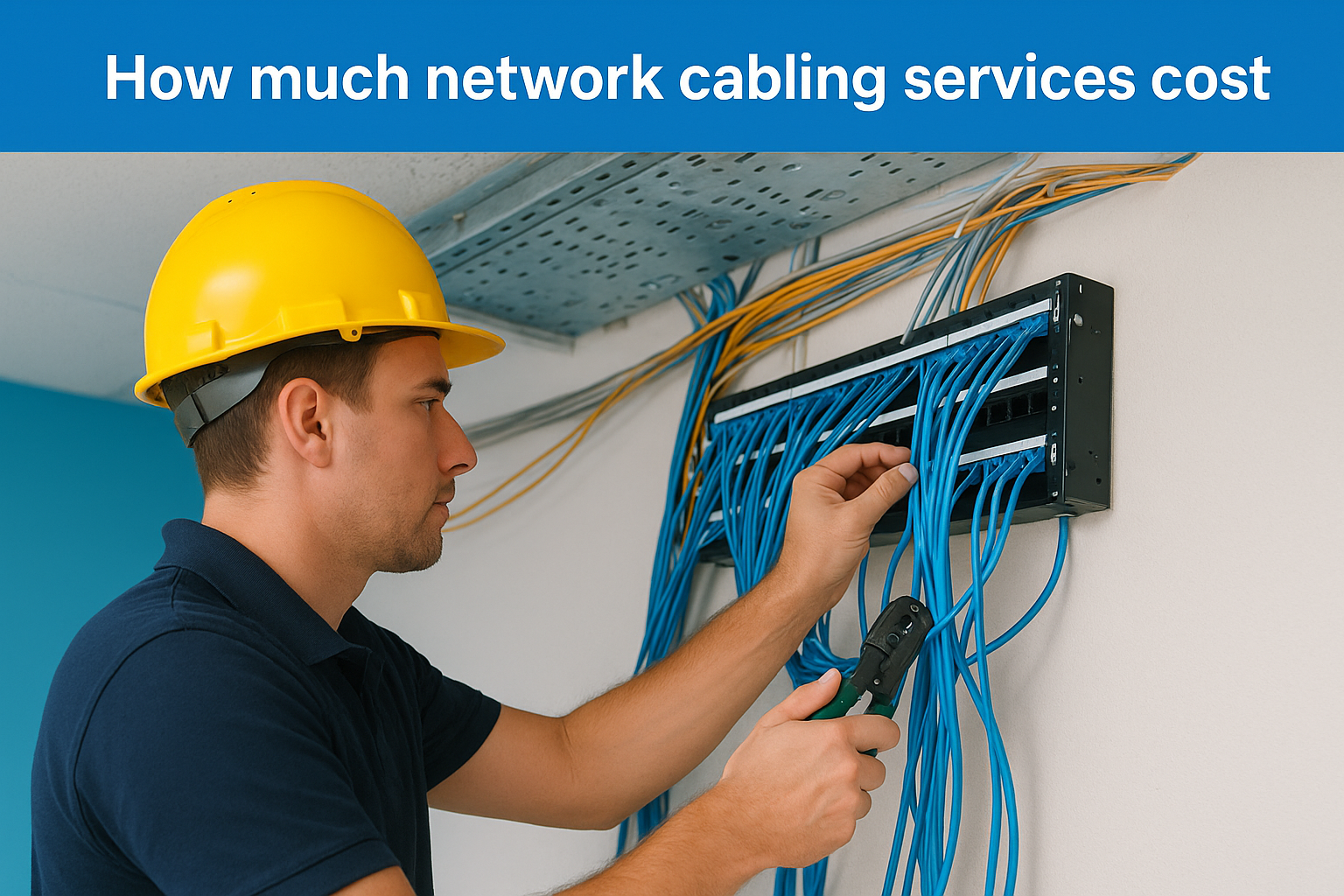
Cost is the question everyone asks first, and it’s also the hardest to answer with a single number because so many variables move the price. A single-office buildout with 20 drops costs a fraction of what a hospital wing or a multifamily campus with hundreds of units requires. Network cabling costs typically get quoted per drop, per foot of cable, or as a bundled project price, so ask which method a contractor is using before you compare bids side by side.
What drives the price up or down
Several factors push a quote higher, and understanding them helps you spot a bid that’s unrealistically low. Building age matters because older structures often lack existing conduit, which means crews spend extra hours cutting new pathways instead of pulling cable through ones already in place. Cable category matters too, since Cat6a and fiber cost more per foot than Cat5e (fiber optic cable installation cost swings widely by run length), and ceiling height, plenum requirements, and access restrictions in occupied buildings all add labor time that a quick estimate might miss.
The cheapest bid is rarely the cheapest project once you count the rework.
Typical price ranges by project type
Pricing varies by region and labor market, but the ranges below reflect what most commercial buildouts fall into. Use these as a sanity check against any quote you receive, not as a firm promise, since your building’s specifics will shift the final number.
| Project Type | Typical Price Range | Key Cost Drivers |
|---|---|---|
| Small office (20-30 drops) | $3,000 – $8,000 | Cable category, existing pathways |
| Mid-size commercial buildout | $10,000 – $40,000 | Drop count, ceiling access, PoE needs |
| Hospital wing or medical facility | $50,000+ | Compliance, infection control, RF isolation |
| Multifamily campus headend | $75,000+ | Unit count, existing infrastructure, ISP integration |
Why the lowest bid can cost you more
A quote that comes in far below competitors usually means something’s missing, whether that’s testing and certification, proper labeling, or plenum-rated cable in spaces that require it. Local network cabling installers who skip these steps can offer a lower number up front, but you end up paying for the gap later through service calls, failed inspections, or a full re-pull once someone discovers the shortcut. Ask every bidder to itemize what’s included, specifically whether testing, documentation, and warranty coverage are part of the price or billed separately.
Getting an accurate quote
An honest contractor won’t give you a firm number without seeing the site first, because too many variables hide behind walls and above ceilings. Expect a site survey before a real quote, and be wary of anyone who prices a commercial job over the phone based on square footage alone. Ask for a written scope that lists drop counts, cable category, testing procedures, and documentation, so you can compare bids on equal footing instead of guessing what each number actually includes.
Electrician or cabling specialist: who should you call
This question trips up a lot of building owners, because electricians and cabling specialists both work with wire, both carry tools that look similar, and both can technically pull cable through a wall. But the skill sets diverge fast once you get past the basics. An electrician is trained and licensed for power, voltage, breaker panels, and code compliance around anything that can shock or start a fire. A cabling specialist works in low-voltage data and telecom cabling, focused on signal integrity, category standards, and network performance rather than amperage.
Hiring an electrician for a data network is like hiring a plumber to install your HVAC system: adjacent skills, wrong specialty.
What each one is actually trained to do
Electricians handle line-voltage work: panel upgrades, outlet installs, lighting circuits, anything governed by the National Electrical Code that carries real current. Some electricians dabble in low-voltage cabling on the side, but that’s rarely their core training, and it shows in the results. Structured cabling requires knowledge of category standards, testing equipment, pathway separation from power lines to avoid EMI interference, and termination techniques specific to data jacks and patch panels. A cabling specialist lives in that world daily, which is why their terminations test clean and their documentation holds up under scrutiny.
When you actually need both
Most commercial buildouts need both trades, just for different parts of the job. Electricians run power to your telecom room and the racks holding your server room equipment essentials, install dedicated circuits for network gear, and handle any conduit work that falls under electrical code. Cabling specialists take it from there, pulling and terminating the actual data and telecom lines, then testing and certifying every run. A network cabling company that manages both relationships, or subcontracts electrical work directly, saves you from coordinating two separate vendors on your own timeline.
Quick reference: who to call for what
| Task | Call an Electrician | Call a Cabling Specialist |
|---|---|---|
| Power outlet or panel work | Yes | No |
| Running Cat6/Cat6a for data | No | Yes |
| Dedicated circuit for a rack | Yes | No |
| Testing and certifying network runs | No | Yes |
| Fiber termination and splicing | No | Yes |
| Conduit for low-voltage pathways | Sometimes | Sometimes |
That last row is where confusion usually starts, since conduit work can fall under either trade depending on local code and building type. The safest move is asking your structured cabling contractor directly whether they coordinate electrical work themselves or expect you to hire that separately. A team with design-build experience, like the model Trindom Global uses on hospital and commercial projects, typically has this relationship already sorted out, so you’re not stuck playing project manager between two crews who’ve never worked together before.
Signs your building needs new or upgraded cabling
Most building owners don’t think about cabling until something breaks, but the warning signs usually show up long before a full outage. Recognizing these signs early lets you plan an upgrade on your own schedule instead of scrambling during an emergency, and it’s often the reason someone starts searching for network cabling services near me in the first place. If you’re seeing more than one of the symptoms below, it’s worth scheduling a site assessment rather than waiting for a full failure.
Performance symptoms you can measure
Slow file transfers, dropped VoIP calls, and Wi-Fi access points that never hit their rated speed are the clearest signals that your cable infrastructure can’t keep up with current demand. IT teams often blame the switch or the router first, but if those symptoms show up building-wide rather than on a single device, the cabling itself is usually the bottleneck. Intermittent connectivity that comes and goes with no clear pattern, especially during high-traffic hours, points to runs that are either too long, poorly terminated, or running the wrong category for your bandwidth needs.
If your network problems disappear when you swap a device but return within a week, the cable is the problem, not the hardware.
Physical signs during a walkthrough
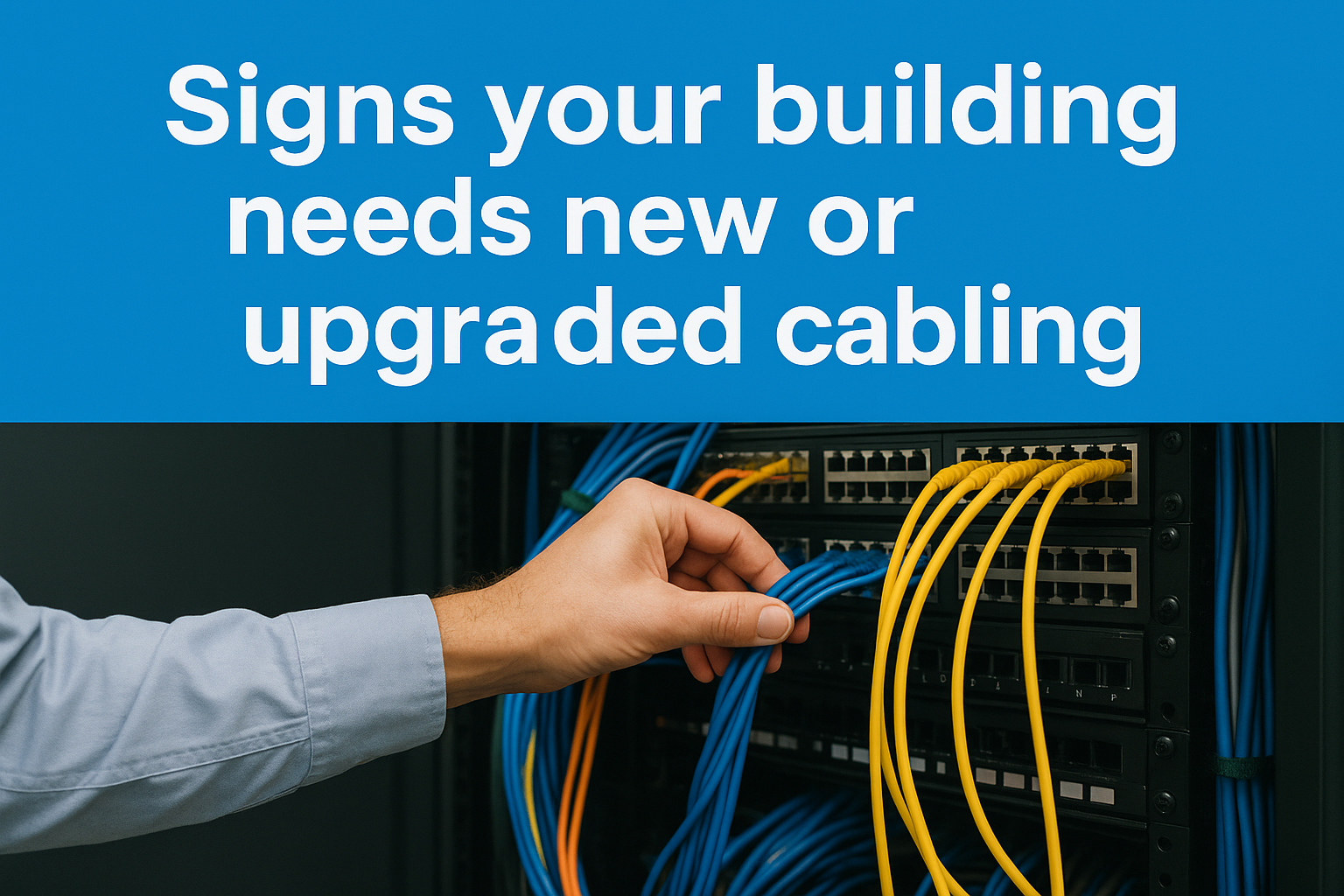
Walking your telecom room tells you almost as much as running a speed test. Bundles of cable with no labeling, exposed splices, or runs draped over ceiling grid instead of secured in J-hooks all point to an installation that skipped proper standards. Cracked or yellowed jacketing on older cable, especially anything installed before Cat5e became standard, means you’re running infrastructure that predates most of the devices plugged into it. Outdated wiring like this isn’t just slow, it’s a liability if it fails during a fire inspection or a tenant complaint.
Business changes that outpace your cabling
Growth is one of the most common reasons cabling that worked fine for years suddenly can’t keep up. A hospital adding new diagnostic equipment, a hotel expanding guest tech that depends on hospitality RF and network installation, or a multifamily property increasing unit density all push bandwidth demands past what the original build accounted for. If you’ve added PoE cameras, new access points, or additional workstations without planning network infrastructure capacity, you’re likely running closer to the edge than your IT staff realizes. Watch for these signals specifically:
- Frequent service calls for the same dead ports or dropped connections
- No documentation showing where cables run or what category was installed
- Recent equipment upgrades that haven’t been matched with a cabling assessment
- Visible damage, water exposure, or rodent activity in ceiling spaces
- A building that’s changed use or tenant density since the cabling was last touched
Any one of these on its own might not justify a full re-cable, but stacking two or three together usually means it’s time to call in a professional assessment before the problem escalates further.
Questions to ask before hiring a cabling contractor
A good proposal answers most of these questions before you even ask, but plenty of contractors count on you not knowing what to check. Walking into a bid meeting with a list forces every commercial cabling contractor to show their work instead of leaning on a slick pitch deck. Use these as a starting point, then push for specifics whenever an answer feels vague or rehearsed.
Questions about scope and process
Start with the basics that reveal whether a contractor actually plans a project or just shows up and starts pulling wire. Ask them to walk through their process step by step, since a team that skips straight to price without mentioning a site survey is telling you something important about how they operate.
- Will you conduct a site survey before providing a firm quote?
- What cable category do you recommend for our building, and why?
- Who handles the design phase, and is it the same team doing the install?
- How do you separate data, power, and low-voltage pathways?
- What’s your typical timeline for a project this size, and what could delay it?
A contractor who can’t answer these questions on the spot hasn’t managed enough projects to handle yours.
Questions about documentation and warranty
Documentation is where cheap bids usually cut corners, so press for specifics rather than accepting "we’ll take care of it" as an answer. Every completed run should come with a test certification report, and every project should end with as-built drawings showing exactly where cable runs and how it’s labeled. Ask what warranty covers the labor and materials, and get the answer in writing rather than as a verbal promise made during the sales call.
| Question | Why It Matters |
|---|---|
| Do you provide certification reports for every run? | Proves the work meets category standards |
| Will we receive as-built documentation at closeout? | Saves hours during future troubleshooting |
| What’s covered under warranty, and for how long? | Protects you if a termination fails later |
| Who do we call if something breaks after installation? | Confirms ongoing support, not just a one-time job |
Questions about industry-specific experience
Finally, ask about experience that matches your actual building type, since a crew skilled at retail buildouts might have zero experience with hospital infection control protocols or multifamily headend integration. Request references from at least two projects in your industry completed within the last two years, then actually call them. A local network cabling installer with real experience in your sector will have answers ready, project names, timelines, and a point of contact who’ll vouch for the work, rather than deflecting to generic praise about customer service.
Finding the right team for the job
A search for network cabling services near me should end with a contractor who treats your building’s infrastructure as a long-term investment, not a quick punch-list item. You’ve seen what separates a legitimate cabling company from someone with a crimping tool and a van: licensing, testing documentation, design-build capability, and real experience in your specific industry, whether that’s healthcare, hospitality, or multifamily housing. Skipping that vetting is how buildings end up with dead ports and mystery outages years down the road.
Before you sign anything, run through the checklists and questions covered here. Ask for references, demand test certifications, and confirm the crew has actually worked in buildings like yours. If you want a team that already handles design-build, installation, and integration across hospitals, commercial properties, and government projects, see Trindom Global’s structured cabling and headend buildout services and get a real site assessment instead of a guess over the phone.


