

You need IT infrastructure work done right, whether that’s structured cabling, medical equipment installation, or a full network buildout, and you know a solid rfp for it consulting services is the first step. But most templates you find online are generic, written for software consulting or staffing, and they leave out the technical details that actually matter for physical infrastructure projects. That gap costs you time and, worse, it costs you vendors who can’t scope your project accurately because your RFP didn’t ask the right questions.
This guide gives you a practical structure for writing an RFP that gets you accurate, comparable bids from qualified IT consulting and installation firms. You’ll learn what sections to include, what technical specifications to spell out, and how to word your evaluation criteria so you’re not stuck comparing apples to oranges when proposals come in.
We wrote this from the vendor side, having responded to hundreds of RFPs for hospitals, government agencies, and commercial properties. Below, you’ll find the exact framework we recommend: project scope, technical requirements, timeline expectations, and the procurement details that especially matter if you’re working with MWBE certification requirements or public sector rules.
What a Strong IT Consulting RFP Should Achieve
Before you write a single line, get clear on what the document is actually supposed to do. An RFP for IT consulting services isn’t a wish list. It’s a technical brief that lets a vendor scope your project accurately without a dozen follow-up calls. If your RFP is vague, you’ll get vague proposals back, or worse, low bids from firms that didn’t understand what they were pricing and will hit you with change orders once the work starts.
A good RFP eliminates guesswork on both sides of the table.
Get comparable bids, not just cheap ones
Your first goal is apples-to-apples comparison. When three vendors bid on the same project, you want their proposals to differ on approach and price, not on what they assumed the scope included. This means specifying exact quantities, locations, and technical standards up front rather than leaving room for interpretation. A cabling contractor who assumes Cat6 when you needed Cat6A shielded runs for a hospital environment isn’t going to give you a useful number, and you won’t find out until installation is underway.
Filter for real qualifications early
Second, your RFP should screen out unqualified vendors before you waste time on calls and site visits. If you’re installing medical equipment in a hospital, you need proof of relevant experience, technician certifications, and familiarity with infection control protocols during construction. If you’re running a government project, you need vendors who understand procurement rules, bonding requirements, and reporting obligations. Spell these requirements out in the RFP itself so unqualified firms self-select out instead of submitting proposals you’ll have to reject later.
Protect your timeline and budget
Third, a strong RFP protects your project timeline and budget from the start. Vague scope language is the number one cause of scope creep and change orders on infrastructure projects. When you define deliverables, milestones, and acceptance criteria clearly, you give yourself contractual leverage later if a vendor tries to bill for work that should have been included in the base price.
Support your procurement and compliance needs
Fourth, if you’re a government agency or a business with MWBE certification requirements or supplier diversity goals, your RFP needs to document that process correctly. Trindom Global, for example, is a certified minority and women-owned small business, and we’ve seen plenty of RFPs that either skip certification requirements entirely or word them so loosely that unqualified vendors respond anyway. If diversity procurement matters to your organization, say so explicitly, spell out who counts as an MWBE vendor, and ask for proof of certification, not just a checkbox.
Here’s a quick checklist to run your draft against before you send it out:
- Does it specify exact quantities, equipment models, or technical standards, not just general categories of work?
- Does it require proof of relevant licenses, certifications, or past project experience?
- Does it define a clear timeline with milestones, not just a final deadline?
- Does it state your budget range or ask vendors to itemize pricing by phase?
- Does it list required certifications (MWBE, bonding, insurance) if these matter for your procurement?
- Does it explain exactly how proposals will be scored and by whom?
What a strong RFP achieves is a proposal comparison you can actually trust. That’s what the next seven steps will help you build, section by section, so the document you send out gets you bids you can act on instead of a stack of proposals you have to decode one phone call at a time.
Step 1. Identify your business challenge and assemble your team
Start by writing down the actual problem you’re trying to solve, not the solution you think you need. Maybe your hospital’s wireless network can’t handle the volume of connected devices on a new wing, or your multifamily property is losing tenants to competitors with better internet. Naming the business challenge first keeps your RFP focused on outcomes instead of a specific technology you read about in a trade publication that might not even be the right fit.
Write a one-paragraph problem statement
Before you touch scope of work or budget, draft a short statement that explains what’s broken or missing and why it matters now. Keep it to a few sentences. Something like: "Our 200-bed hospital needs structured cabling and headend infrastructure upgraded to support new medical equipment installations across three floors, with minimal disruption to patient care areas." This statement becomes the anchor for every other section of your RFP, and it’s the first thing vendors read to decide if the project is a fit for their capabilities.
A clear problem statement keeps vendors from guessing what success looks like.
Pull together the right stakeholders
Next, assemble the internal team who will shape requirements and eventually score proposals. IT infrastructure projects touch more departments than people expect, and leaving one out usually surfaces as a change order later. For a hospital installation, that might mean facilities management, biomedical engineering, infection control, and IT security all weighing in before the RFP goes out.
A typical team for an infrastructure RFP includes:
- Project sponsor: owns the budget and final decision
- Technical lead: IT director or network engineer who defines specs
- Facilities or operations manager: knows building constraints, access windows, and disruption tolerance
- Procurement or contracts officer: handles compliance, bonding, and MWBE requirements
- End-user representative: for hospitals, this is often a clinical or biomedical staff member who understands equipment workflow
Set your internal timeline before you write anything
Finally, agree internally on how much time you have. If your equipment vendor has a hard installation date, work backward from it to figure out how many weeks you can realistically give bidders to respond, ask questions, and submit. Rushed RFP timelines produce rushed proposals, and rushed proposals are where scope gaps hide. Getting this internal alignment locked in before you draft the document saves you from rewriting sections once stakeholders start disagreeing mid-process.
Step 2. Provide company background and project context
Once you know your problem and your team, give vendors enough company background to understand who they’re bidding to serve. A vendor pricing a structured cabling job for a 400-room hotel needs different context than one bidding on a rural hospital’s medical equipment installation, even if the technical scope looks similar on paper. Skip this section and you’ll get proposals written for a generic client, not yours.
Describe your organization and site
Spell out the basics: industry, number of locations, building age, square footage, and any physical constraints that affect installation work. For a hospital, note whether the facility is operational during construction, since infection control and patient safety protocols change how a vendor schedules crews and stages equipment. For a multifamily property, mention unit count, existing infrastructure, and whether residents will be onsite during the work. This is also where you note prior related projects, since a vendor who knows you upgraded half your buildings’ network backbone last year will scope the remaining half more accurately.
Context turns a generic proposal into one written specifically for your building.
Explain why this project matters now
Connect the background to your project context, meaning the specific trigger that’s pushing this RFP out the door. Maybe a new wing is opening, a lease renewal depends on faster internet, or aging cable plant is causing outages. Vendors use this context to gauge urgency and flexibility, and it helps them recommend phased approaches if your timeline or budget can’t support everything at once.
Give vendors what they need in a short profile
A useful company background section usually covers:
- Organization type and size: hospital system, hotel group, property management company, government agency
- Site details: square footage, number of buildings, age of existing infrastructure
- Operational constraints: hours of access, occupancy during construction, security clearance requirements
- Relevant history: past vendors, existing equipment brands, any ongoing service contracts
- Business driver: the event or deadline creating urgency for this project
Don’t overdo this section. Two or three tight paragraphs plus a details list is enough. Vendors skim RFPs quickly when deciding whether to bid, and a background section buried in six pages of corporate history works against you. The goal is giving a qualified IT consulting firm just enough to picture your site and your constraints before they get into the technical scope of work, which is where the real specification work happens next.
Step 3. Define the scope of work and deliverables
This is the section vendors read most closely, and it’s where most RFPs fall apart. A vague scope of work produces vague bids, and vague bids turn into change orders once installation starts. Spell out exactly what work is included, what’s excluded, and what a finished deliverable looks like, so a contractor can price the job without guessing at quantities or standards.

List the physical work in specific terms
Don’t write "upgrade network infrastructure." Write what that actually means on your site: how many drops, what cable category, which floors, and what equipment gets mounted where. If you’re issuing an RFP for structured cabling and headend buildout, list riser counts, patch panel specs, and rack elevations from your structured cabling design if you have them. If the project involves medical equipment installation, name the equipment models, mounting requirements, and any coordination needed with biomedical engineering. Specificity here is what separates a bid you can trust from one built on assumptions.
Vague scope language is the single biggest driver of change orders on infrastructure projects.
Define what counts as a finished deliverable
Vendors need to know what "done" looks like before they can price it. Spell out testing requirements, documentation handoffs, and any commissioning steps required for sign-off. A cabling job isn’t finished until every run passes certification testing and you’ve received labeled as-builts, not just cable pulled through conduit.
A solid scope section usually breaks deliverables into a table like this:
| Deliverable | Standard/Requirement | Proof of Completion |
|---|---|---|
| Cable installation | Cat6A shielded, TIA/EIA-568 compliant | Certification test reports |
| Headend equipment | Rack-mounted, labeled per site standard | Photos + as-built diagrams |
| Medical equipment mounting | Per manufacturer spec, coordinated with biomed | Sign-off from facilities/biomed |
| Network testing | Full connectivity and throughput testing | Test logs, punch list closeout |
| Documentation | As-built drawings, warranty paperwork | Delivered PDF/CAD files |
Note exclusions and coordination points
Be just as clear about what’s out of scope. If electrical work, permitting, or asbestos abatement falls to another contractor, say so, otherwise you’ll get bids padded with assumptions or, worse, bids missing costs you’ll have to cover later. Also flag any coordination points, like working around an active nurses’ station or hotel guest floors, since these affect both price and schedule. A well-defined scope, paired with clear deliverables, sets up the next step: attaching real goals, metrics, and a timeline vendors can commit to.
Step 4. Set goals, metrics, and timeline
Scope tells a vendor what to build. Goals tell them what success looks like once it’s built. Without measurable project goals, you’re stuck accepting a contractor’s word that the job is done right, instead of checking it against a number you agreed on before work started. This step turns your problem statement from Step 1 into something you can actually verify at handoff.

Translate objectives into measurable metrics
Take the business challenge you wrote earlier and attach numbers to it. "Improve wireless coverage" isn’t a metric. "99% signal strength coverage across all patient rooms, tested with a validated survey tool" is. If your multifamily property needs faster internet to compete for tenants, specify the throughput speed each unit must deliver, not just "high-speed." Vendors price differently when they know the exact bar they need to clear, and you avoid disputes later about whether the work actually met your needs.
If you can’t measure it, you can’t hold a vendor accountable for it.
Common metrics worth naming in an IT consulting RFP include:
- Network performance: throughput, latency, uptime percentage
- Coverage: signal strength thresholds by zone or floor
- Capacity: number of concurrent devices or connections supported
- Compliance: cable certification pass rates, code compliance sign-offs
- Response time: for ongoing support or warranty issues post-install
Build a realistic project timeline
Once goals are set, lay out a timeline with milestones that keep an IT build on schedule, not just a final due date. Work backward from any hard constraint, like an equipment delivery date or a hospital wing opening, and build in review points where you’ll check progress against your metrics. A phased infrastructure job, say, cabling floor by floor in an occupied hospital, needs milestone dates for each phase so you can catch a slipping schedule before it threatens the whole project.
A typical timeline section might look like this:
| Milestone | Target Date | Deliverable |
|---|---|---|
| RFP responses due | Week 2 | Vendor proposals submitted |
| Vendor selection | Week 4 | Contract awarded |
| Design review | Week 6 | Final cabling/headend design approved |
| Phase 1 installation | Week 10 | Floor 1-2 complete, tested |
| Phase 2 installation | Week 14 | Floor 3-4 complete, tested |
| Final commissioning | Week 16 | Full sign-off, documentation delivered |
Spell out how flexible these dates are. Government projects with fixed fiscal-year deadlines need firmer language than a commercial buildout with some cushion. Whatever you decide, put it in writing so vendors bid a schedule they can actually hold to, not one they guess at.
Step 5. Establish your budget
Money is where a lot of RFPs go quiet, and that silence hurts you more than it protects you. Vendors need some sense of your budget range to size a proposal that fits reality, not a number pulled from a trade show quote three years ago, so check what a fiber or cabling install costs today if you need a baseline. Withholding it entirely doesn’t get you a better deal, it gets you a spread of bids from $80,000 to $400,000 for the same job, because nobody knew what ballpark you were aiming for.
Hiding your budget doesn’t protect you, it just widens the spread of bids you have to sort through.
Decide how much budget detail to share
You don’t have to publish an exact dollar figure if that makes your procurement team nervous. A range works fine: "This project has an estimated budget of $150,000 to $200,000, inclusive of labor and materials." That single sentence does more to narrow your bid spread than three extra pages of scope language. If you genuinely can’t share a range because of internal approval processes, at least ask vendors to itemize their pricing so you can compare structure even without a target number to check it against.
Ask for pricing broken out by phase and category
Require vendors to itemize costs rather than submit one lump sum. This protects you two ways: it shows you where the money’s actually going, and it gives you a paper trail if a vendor later tries to bill for something that should’ve been covered in the original price. A typical breakdown request should cover:
- Labor, separated by installation, testing, and project management
- Materials and equipment, itemized by category (cabling, racks, mounting hardware)
- Permitting and compliance costs, if applicable to your jurisdiction
- Contingency or change order rate, so you know the hourly or percentage rate before work starts, not after
- Payment schedule tied to milestones, not just a deposit and final payment
Account for MWBE and compliance costs
If your organization has supplier diversity goals or works with certified minority and women-owned business enterprise vendors, note whether how MWBE certification is earned and certification status affect scoring weight or contract set-asides. This matters for budget planning too, since some public agencies allocate specific dollar percentages toward MWBE-certified contractors and need that documented in the RFP itself, not decided informally after bids come in.
Once your budget parameters are clear, you’re ready to tell vendors exactly how to respond and how you’ll judge what they send back, which is the job of your submission and evaluation section next.
Step 6. Outline submission requirements and evaluation criteria
Vendors need to know exactly what to submit and how you’ll judge it, or you’ll get proposals in a dozen different formats that make comparison miserable. This step is where you write the rules of the game before anyone starts playing, so your submission requirements and evaluation criteria work together instead of leaving room for a vendor to talk their way past a gap in qualifications.
Spell out the submission format
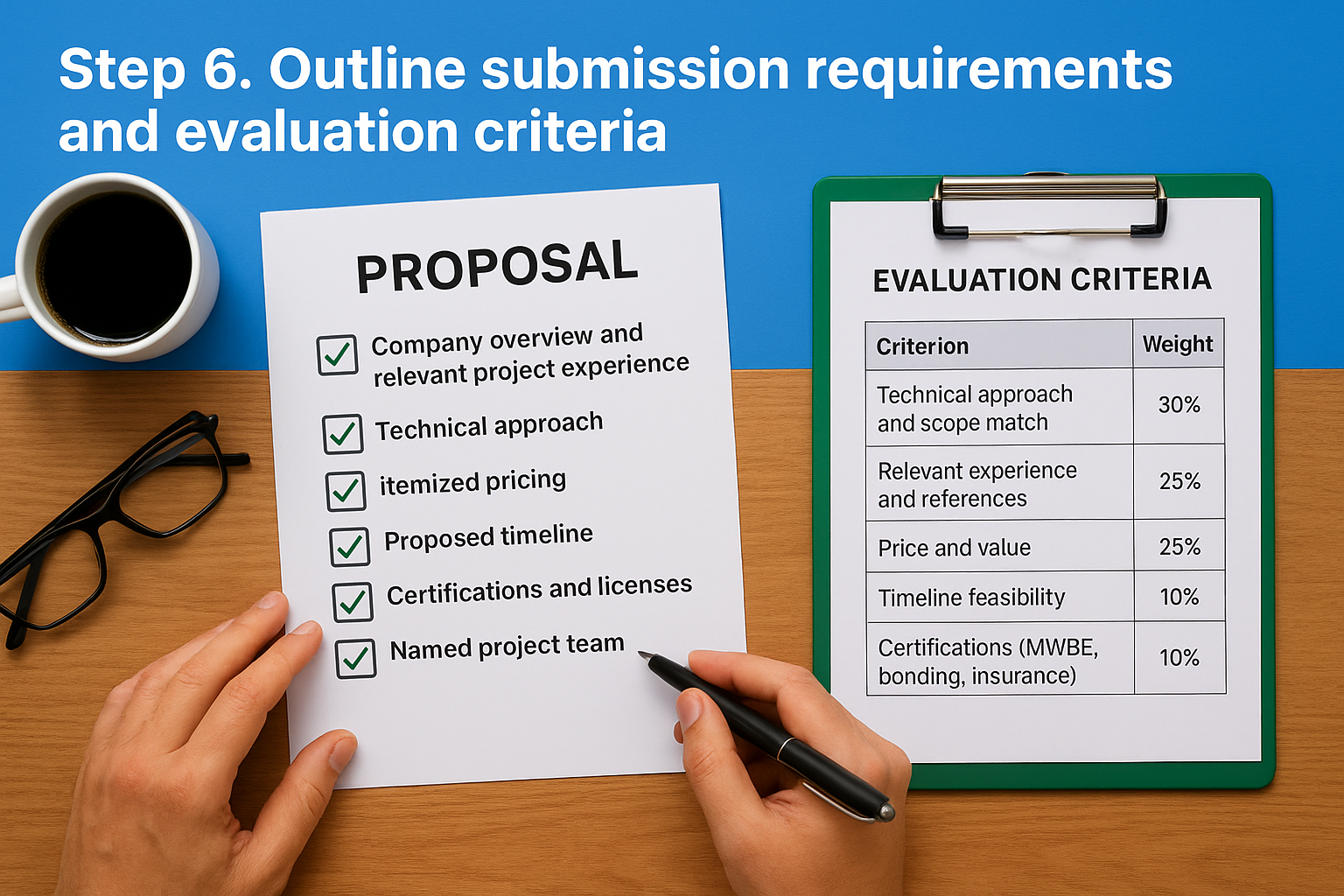
Tell vendors precisely what a complete proposal must include and how to structure it. Loose formatting instructions produce proposals that bury pricing on page nine or skip your required certifications entirely. A clean submission checklist should require:
- Company overview and relevant project experience, with references from similar-scope work
- Technical approach, addressing each item in your scope of work directly
- Itemized pricing, matching the categories from your budget section
- Proposed timeline, mapped to the milestones you set in Step 4
- Certifications and licenses, including MWBE status if applicable, bonding, and insurance
- Named project team, with resumes or certifications for lead technicians
A proposal you can’t compare line-by-line against another isn’t a proposal you can trust.
Weight your evaluation criteria before bids arrive
Decide how you’ll score submissions before you read a single one. Scoring after the fact invites bias toward whichever proposal reads the smoothest, not the one that actually fits your project. A weighted scorecard keeps the process defensible, especially for government agencies where procurement rules require documented, consistent scoring.
| Criterion | Weight | What You’re Checking |
|---|---|---|
| Technical approach and scope match | 30% | Does the plan address every deliverable? |
| Relevant experience and references | 25% | Similar projects, verifiable references |
| Price and value | 25% | Itemized cost versus scope delivered |
| Timeline feasibility | 10% | Realistic against your milestones |
| Certifications (MWBE, bonding, insurance) | 10% | Documented proof, not just claims |
State the deadline and the questions process
Give vendors a firm submission deadline and a single point of contact for questions, ideally with a published Q&A deadline so every bidder works from the same answers. If you allow one-off phone calls to your technical lead, you’ll end up with vendors bidding on different information, which defeats the comparison you built this whole document to protect.
Step 7. Finalize the selection process and distribute the RFP
Before you send anything out, lock down how the process ends, not just how it starts. Decide who has final sign-off authority, whether that’s a single project sponsor or a procurement committee, and confirm that legal or contracts staff have reviewed your terms and conditions language. Skipping this step means you’ll be negotiating internally about authority to award a contract at the exact moment vendors are waiting on an answer, which stalls a project you’ve already spent weeks scoping.
Shortlist finalists and verify what they claim
Once proposals score against your weighted criteria, narrow the field to two or three finalists and schedule short interviews or site walkthroughs before you commit. Use this stage to check references directly rather than trusting the two names a vendor hand-picked for their proposal. Ask a reference project manager the questions that actually predict performance:
- Did the vendor hit the milestones they proposed, or did the schedule slip?
- Were change orders reasonable, or did the price grow well beyond the original bid?
- Would they hire this vendor again for a similar infrastructure project?
A reference call that takes fifteen minutes can save you months of change-order disputes.
Choose your distribution channels
How you distribute the RFP determines who bids on it. A hospital installation or government cabling job needs different reach than a single-property multifamily upgrade. Common channels include:
- Direct outreach to vendors with proven experience in your sector, especially firms already familiar with hospital protocols or public procurement rules
- Government procurement portals, required for most public agency projects and often the only legally acceptable channel
- MWBE and supplier diversity registries, if you have set-aside goals to meet
- Industry associations or vendor networks listing structured cabling installation companies, RF specialists, or medical equipment installers
Set a firm distribution date and give vendors enough runway to respond, typically two to four weeks depending on project complexity.
Confirm contract terms before you award
Finally, get contract terms drafted before you notify a winner, not after. Vendors move faster when they know payment terms, insurance requirements, and warranty language are already settled rather than negotiated line by line post-award. This last step turns your RFP from a comparison exercise into a signed agreement, ready to move into the outline you’ll build the actual document around next.
A sample outline for your IT consulting RFP
Pulling everything from the last seven steps into one document is easier when you’re working from a template instead of a blank page. Below is a ready-to-use outline you can copy into a document and fill in section by section, adjusted to whatever mix of structured cabling, medical equipment, or RF work your project involves.
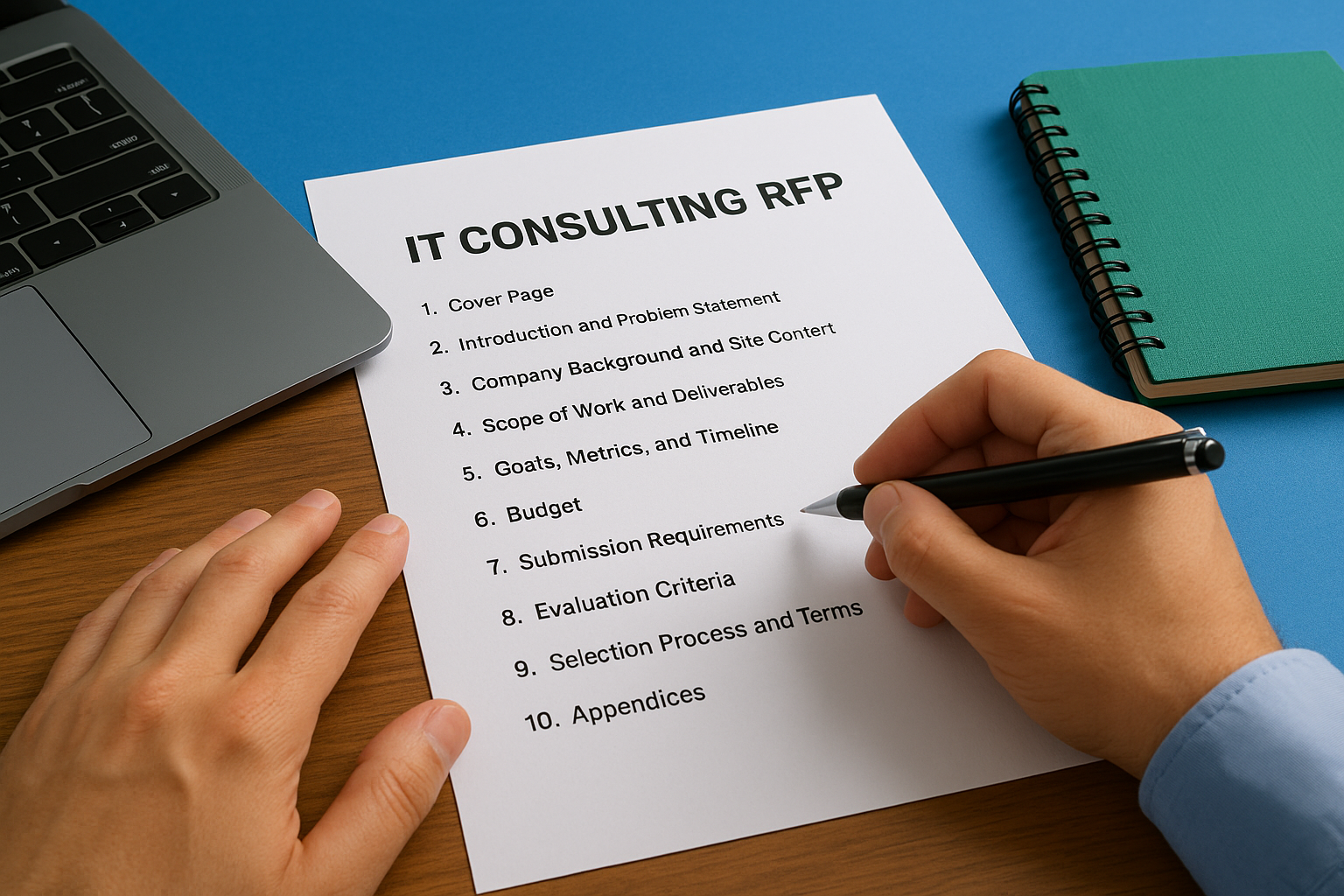
A good outline turns seven scattered steps into one document a vendor can actually bid from.
Quick reference before you start drafting:
1. Cover Page
   - Organization name, project title, RFP issue date, response deadline

2. Introduction and Problem Statement
   - One-paragraph description of the business challenge
   - Why this project matters now

3. Company Background and Site Context
   - Organization type, size, and locations
   - Operational constraints (occupancy, access hours, security)
   - Relevant project history

4. Scope of Work and Deliverables
   - Detailed technical requirements (cable types, equipment models, quantities)
   - Deliverables table with standards and proof of completion
   - Exclusions and coordination points

5. Goals, Metrics, and Timeline
   - Measurable success criteria
   - Milestone-based project timeline

6. Budget
   - Budget range or itemized pricing request
   - Payment schedule tied to milestones

7. Submission Requirements
   - Required proposal sections and format
   - Certifications, licenses, MWBE documentation

8. Evaluation Criteria
   - Weighted scorecard
   - Question deadline and point of contact

9. Selection Process and Terms
   - Award timeline
   - Contract terms and conditions summary

10. Appendices
    - Site drawings, equipment lists, existing network diagrams
Every RFP outline should flex to match your project type. A hospital-focused document needs an appendix for infection control protocols and biomedical coordination requirements. A multifamily ISP upgrade needs unit counts and the existing wiring diagrams from your network infrastructure plan instead. Government agencies usually need to add a compliance section referencing specific procurement codes, bonding thresholds, or reporting formats required by their jurisdiction.
Keep the document tight even with all ten sections included. Vendors bidding on infrastructure work skim for scope and numbers first, so front-load the technical detail and push boilerplate legal language into an appendix where it won’t slow down a first read. A fifteen-page RFP built from this outline, with a clear deliverables table and weighted scorecard, will get you tighter bids than a forty-page document written to cover every possible contingency instead of your actual project.
From RFP to the right IT partner
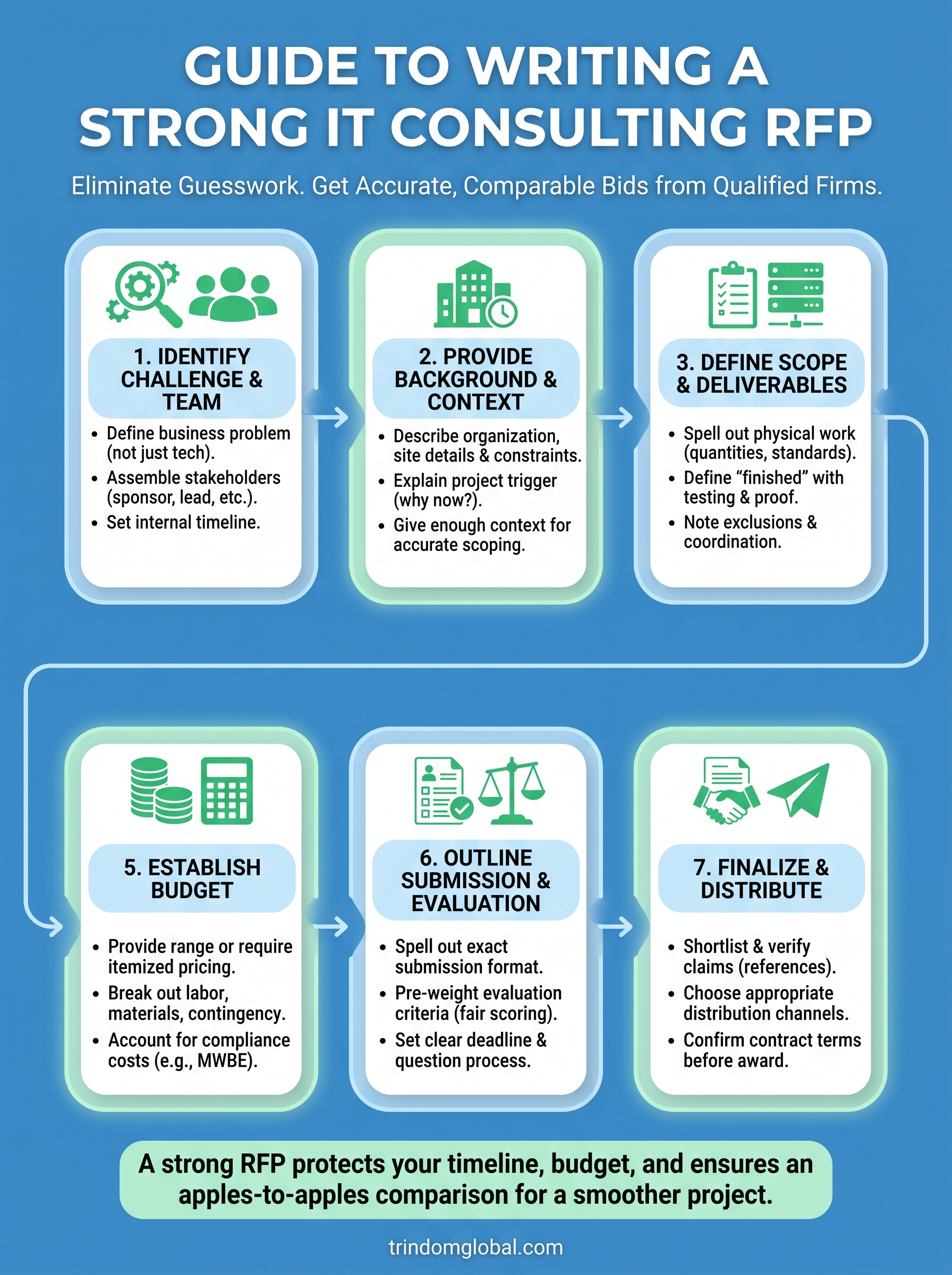
A well-built RFP for IT consulting services does more than solicit bids. It forces clarity on your own project before you ever ask a vendor to price it, and that clarity is what separates a smooth installation from six months of change orders. Work through the seven steps in order, fill in the outline above, and you’ll send out a document vendors can actually bid against, not one they have to guess at.
Once your RFP is ready, the vendors who respond will tell you a lot by how they respond. Look for firms who ask sharp scoping questions, cite relevant experience in hospitals, commercial properties, or government work, and document their certifications without being asked twice. If you’d rather skip the guesswork on who’s qualified, compare the firms that handle IT infrastructure installation end to end, including Trindom Global, before you finalize the scope.


