

Picking the wrong technology partner costs you more than money. It costs you uptime, security, and time you don’t have to spare on fixing avoidable problems. If you’re researching small business it consulting services, you’re probably facing a decision that feels bigger than it should: build an internal IT function, hire a generalist contractor, or bring in specialists who actually understand infrastructure design.
This article breaks down what these engagements actually include, from initial network assessments to ongoing support, so you know what you’re paying for before you sign anything. We’ll cover realistic pricing ranges, the difference between managed services and project-based consulting, and the red flags that signal a provider isn’t equipped to handle your growth.
At Trindom Global, we work with organizations that need structured cabling, integration, and infrastructure planning done right the first time, not patched together. Whether you’re a healthcare practice, a hospitality operation, or a growing multifamily property, the questions below will help you evaluate any consultant, including us, before committing to a contract.’
Why small business IT consulting matters
Small businesses run on a fraction of the technical staff that enterprises keep on payroll, yet they face the same cybersecurity threats, compliance requirements, and infrastructure demands. IT consulting services for small businesses exist precisely because you can’t justify a full-time specialist for every discipline, from network architecture to structured cabling to vendor coordination. When something breaks during your busiest week, or a compliance audit lands on your desk with a two-week deadline, you need people who’ve solved that exact problem before, not a generalist learning on your dime.
The true cost of doing IT alone
Owners often assume skipping outside help saves money, but the math rarely works out that way. A single unplanned outage can cost a healthcare practice or a hospitality property thousands of dollars in missed intake, canceled bookings, or idle staff, and that figure doesn’t include the reputational damage. Downtime rarely announces itself politely; it shows up during peak season, right when a patched-together network finally gives out.
A network that “mostly works” is still one failure away from a very expensive day.
The hidden costs stack up in predictable ways:
- Emergency repair rates run far higher than planned maintenance contracts
- Compliance penalties hit harder when infrastructure gaps go undocumented
- Staff time gets diverted to troubleshooting instead of billable or guest-facing work
- Reputation damage from outages or breaches outlasts the technical fix itself
Bringing in outside expertise upfront, particularly for network assessments and how to plan network infrastructure properly, catches weak points before they turn into these line items.
Security threats don’t check your revenue
Attackers don’t scale their tactics to match your company size. In fact, the Cybersecurity and Infrastructure Security Agency reports that small and medium organizations are frequent targets precisely because attackers assume their defenses are thinner. Healthcare practices carrying patient data, multifamily properties running shared networks, and hospitality operators handling guest payment information all sit squarely in that crosshair. Qualified IT consulting services small business owners can trust will build layered protections into the infrastructure itself, not bolt security on as an afterthought once something has already gone wrong.
Growth exposes weak infrastructure fast
Growth is usually the moment infrastructure problems stop hiding. A property that added twenty units, a clinic that opened a second location, or a hotel that upgraded its guest Wi-Fi will quickly discover whether the original cabling, headend, and network backbone can actually support the new load. Infrastructure built without a scalable design forces you into disruptive rework later, often at a much higher cost than doing it right the first time. Understanding this dynamic early is exactly why a design-build consulting relationship, rather than a reactive break-fix arrangement, tends to serve growing organizations better over the long run. The businesses that treat consulting as a planning partner, not an emergency hotline, are the ones that scale without the growing pains showing up as downtime.
How to choose the right IT consulting partner
Finding it consulting services for small businesses that actually fit your operation takes more than a Google search and a quick call. You’re vetting a partner who will touch your network, your compliance posture, and potentially your patient or guest data, so the interview process deserves real scrutiny. Ask pointed questions about past projects in your industry, request references you can actually call, and pay attention to whether the consultant asks about your goals or jumps straight to selling a package.
Specialization beats generalist experience
Generalist IT contractors can patch a printer or reset a router, but infrastructure design work, structured cabling, headend buildout, RF installation, demands specialists who’ve done it in environments like yours. A consultant who has installed medical equipment in a hospital understands regulatory constraints that a residential IT generalist has never encountered. Verify their track record in your specific sector before anything else.
The right partner has already solved your exact problem somewhere else.
Certifications and vendor relationships matter
Strategic vendor partnerships signal that a consultant has invested in staying current with the equipment and standards your industry actually uses. Ask which manufacturers and platforms they’re certified on, and confirm those certifications are current, not from a training completed five years ago. A consultant with strong vendor ties can also often get you better pricing and faster support escalation when something goes wrong.
Confirm design-build capability, not just repair
Many providers only react to problems after they happen. Look instead for a design-build model, where planning, installation, and integration happen under one team that owns the outcome end to end, and start by finding a design build company near you. This matters especially if you’re scaling: a fragmented team of separate vendors for cabling, network, and equipment often leaves gaps nobody takes ownership of.
Use this checklist when comparing candidates:
- Do they have documented experience in your specific industry (healthcare, hospitality, multifamily, government)?
- Can they provide references from projects similar in scope to yours?
- Do they hold current certifications with relevant equipment manufacturers?
- Do they offer design-build services, or only repair and maintenance?
- Are they certified as a minority or women-owned business, if that matters for your procurement requirements?
- Do they explain pricing clearly before you sign anything?
Don’t skip the procurement fit check
Regulated buyers, especially government agencies and healthcare systems, often have procurement rules that go beyond technical capability. If your organization prioritizes or requires minority and women-owned business vendors, confirm minority-owned business certification requirements upfront rather than discovering a mismatch mid-negotiation. This single detail can determine whether a consultant is even eligible to bid on your project, so it’s worth verifying before you invest time in a longer evaluation process.
Core IT services small businesses typically need
Most owners searching for it consulting services small business providers offer don’t need everything at once. You need the specific pieces that keep your operation running and protected, delivered by people who understand how they connect. Knowing what falls under this umbrella helps you spot a consultant who’s padding a proposal versus one who’s scoping your actual needs.
Network assessments and infrastructure design
Before any cabling goes in or equipment gets mounted, a competent consultant starts with a network assessment that maps your current setup against your actual usage patterns and growth plans, then moves on to how to design network infrastructure around what it finds. This step catches undersized backbones, outdated switches, and single points of failure before they become 2 a.m. emergencies. Skipping it is how businesses end up with infrastructure that technically works on day one but buckles under real load six months later.
Good infrastructure planning is invisible when it’s working and catastrophic when it isn’t.
Structured cabling and headend buildout
Physical infrastructure, meaning structured cabling and headend buildout for network, telecom, and TV systems, forms the backbone everything else depends on. Multifamily properties, hospitality venues, and commercial buildings all need this done to code and built for future capacity, not just today’s device count. Poorly planned cabling is expensive to rip out and redo, so this is one area where cutting corners costs you twice.

Specialized installation and integration
Specialized environments demand specialized installers. Hospitals need clinical-grade equipment installation handled by technicians who understand clinical workflows and regulatory constraints, while hospitality and commercial properties need RF and network installation tuned for guest density and coverage. Government projects add another layer entirely, since government vendor list requirements and RFP rules shape how the work gets scoped and delivered from the start.
| Service | Typical need | Common client type |
|---|---|---|
| Network assessment | Baseline before design or upgrade | All sectors |
| Structured cabling & headend | Network, telecom, TV backbone | Multifamily, commercial |
| Medical equipment installation | Clinical-grade infrastructure | Hospitals, healthcare |
| RF and network installation | Wireless coverage, guest networks | Hospitality, commercial |
| High-speed ISP integration | Resident-facing internet service | Multifamily campuses |
Property operators managing multiple residential buildings often need a slightly different track: high-speed internet delivered at scale across an entire campus. That’s where a sister service like Trintel fits in, handling the ISP side specifically for multifamily communities rather than treating it as a generic network install.
How much do small business IT consulting services cost
Pricing for small business it consulting services varies more than most owners expect, because you’re not buying a single product, you’re buying a mix of assessment, design, labor, and equipment that shifts based on your industry and scope. A quick network cleanup for a small office costs a fraction of what a multi-building structured cabling project or a hospital equipment installation runs. Anyone quoting you a flat number before understanding your site, your existing infrastructure, and your compliance requirements is guessing, not scoping.
Pricing models you’ll encounter
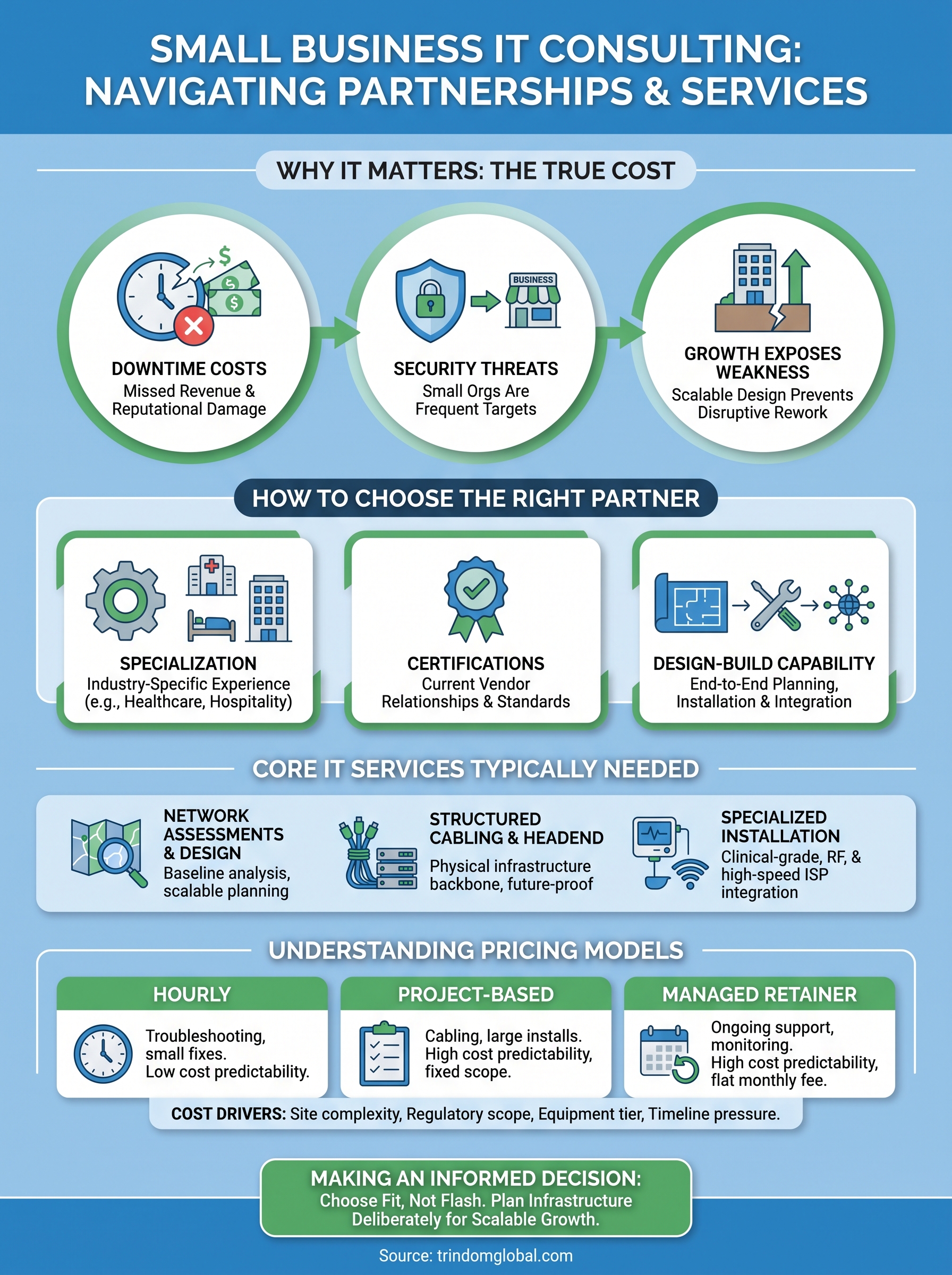
Consultants typically structure their fees one of three ways, and each fits different situations. Hourly billing suits small, well-defined tasks like troubleshooting or a one-time assessment. Project-based pricing fits larger builds, cabling installs, headend buildouts, equipment integrations, where the scope is fixed enough to quote a total. Managed retainer agreements suit ongoing support, giving you predictable monthly costs in exchange for continuous monitoring and maintenance.

| Pricing model | Typical use case | Cost predictability |
|---|---|---|
| Hourly | Troubleshooting, small fixes | Low, varies by hours worked |
| Project-based | Cabling, installs, integrations | High, fixed scope and price |
| Managed retainer | Ongoing monitoring, support | High, flat monthly fee |
The cheapest quote rarely accounts for the full scope of work you actually need done.
What drives the price up or down
Several factors push a quote higher or lower before a single cable gets run. Facility size and the number of locations matter, as does whether you need new construction wiring or a retrofit around existing walls and ceilings. Compliance requirements, especially in healthcare, add specialized labor and documentation that generalist installers can’t provide. Equipment specifications, particularly for medical devices or hospitality-grade RF systems, shift material costs significantly, and fiber optic installation pricing is another line item worth understanding before you compare bids.
Keep these variables in mind when comparing bids:
- Site complexity: new construction versus retrofit around existing infrastructure
- Regulatory scope: healthcare and government work require documented compliance steps
- Equipment tier: standard network gear versus clinical or hospitality-grade systems
- Timeline pressure: rushed installs typically cost more than planned schedules
- Vendor certifications: certified installers may charge more upfront but reduce rework risk
Understanding these drivers helps you ask sharper questions during the bidding process instead of comparing bottom-line numbers that hide very different scopes underneath.
Getting an accurate quote
Expect a serious consultant to walk your site, review your current setup, and ask about your growth plans before handing you a number. If a provider quotes it consulting services for small business projects over the phone without ever seeing your facility, treat that as a warning sign rather than a convenience. A written proposal should break down labor, materials, and any ongoing support separately, so you can see exactly what you’re paying for and compare it apples-to-apples against competing bids.
Making an informed IT decision
Choosing among small business it consulting services comes down to fit, not flash. You want a partner who scopes your actual infrastructure, explains pricing before you sign, and has solved problems in your specific industry, whether that’s a hospital floor, a hotel network, or a multifamily campus. Skip anyone who quotes blind or treats design and installation as separate, disconnected steps.
Getting this decision right protects more than your budget. It protects your uptime, your compliance standing, and the trust your patients, guests, or residents place in you every day. The businesses that plan infrastructure deliberately, rather than patching it together under pressure, are the ones that scale without constant firefighting.
If you’re ready to move past guesswork and talk through your actual infrastructure needs, review Trindom Global’s design-build and IT infrastructure services and get a scoped assessment before you commit to anything.


