

You are staring down a network upgrade, a new facility build-out, or a stack of vendor proposals that all promise the same thing, and none of it lines up with what your organization actually needs three years from now. That gap between daily IT decisions and long-term business goals is exactly what strategy IT consulting exists to close. It is not another layer of tech jargon on top of your existing headaches, it is a structured way to figure out what infrastructure you actually need before you spend money on it.
So what IT strategy and consulting looks like in practice? It means bringing in specialists who assess your current systems, map out your goals, and build a roadmap that connects the two, covering everything from network design to equipment selection to implementation timelines. Good it strategy consulting services don’t just hand you a report; they stay involved through planning and installation so the strategy actually gets built.
In this article, we’ll break down what IT strategy consulting includes, how the process typically works, and how it helps organizations like hospitals, commercial properties, and government agencies make smarter infrastructure decisions from day one.
Why IT strategy consulting matters for your business
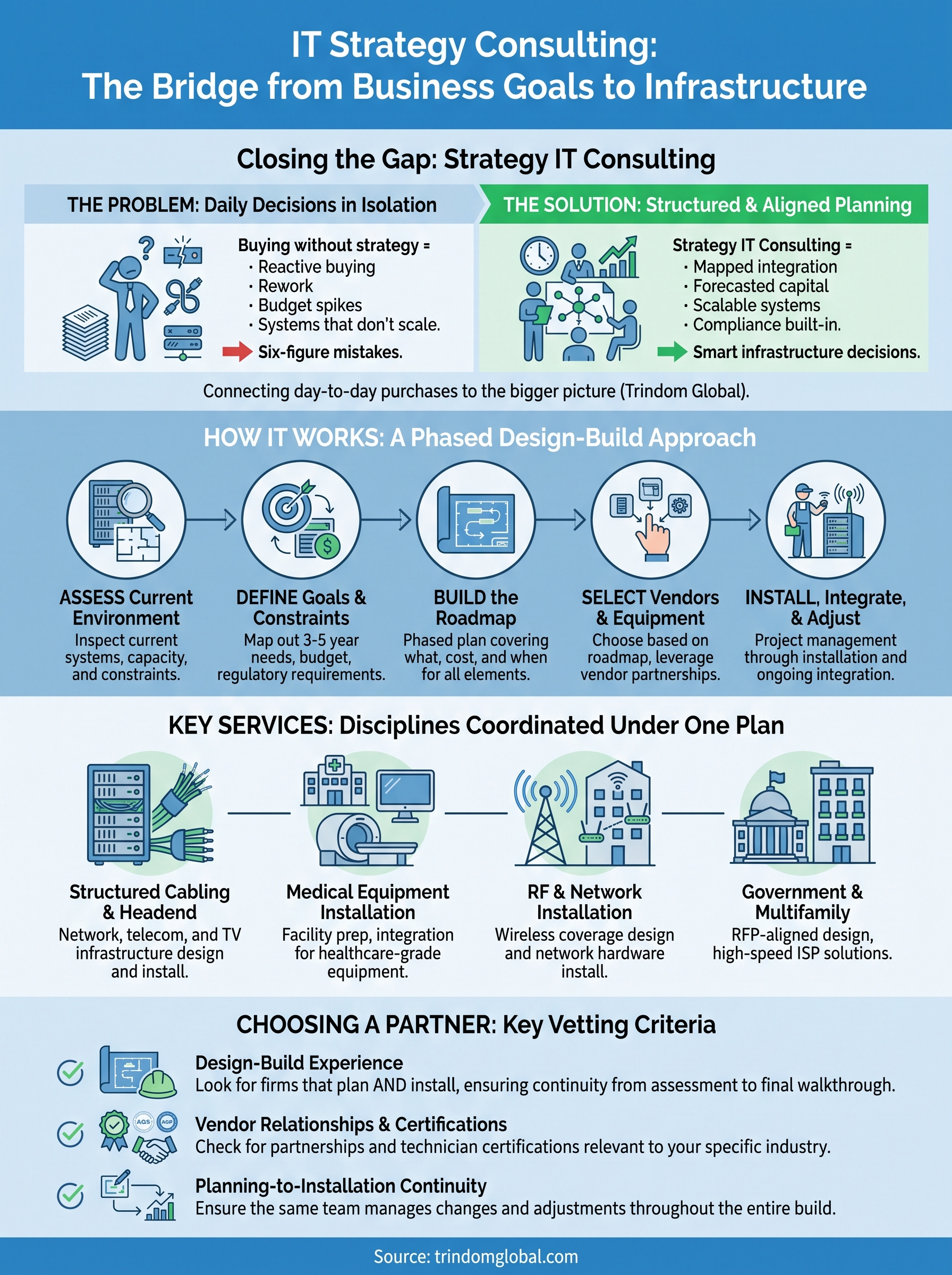
Most organizations don’t fail at IT because they picked the wrong switch or the wrong vendor. They fail because nobody connected the day-to-day purchase to the bigger picture. A hospital adds a wing without planning the network backbone to support new medical equipment. A property operator wires a building for internet speeds that were competitive five years ago. A government agency buys hardware that technically meets the RFP but doesn’t integrate with anything else on campus. Strategy IT consulting exists to stop these mismatches before they turn into six-figure mistakes.
Buying technology without a strategy is how you end up paying twice for the same problem.
The real cost of skipping strategy
Skipping the strategy phase feels cheaper in the moment, but the bill shows up later, usually as rework, downtime, or a system that can’t scale. Consider what happens when infrastructure decisions get made in isolation instead of as part of a coordinated plan:

| Reactive approach | Strategic approach |
|---|---|
| Buy equipment first, figure out integration later | Map integration needs before purchasing |
| Each department picks its own vendors | Vendor selection tied to a shared roadmap |
| Upgrades happen when something breaks | Upgrades scheduled around growth and lifecycle |
| Compliance gaps discovered during an audit | Compliance built into the design phase |
| IT budget spikes unpredictably | Capital spending forecasted years out |
That table isn’t hypothetical. It’s the difference between a client who calls us after a failed install and one who calls before signing a purchase order. The second group spends less overall, even though the upfront consulting fee makes it look like they’re spending more.
Aligning technology with where the business is headed
Aligning your infrastructure with actual business goals, not just this quarter’s pain points, is the whole point of bringing in outside expertise. A commercial property planning three years of tenant growth needs a different structured versus unstructured cabling approach and RF coverage than one planning to sell in eighteen months. A hospital opening a new imaging suite needs power, cooling, and network capacity calculated against equipment specs, not guessed at. This is where what is IT strategy consulting stops being an abstract question and becomes a concrete deliverable: a document and a plan that ties every infrastructure decision back to a business outcome you can measure.
Why regulated and complex environments feel this the most
Organizations working under strict procurement rules or safety requirements have the least room for guesswork. Healthcare systems answer to regulators and patient safety standards. Government agencies answer to RFP language and audit trails. Multi-family operators answer to residents who expect internet that works on day one, not after three service calls. None of these groups can afford a trial-and-error approach to infrastructure, which is exactly why they lean on outside consulting rather than handling it internally.
Partnering with a firm that combines design-build consultation with hands-on installation, like the design-build consulting services we provide at Trindom Global, means the strategy doesn’t sit on a shelf. It gets built, tested, and adjusted as your organization actually grows into it. That continuity, from the first assessment through the final walkthrough, is the piece most in-house IT teams don’t have the bandwidth to manage on their own.
How IT strategy consulting works, step by step
A good consulting engagement follows a sequence, not a guess, much like the phases of a design-build project. IT strategy consulting starts with understanding what you already have and what you’re trying to accomplish, then moves through design, vendor selection, and implementation before anyone touches a cable or a switch. Skipping steps is how projects end up back at square one six months in.
Step 1: Assess the current environment
Every engagement starts with a hard look at what’s already in place. That means walking the facility, reviewing existing network diagrams, checking equipment age and capacity, and talking to the people who deal with the current setup every day. You can’t build a roadmap on top of infrastructure nobody has actually inspected.
Step 2: Define business goals and constraints
Next comes the part most vendors skip: connecting the technical assessment to what the organization actually needs three to five years out. A hospital’s goal might be supporting a new surgical wing. A property operator’s goal might be competing on internet speed with a new development down the street. Strategy IT consulting only works if the goals get defined clearly, including budget ceilings, timeline constraints, and any regulatory requirements that shape what’s even possible.
Step 3: Build the roadmap
With the current state and the goals both on the table, the consultant builds a phased plan. This is where cabling layouts, headend design, equipment specs, and integration points get mapped out against a timeline, the same discipline behind building a phased network infrastructure plan. The roadmap should answer three questions for every recommendation:
- What problem does this solve?
- What does it cost, including installation and ongoing maintenance?
- When does it need to happen relative to everything else in the plan?
A roadmap that doesn’t answer what, cost, and when isn’t a strategy, it’s a wish list.
Step 4: Select vendors and equipment
Once the roadmap is set, vendor and equipment selection happens against that plan rather than against whoever calls first with a proposal. This step benefits enormously from established vendor partnerships, since a consultant who already knows which manufacturers deliver on hospital-grade RF coverage or carrier-grade headend equipment saves you months of trial and error.
Step 5: Install, integrate, and adjust
The last step is where a lot of consulting relationships fall apart, because plenty of firms hand over a report and walk away. The stronger model carries the strategy through installation and integration, with the project management habits that keep an IT build on schedule and catch problems before they become change orders. Real environments shift during a build, a wing gets delayed, a vendor discontinues a model, and the plan needs to flex without losing the underlying goals. That continuity, from assessment through final integration, is what separates a strategy document from a strategy that actually gets used.
Key services covered by IT strategy consulting
IT strategy consulting isn’t a single service, it’s a bundle of related disciplines that get coordinated under one plan instead of handled in silos. IT strategy consulting services typically span everything from the physical cabling in the walls to the equipment plugged into it, and the strength of the engagement comes from how well those pieces talk to each other. Here’s a breakdown of the core service areas and who typically needs them most.
| Service area | What it covers | Who relies on it most |
|---|---|---|
| Structured cabling and headend buildout | Network, telecom, and TV infrastructure design and install | New builds, renovations, multi-tenant properties |
| Medical equipment installation | Facility prep, integration, and project management for hospital-grade equipment | Hospitals and healthcare systems |
| RF and network installation | Wireless coverage design and network hardware install | Commercial and hospitality venues |
| Government infrastructure projects | RFP-aligned design and procurement support | Government agencies and public sector clients |
| Multifamily ISP solutions | High-speed connectivity design for residential campuses | Property operators and multi-family owners |
Structured cabling and headend buildout
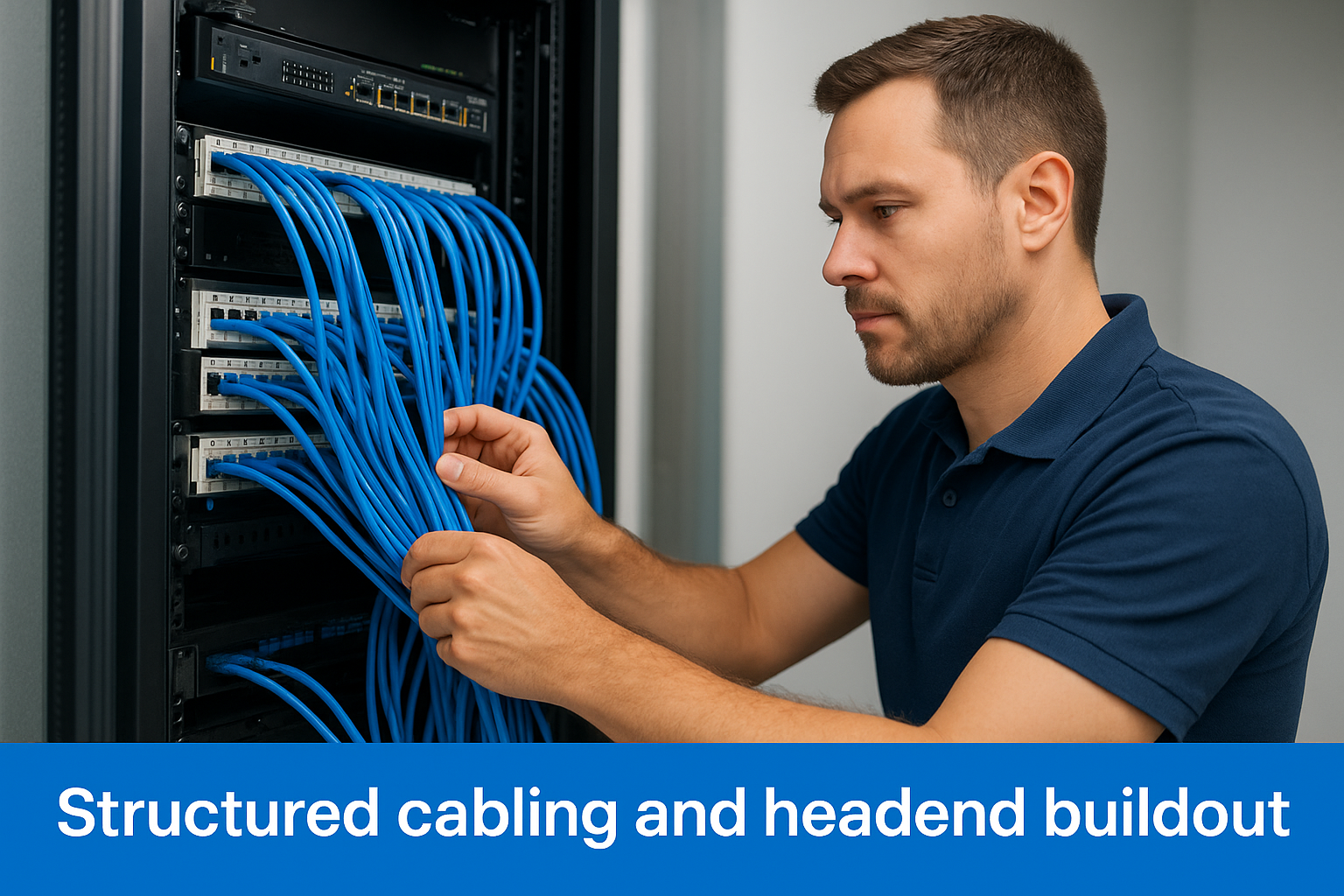
Getting the backbone right is where most infrastructure projects either succeed or start bleeding money. Trindom Global’s structured cabling and headend buildout work covers the network, telecom, and TV infrastructure that everything else in a building depends on, and getting that wrong means ripping out walls later.
Medical equipment installation for healthcare facilities
Hospitals carry the highest stakes of any environment we work in, because a miscalculated power load or network drop can delay patient care. Our work here pairs qualified technicians with dedicated project management, so imaging suites, monitoring systems, and other capital equipment go live on schedule and integrate cleanly with the hospital’s existing network, which is exactly what medical equipment installation services include.
A hospital network built around actual equipment specs, not guesses, is the difference between a smooth go-live and a delayed surgical wing.
RF and network installation for commercial and hospitality spaces
Restaurants, hotels, and retail properties live and die by whether the wireless network actually reaches every corner a guest expects it to. RF and network installation planning maps coverage against the building layout before equipment gets mounted, avoiding the dead zones that plague rushed installs.
Government and multifamily infrastructure
Government projects come with RFP language and the vendor list requirements that shape what’s even allowed, while multi-family operators compete on internet speed as a resident amenity. Trindom Global handles the former directly and supports the latter through Trintel, its sister service focused on high-speed ISP solutions for residential campuses, giving property operators the same design-build discipline used on our commercial and healthcare projects.
How to choose the right IT strategy consulting partner
Picking the wrong partner costs more than a bad vendor quote, because a weak strategy engagement can lock you into infrastructure decisions you’re stuck with for a decade. Before you sign anything, look past the sales pitch, compare the firms in this space, and check whether the one you’re considering actually has the track record to back up its claims about strategy IT consulting. The right partner should be able to point to completed projects in your specific sector, not just a generic list of capabilities on a website.
Look for design-build experience, not just advice
Generic consultants who only produce reports leave you to find an installer on your own, which reintroduces the exact disconnect strategy work is supposed to fix. Firms that combine planning with actual installation, and knowing how to pick a design-build firm near you, keep the same team accountable from the first assessment through the final walkthrough. That continuity matters more than a polished slide deck.
A consultant who never installs anything has no reason to make a plan that’s actually buildable.
Check vendor relationships and certifications
Ask specifically which manufacturers and vendors the firm has established partnerships with, and whether their technicians carry the certifications your project requires. A firm with no vendor leverage will struggle to get equipment on schedule or negotiate pricing on your behalf.
Use this checklist when you’re vetting a potential partner:
- Do they have completed projects in your sector (healthcare, hospitality, government, multifamily)?
- Can they name specific vendor partnerships relevant to your equipment needs?
- Do their technicians hold the certifications your industry requires?
- Will the same team stay involved from assessment through installation?
- Can they work within your procurement process, including MWBE requirements if that applies?
Ask about continuity from planning to installation
Before signing a contract, ask directly how the firm handles changes that come up mid-project. Wings get delayed, vendors discontinue models, budgets shift. A partner who only delivers a static document will leave you improvising when reality doesn’t match the plan.
Finally, weigh whether the firm understands your procurement environment. Government agencies need a partner fluent in RFP requirements, hospitals need one that understands clinical workflows, and property operators need one that can move fast on tight construction timelines. Trindom Global’s status as a minority business enterprise and women-owned business also gives procurement teams an added advantage when MWBE participation matters to a project’s scoring or compliance requirements.
Putting IT strategy into practice
Strategy IT consulting only earns its keep when it moves off the page and into the walls, the racks, and the equipment your team uses every day. You’ve seen why skipping this step costs more later, how the process runs from assessment through installation, and what to check before you hire anyone to lead it. The organizations that get this right treat their infrastructure plan as a living document, not a binder that sits in a drawer until the next audit.
If you’re staring at a build-out, a network upgrade, or a stack of vendor proposals that don’t add up to a coherent plan, don’t guess your way through it. Talk to Trindom Global about the design-build and IT infrastructure services that carry your strategy from the first walkthrough to the final integration, so the plan you pay for is the plan you actually get built.


