

Picking the wrong IT partner costs more than money. It costs months of delayed rollouts, mismatched systems, and a network that can’t support what your organization actually needs. If you’re searching for top IT strategy consulting firms, you’re probably past the point of wanting generic advice about what IT strategy consulting is and how it helps and ready to compare firms that can actually execute on a plan.
This list breaks down the it strategy consulting companies worth your attention in 2026, from global advisory giants to specialized regional players who understand niche sectors like healthcare, hospitality, and multifamily housing, and it sits alongside our wider roundup of the best IT services and consulting companies. We’ve included firms with different strengths so you can match the right partner to your project scope, budget, and industry, whether that’s a hospital network overhaul or a ground-up build handled by a structured cabling installation company.
Below, you’ll find the best it strategy consulting firms ranked by track record, industry focus, and the breadth of services they bring to design-build and integration work. We know this space well. Trindom Global works alongside healthcare systems, government agencies, and commercial properties every day on the design, installation, and integration side of IT infrastructure, so we know what separates a firm that talks strategy from one that delivers results.
1. Accenture
Accenture sits at the top of nearly every list of top IT strategy consulting firms, and for good reason. With over 700,000 employees worldwide and a technology practice that spans cloud migration, cybersecurity, and enterprise architecture, Accenture has the scale to run a strategy engagement for a Fortune 500 company and then staff the implementation team that builds it out. That combination of strategy and execution is rare among the big consultancies, most of which hand off delivery to a different vendor once the roadmap is signed off.

Core IT strategy services
Accenture’s IT strategy work typically starts with a technology audit and gap analysis, then moves into roadmap development, vendor selection, and change management. The firm’s enterprise architecture teams work alongside its cloud and data practices, so a strategy document rarely stays theoretical. Clients get modernization plans for legacy systems, cloud migration strategy (heavy on Microsoft Azure and AWS partnerships), AI integration roadmaps, and cybersecurity risk assessments bundled into a single engagement.
Industries and specializations
Accenture’s specialization spans nearly every major vertical, but it has particularly deep benches in financial services, healthcare, retail, and government. Its healthcare practice covers hospital system consolidations and electronic health record transitions, while its public sector division regularly wins large federal and state government contracts. This breadth is a double-edged sword: you get proven playbooks for common problems, but less of the boutique, hands-on attention smaller firms offer.
A firm this size can plan a national rollout and staff the team to build it, but that scale comes with a price tag most mid-market organizations can’t stretch to.
Who it’s best for
Accenture fits large enterprises and government agencies with complex, multi-year technology transformations and budgets to match. If your organization needs a strategy partner that can also manage a global rollout across dozens of locations, Accenture’s size becomes an asset rather than overhead. Smaller organizations and single-facility operations, though, often find the engagement model heavier than what the project actually requires.
How engagements and pricing work
Accenture doesn’t publish standard rates, and pricing varies widely by scope, but expect strategy engagements to start in the hundreds of thousands of dollars and scale into the tens of millions for full transformation programs. Contracts typically run 6 to 24 months and are structured around milestones rather than flat fees.
| Factor | Typical Range |
|---|---|
| Engagement length | 6-24 months |
| Entry-level project cost | $250,000+ |
| Large transformation programs | $10M+ |
| Best-fit client size | Enterprise, government |
Organizations evaluating it strategy consulting firms at this tier should expect a formal RFP process, detailed statements of work, and dedicated account teams rather than a single consultant.
2. McKinsey & Company
McKinsey & Company built its reputation advising boardrooms, and its McKinsey Digital practice extends that same C-suite focus into technology strategy. Where Accenture pairs strategy with execution, McKinsey stays closer to the advisory side, producing rigorous analysis and roadmaps that client teams or outside vendors then implement. Among it strategy consulting firms, McKinsey remains the name executives reach for when a decision carries board-level scrutiny.
Core IT strategy services
McKinsey’s technology work centers on digital transformation strategy, IT operating model redesign, and technology investment prioritization. Engagements often include benchmarking against industry peers, data-driven cost modeling, and organizational change recommendations. The firm rarely handles hands-on installation or integration work, so clients need a separate execution partner once the strategy is set.
Industries and specializations
McKinsey’s strongest sector work sits in banking, healthcare payers, energy, and large-scale manufacturing. Its healthcare systems practice focuses heavily on payer-provider technology strategy and value-based care infrastructure, though it engages less directly with hospital-floor equipment installation than medical equipment installation companies built for that work.
McKinsey sharpens the decision, but someone else still has to build what gets decided.
Who it’s best for
This firm suits large enterprises and healthcare payers needing an outside, data-backed case to justify a major technology investment to their board or investors. Organizations that already know what they need to build should look elsewhere.
How engagements and pricing work
McKinsey doesn’t publish rates, but strategy engagements commonly start around $500,000 and run several months, billed on a project basis rather than hourly. Expect a small, senior team and a polished final deliverable rather than ongoing implementation support.
3. Deloitte
Deloitte blends the advisory rigor of a traditional consultancy with a technology arm large enough to build what it recommends. Its Deloitte Digital and technology strategy practices sit under one roof with implementation teams, so a roadmap doesn’t have to leave the building to become a working system. Among it strategy consulting companies, Deloitte occupies a middle ground between McKinsey’s pure advisory model and Accenture’s full-scale delivery machine.
Core IT strategy services
Deloitte’s technology strategy work covers IT operating model design, cloud strategy, cybersecurity governance, and enterprise resource planning transformations. The firm also runs dedicated risk advisory services alongside its strategy practice, which matters for regulated industries facing compliance-driven technology upgrades. Clients typically get a phased roadmap with cost estimates attached rather than a purely conceptual document.
Industries and specializations
Healthcare, financial services, and government make up Deloitte’s deepest benches, with a public sector practice that regularly handles state and federal IT modernization contracts. Its healthcare consulting arm works on hospital system integration and health information exchange projects, giving it real familiarity with the operational demands of clinical environments, though device-level work still falls to specialists in medical device integration.
Deloitte works best when compliance and technology decisions have to move together, not on separate tracks.
Who it’s best for
Mid-size to large organizations in regulated industries, particularly healthcare systems and government agencies, get the most value from Deloitte’s combined advisory and risk expertise. Companies wanting a lighter-touch, purely strategic engagement without the risk and compliance layer may find better fits further down this list.
How engagements and pricing work
Deloitte’s strategy engagements generally start around $200,000 and scale based on scope, with larger transformation programs reaching into the millions. Contracts run on a project basis, often 3 to 12 months, with pricing tied to deliverables rather than hourly billing.
4. Boston Consulting Group (BCG)
Boston Consulting Group approaches IT strategy the way it approaches every engagement, through a lens of competitive positioning first and technology second. BCG’s technology advantage practice treats digital infrastructure as a lever for market share rather than a standalone IT problem, which sets it apart from firms that start with systems and work backward to business impact. Among top IT strategy consulting firms, BCG draws clients who want technology decisions framed around growth and competitive threat.

Core IT strategy services
BCG’s core offering includes digital transformation roadmaps, technology operating model redesign, and platform strategy work tied directly to revenue or margin targets. The firm leans heavily on proprietary benchmarking data to show clients where their tech stack lags competitors, then builds a prioritized investment plan around closing that gap. Implementation stays largely in client hands or gets handed to a delivery partner, which is a useful reminder of what an IT consultant actually does and where their scope ends.
Industries and specializations
Consumer goods, industrial manufacturing, and financial services make up BCG’s strongest sectors, with a growing energy and utilities practice focused on grid modernization technology. Healthcare work exists but skews toward payer strategy and pharma R&D systems rather than hospital-floor equipment integration, so hospitals needing hands-on medical equipment installation services typically look elsewhere for that piece.
BCG sells you the business case for change, not the crew that installs the new system.
Who it’s best for
BCG fits large enterprises facing competitive disruption who need a strategy grounded in market data rather than internal IT assessment alone. Organizations wanting a partner focused purely on infrastructure execution won’t find that here.
How engagements and pricing work
Engagements commonly start around $400,000, run 3 to 9 months, and bill on a fixed-scope basis with senior partner involvement throughout, not just at kickoff and signoff.
5. Bain & Company
Bain & Company built its name on private equity due diligence, and that heritage shapes how it approaches IT strategy today. The firm treats technology decisions as an extension of portfolio value creation, which makes it a frequent pick for companies preparing for a sale, a merger, or a post-acquisition integration. Among top IT strategy consulting firms, Bain stands out for tying technology roadmaps directly to deal timelines rather than open-ended transformation programs.
Core IT strategy services
Bain’s technology practice focuses on IT due diligence, cost-takeout analysis, and post-merger systems integration planning. The firm also runs digital maturity assessments that benchmark a client’s tech stack against comparable portfolio companies, then builds a 100-day plan for closing the biggest gaps. Deep technical implementation isn’t part of the standard offering.
Industries and specializations
Private equity, consumer products, and industrial sectors make up Bain’s strongest client base, with healthcare limited mostly to payer and pharma deal work rather than hospital infrastructure. Government and public sector engagements are rare compared to firms like Deloitte or Accenture, so agencies running an RFP process typically won’t find Bain on the shortlist.
Bain treats IT strategy as a deal lever, useful when a transaction is driving the timeline, less so for a standalone infrastructure build.
Who it’s best for
Companies going through a merger, acquisition, or private equity ownership change get the most value from Bain’s deal-oriented approach. Organizations without a transaction on the horizon usually find better alignment with firms focused purely on operational technology strategy.
How engagements and pricing work
Engagements often start around $300,000, run 2 to 6 months, and move fast to match deal timelines, with pricing structured around fixed milestones rather than hourly rates.
6. PwC
PwC brings a tax and audit heritage into its technology consulting practice, which gives it an edge with regulated industries where financial controls and IT systems have to align. Its digital services arm sits inside a firm built on compliance work, so PwC often gets called in when a technology decision has audit or reporting implications attached. Among it strategy consulting firms, PwC draws a client base that values that financial discipline as much as the technology roadmap itself.
Core IT strategy services
PwC’s technology strategy work covers IT risk and controls assessments, ERP modernization planning, and cloud governance frameworks tied to financial reporting requirements. The firm also runs data strategy and analytics engagements aimed at improving decision-making infrastructure. Hands-on installation stays outside PwC’s standard scope, so clients typically pair the firm with a delivery partner.
Industries and specializations
Financial services, insurance, and healthcare payers make up PwC’s deepest practice areas, with growing work in energy and utilities compliance technology. Its government contracts practice handles state-level modernization projects, though at a smaller scale than Deloitte or Accenture.
PwC earns trust where technology and financial controls intersect, not necessarily where physical infrastructure needs building.
Who it’s best for
Organizations in regulated industries facing an audit, IT controls review, or ERP overhaul get the most value from PwC’s combined finance-and-technology lens. Companies needing pure infrastructure build-out should look toward providers of IT infrastructure solutions with stronger execution arms.
How engagements and pricing work
Engagements commonly start around $250,000, run 3 to 9 months, and bill against defined deliverables rather than open-ended hourly work, with senior partners staying involved through each phase.
7. EY
EY brings a global advisory network and a strategy arm known as EY-Parthenon into its technology consulting work, giving clients access to both big-picture business strategy and hands-on IT planning under one roof. Among it strategy consulting firms, EY draws a client base similar to PwC and Deloitte but leans harder into mid-market engagements alongside its enterprise work, making it more accessible to organizations without a Fortune 500 budget.
Core IT strategy services
Growth-focused clients typically bring EY in for digital transformation planning, cybersecurity strategy, and technology-driven cost reduction programs. The firm also runs tax technology and finance transformation work that overlaps with IT strategy when systems need to support new reporting or compliance requirements. Execution and physical installation aren’t part of EY’s core offering, so most clients pair the firm with a separate delivery partner.
Industries and specializations
Healthcare, financial services, and government make up EY’s strongest sectors, with a notable energy and utilities practice focused on grid modernization and sustainability-linked technology investments. Its public sector division handles state and federal contracts, though its footprint there is smaller than Deloitte’s or Accenture’s.
EY works best for organizations that need a strategy partner comfortable moving between finance, tax, and technology conversations.
Who it’s best for
Mid-market and large organizations facing a technology decision tied to financial reporting, tax structure, or compliance find EY’s blended approach useful. Companies needing a pure infrastructure build-out with no financial complexity attached typically find a better fit elsewhere on this list.
How engagements and pricing work
Projects often start around $200,000, run 3 to 9 months, and bill against fixed deliverables rather than open hourly rates, with a partner staying involved from scoping through final handoff.
8. KPMG
KPMG rounds out the Big Four presence on this list with a technology practice built around risk management and regulatory compliance, a natural extension of its audit roots. The firm’s IT advisory arm gets called in most often when a technology decision has to survive scrutiny from regulators, auditors, or a board risk committee. Among it strategy consulting companies, KPMG draws a client base that overlaps heavily with PwC and Deloitte, but its pricing tends to sit slightly below both for comparable scope.
Core IT strategy services
KPMG’s technology strategy work centers on cybersecurity risk assessments, IT controls testing, cloud governance frameworks, and data privacy compliance planning. The firm also runs technology due diligence for mergers and regulatory filings, plus digital transformation roadmaps for clients modernizing legacy systems under compliance pressure. Physical installation and integration work sit outside KPMG’s standard scope, so most clients need a separate execution partner once the strategy is finalized.
Industries and specializations
Financial services, insurance, and healthcare payers make up KPMG’s deepest practice areas, with a solid government contracts division handling state-level compliance and modernization work. Hospital-floor equipment integration and physical network buildout fall outside its wheelhouse, which matters for healthcare systems weighing this firm against design build services near them.
KPMG’s strength shows up in the compliance paperwork, not on the installation floor.
Who it’s best for
Regulated organizations facing an audit, a compliance deadline, or a risk assessment tied to a technology decision get the most value from KPMG’s approach. Companies needing hands-on infrastructure execution alongside the strategy piece should plan on bringing in a second vendor.
How engagements and pricing work
Projects commonly start around $180,000, run 3 to 9 months, and bill against fixed deliverables tied to compliance milestones rather than open hourly rates, with senior staff involved through sign-off.
9. IBM Consulting
IBM Consulting pairs decades of enterprise technology experience with a hardware and software pedigree few competitors can match. Its hybrid cloud and AI practice grew out of the same lab work that produced IBM’s own platforms, so strategy recommendations often lean toward IBM technology stacks alongside open-source alternatives. Among it strategy consulting companies, IBM Consulting stands out for clients already running IBM infrastructure who want a strategy partner fluent in the systems they’ve already invested in.

Core IT strategy services
IBM’s technology strategy work covers hybrid cloud architecture, AI and automation roadmaps, and legacy mainframe modernization planning. The firm also runs cybersecurity strategy and managed security services, plus data platform consulting for organizations trying to consolidate fragmented systems. Unlike pure advisory firms, IBM Consulting can staff implementation teams directly, closing the gap between strategy and delivery.
Industries and specializations
Financial services, healthcare, and government make up IBM’s strongest sectors, with particular depth in mainframe-dependent industries like banking and insurance still running core systems IBM built decades ago. Its public sector division handles federal modernization contracts, and its healthcare practice focuses on data interoperability between clinical systems rather than hospital-floor equipment installation.
IBM Consulting shines brightest when a client’s existing tech stack already runs on IBM iron.
Who it’s best for
Organizations running legacy IBM systems, mainframes, or hybrid cloud environments get the most value from this firm’s specialized knowledge. Companies without existing IBM infrastructure often find better alignment with vendor-neutral firms elsewhere on this list.
How engagements and pricing work
Engagements typically start around $200,000, run 3 to 12 months, and bill against milestones tied to technical deliverables. Larger modernization programs involving mainframe migration or enterprise AI rollout can scale well past $1 million depending on system complexity.
10. Capgemini
Capgemini closes this list with a global delivery model built around large-scale IT outsourcing, a background that shapes how the firm approaches strategy work today. Rather than treating strategy as a standalone deliverable, Capgemini often folds it into a broader managed services relationship, which appeals to organizations already outsourcing parts of their IT operations. Among best IT strategy consulting firms, Capgemini stands apart for its willingness to take on long-term operational responsibility after the roadmap ships, not just hand off a document and move on.
Core IT strategy services
Application modernization, cloud migration planning, and enterprise IT outsourcing strategy make up the bulk of Capgemini’s technology consulting work. The firm also runs digital transformation programs centered on SAP and other ERP platforms, plus data and AI strategy engagements tied to its global delivery centers. Capgemini can staff ongoing managed services after the strategy phase, which sets it apart from firms that stop at recommendations.
Industries and specializations
Manufacturing, automotive, financial services, and retail make up Capgemini’s deepest sector expertise, with a strong European presence that benefits multinational clients managing cross-border technology standards. Healthcare work exists but concentrates on payer systems and data interoperability rather than hospital-floor equipment installation.
Capgemini fits organizations planning to hand off IT operations for years, not just a single project.
Who it’s best for
Mid-size to large enterprises seeking a strategy partner willing to also manage ongoing IT operations afterward get the most value here. Organizations wanting a one-time strategic assessment without a long-term outsourcing relationship may find the engagement model heavier than necessary.
How engagements and pricing work
Strategy phases commonly start around $150,000, while combined strategy-plus-managed-services contracts run multiple years and scale into the millions annually, billed on a subscription-style operational model rather than a flat project fee.
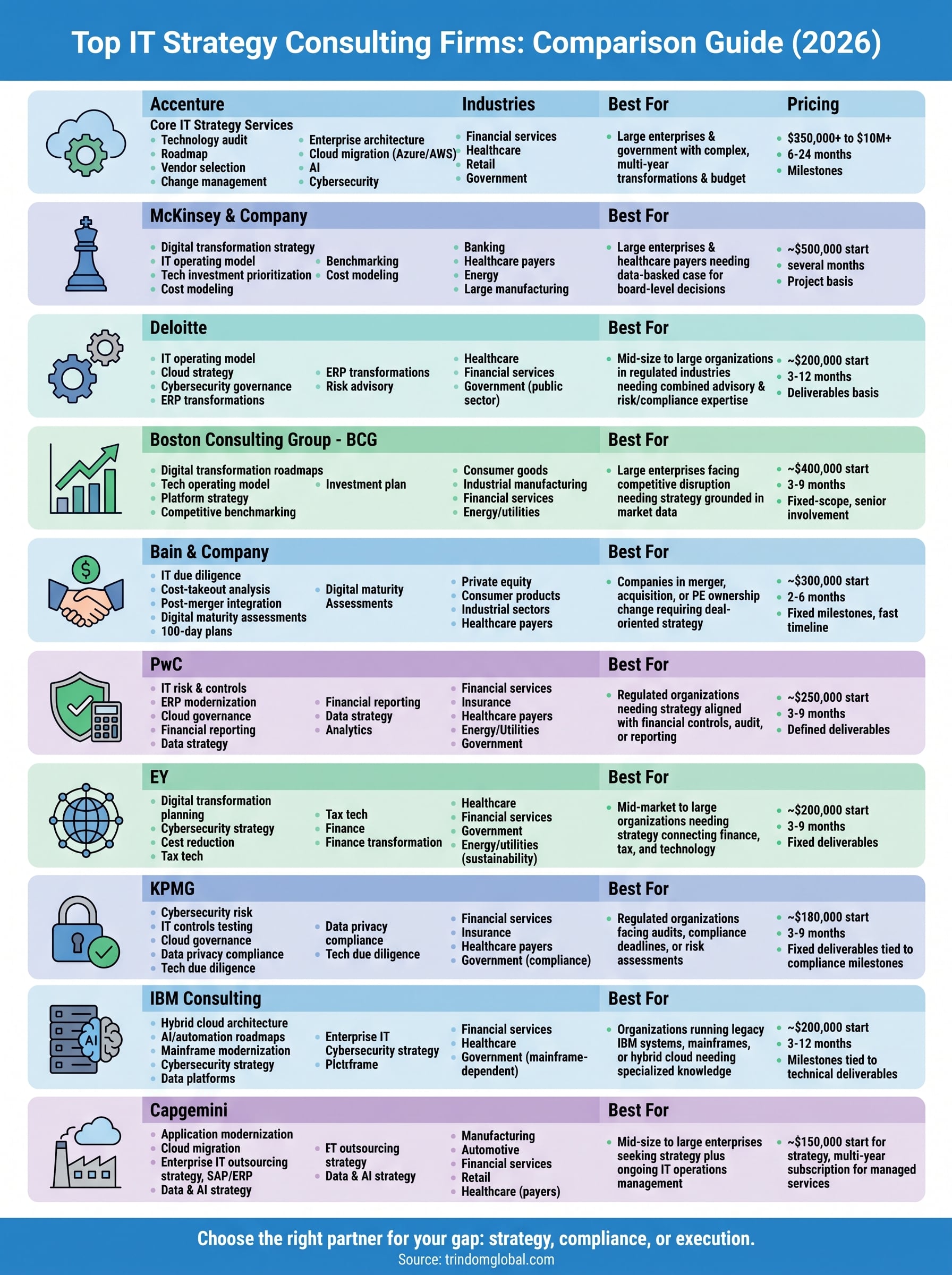
Choosing the right IT strategy partner
Every firm on this list can produce a polished roadmap, but roadmaps don’t install cabling, mount medical equipment, or wire a headend. Match the firm to your actual gap: big-picture strategy from McKinsey or BCG, compliance-driven planning from PwC or KPMG, or a partner comfortable in both boardroom and hospital hallway like Deloitte or Accenture. Whichever name you shortlist, ask directly who handles execution once the strategy document is signed off, because that handoff is where most projects stall.
If your organization needs the piece these consultancies routinely hand off, the actual design-build, installation, and integration work behind the strategy, that’s where Trindom Global comes in. We work directly with hospitals, government agencies, commercial properties, and multifamily operators to turn IT strategy into wired, tested, working infrastructure. Skip the handoff gap and talk to Trindom Global about IT infrastructure installation services for your next project.


