

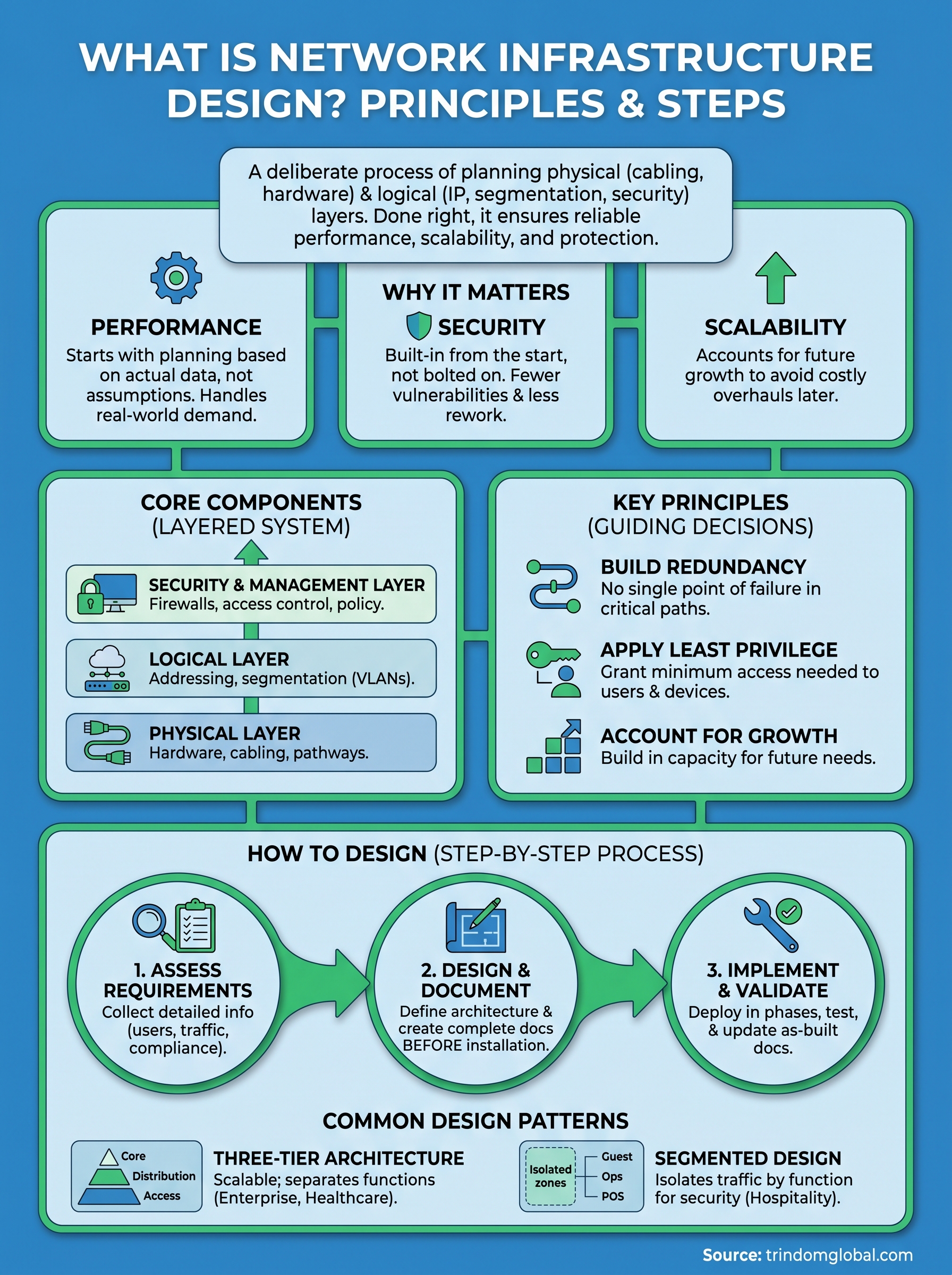
So, what is network infrastructure design? It’s the deliberate process of planning, architecting, and documenting every layer of a network, from physical cabling and hardware placement to logical configurations like IP addressing, segmentation, and security policies. Done right, it gives an organization a network that performs reliably, scales without painful overhauls, and protects critical data and operations from day one.
The stakes are especially high in environments like hospitals, government facilities, and large commercial properties, where downtime or security gaps carry real consequences. A poorly designed network doesn’t just slow things down, it creates costly bottlenecks, compliance risks, and integration headaches that compound over time. That’s why the design phase matters more than most people realize, and why skipping it almost always costs more than investing in it upfront. At Trindom Global, we’ve seen this firsthand through 20+ years of design-build consultation and integration work spanning healthcare, hospitality, government, and multifamily sectors.
This article breaks down the core principles of network infrastructure design, walks through the key steps involved, and covers the best practices that separate a functional network from one built to last.
Why network infrastructure design matters
Understanding what is network infrastructure design is only the first step. The harder question is why organizations should dedicate serious time and resources to it before laying a single cable or racking a single switch. The answer is direct: every decision you make downstream, from equipment selection to security policy, depends on the quality of your design. Skip this phase, and you build on assumptions instead of evidence.
Performance starts with planning
Network performance issues rarely appear out of nowhere. They trace back to design decisions made early in the project, such as placing bandwidth-heavy systems on undersized links, failing to account for traffic patterns, or neglecting redundancy at critical junctions. When you design the network with actual usage data and projected growth in mind, you give yourself a foundation that handles real-world demand instead of buckling under it.
That gap between theoretical capacity and actual performance is almost always a design problem, not a hardware problem. Throwing more equipment at a poorly structured network rarely fixes the underlying issue. It just adds cost and complexity on top of a flawed foundation.
Security is built in, not bolted on
A network designed without security in mind puts you in a reactive posture later. Retrofitting segmentation, access controls, and monitoring into a live network is significantly harder and more expensive than building those controls into the original architecture. This matters especially in regulated environments like healthcare and government, where compliance requirements such as HIPAA carry real penalties for gaps in network security.
A network you patch for security after the fact will always have more exposure than one designed with security as a core requirement.
Designing security into the architecture from the start means fewer vulnerabilities, fewer surprises during audits, and far less rework down the road.
Scalability saves money over time
Organizations rarely stay the same size. You add locations, users, devices, and services, and your network needs to absorb that growth without requiring a full rebuild. Poor scalability is one of the most common reasons organizations face expensive infrastructure overhauls just a few years after installation. A well-structured design accounts for future growth by building in logical segmentation, modular hardware choices, and capacity headroom that lets you expand without disrupting existing operations.
The upfront investment in thoughtful design consistently outperforms the cost of reactive fixes. When you take the time to understand your five-year growth trajectory before finalizing the design, you avoid the scenario where a new building, a hundred additional users, or a shift to cloud-heavy workloads forces you to rebuild infrastructure you just installed.
Core components of network infrastructure design
When you break down what is network infrastructure design, you’re really looking at a layered system where each component depends on the others working correctly. Understanding these components upfront gives you the clarity to make informed decisions, avoid costly gaps, and build a network that functions as a unified system rather than a collection of loosely connected parts.
Physical layer: hardware and cabling
The physical layer is the literal foundation of your network. It covers structured cabling, switching hardware, routers, wireless access points, and the physical pathways that carry data between devices. Decisions made here, such as cable category, rack placement, and redundant uplinks, directly affect how much bandwidth your network can sustain and how hard it is to troubleshoot or expand later. Poor physical design creates interference, bottlenecks, and maintenance nightmares that no software fix can resolve.
Logical layer: addressing and segmentation
Above the physical layer sits the logical architecture, which controls how traffic flows, how devices communicate, and how the network is segmented. This includes IP addressing schemes, VLANs, routing protocols, and DNS configuration. Proper segmentation keeps different types of traffic isolated, so a guest Wi-Fi network, for example, never touches your operational systems.

Logical segmentation is one of the highest-leverage decisions you make during the design phase because it affects both performance and security simultaneously.
Security and management layer
Every network needs a clearly defined security and management layer that controls access, monitors activity, and enforces policy. This includes firewalls, intrusion detection systems, access control lists, and network monitoring tools. Building this layer into the original design, rather than adding it after deployment, means your security posture is consistent and auditable from the first day the network goes live.
Principles behind secure, scalable network design
Knowing what is network infrastructure design conceptually is useful, but the principles that guide sound design decisions are what separate a network that holds up over time from one that creates problems the moment conditions change. These principles aren’t abstract theory. They’re practical guidelines that should shape every architecture decision you make, from your first site survey to your final documentation.
Build redundancy into critical paths
Redundancy means that no single point of failure can take down your entire network. For critical systems, such as hospitals or data centers, you need redundant uplinks, failover switching, and backup power at key junctions. A network that goes down when one component fails isn’t a resilient network, regardless of how well the rest of it performs.
Redundancy isn’t optional in environments where downtime has a direct cost to operations, patient care, or public safety.
Apply least privilege to every segment
Access control is most effective when you grant users and devices only the access they actually need, nothing more. This principle, called least privilege, limits the blast radius of a breach or misconfiguration. When you combine this with proper VLAN segmentation and role-based access policies, you make lateral movement across your network significantly harder for any unauthorized party.
Enforcing least privilege during the design phase also simplifies your audit process later. When access rights are baked into the architecture, you spend far less time reconciling who can reach what and why.
Account for growth before you need it
Your network should handle current traffic loads and anticipated expansion without requiring structural changes. Build in IP address space beyond immediate needs, select modular hardware with upgrade paths, and document your design so that adding capacity later is a planned process, not an emergency scramble.
How to design network infrastructure step by step
Understanding what is network infrastructure design in theory only gets you so far. Putting it into practice requires a structured sequence that moves from discovery through documentation before you install a single device. Skipping steps early in this process creates expensive problems that surface during deployment or, worse, after go-live when fixing them disrupts live operations.
Step 1: Assess your requirements and current state
Start by collecting detailed information about your environment, including user counts, device types, application dependencies, traffic patterns, and compliance requirements. Talk directly to the teams who use the network every day, not just IT leadership. This discovery phase surfaces constraints and dependencies that a scope document alone will never capture, and those gaps are exactly what cause rework later.
Key inputs to gather during assessment:
- Current bandwidth usage and peak demand windows
- Security and compliance mandates (such as HIPAA or FedRAMP, depending on your sector)
- Planned growth in users, locations, or connected devices over the next three to five years
Good network infrastructure planning also includes a physical site survey. You need to know what the pathways, equipment rooms, and power can support before you commit to a design.
Step 2: Design your architecture and document it completely
With solid requirements in hand, define your topology, segmentation strategy, hardware selection, and IP addressing scheme. Map how traffic flows between segments and identify where redundancy is necessary. Before installation begins, document every decision, covering cable runs, VLAN structure, routing choices, and security policies, so your team and all vendors are working from a single verified source of truth.

A complete design document reviewed before any installation begins catches conflicts on paper, where fixing them costs nothing.
Step 3: Implement in phases and validate at each stage
Deploy the network in controlled phases rather than all at once. Test performance and security against your original requirements at each phase before moving forward. When you find deviations from the planned design, update your as-built documentation immediately so your records accurately reflect the final installed state.
Network infrastructure implementation covers more than racking equipment. It includes installing cabling and hardware, configuring and integrating systems, testing against your requirements, and formal sign-off. It works best when one project manager and one tech team own the whole sequence, so the people who build the network work from the same documentation the designers produced.
Common design patterns and real-world examples
When you understand what is network infrastructure design at a conceptual level, the next step is seeing how that understanding translates into actual architectures. Design patterns give you a proven starting point rather than building from scratch every time, and selecting the right pattern for your environment is one of the most consequential early decisions in the process. Keep in mind that topology, the way devices are arranged physically and logically, is only one part of the job. Design also covers addressing, segmentation, security, hardware selection, and documentation.
Three-tier architecture
The three-tier model divides your network into core, distribution, and access layers, each with a defined role. The core layer handles high-speed data transfer between major network segments. The distribution layer enforces policy, routing, and segmentation. The access layer connects end devices. This pattern scales cleanly and remains one of the most widely deployed architectures in enterprise and healthcare environments because each layer can be upgraded or expanded independently without disrupting the others.
Three-tier architecture works because it separates function from scale, letting you grow one layer without rebuilding the entire network.
Healthcare systems use this pattern to isolate medical device networks from general staff traffic, which supports both performance and compliance requirements simultaneously.
Flat vs. segmented design in production environments
A flat network places all devices on a single broadcast domain with minimal logical separation. It’s common in small offices with low complexity, but it creates serious security and performance problems as your environment grows. Every device can reach every other device, which is exactly the condition that makes breaches spread quickly.
Segmented designs, by contrast, divide traffic into distinct zones based on function, device type, or security requirement. Hospitality networks are a practical example: guest Wi-Fi, back-of-house operations, and point-of-sale systems each occupy isolated segments, preventing a compromised guest device from reaching payment systems or property management platforms.
Putting your design into action
Understanding what is network infrastructure design gives you the foundation, but execution is where the outcomes are determined. Every principle covered in this article, from redundancy and segmentation to phased deployment, only delivers value when you apply it systematically and document every decision along the way. Skipping the planning phase doesn’t save time. It transfers that cost to the implementation and maintenance stages, where fixing mistakes is significantly harder and more expensive.
Your environment, whether a hospital, a government facility, or a large commercial property, has specific requirements that a generic approach won’t address. Working with a team that brings deep installation and integration experience means your design translates into a network that performs reliably from day one. If you’re ready to move from planning to execution, connect with Trindom Global’s design-build team to get expert guidance on your next infrastructure project.