

If you’re trying to figure out women owned business certification requirements, you’ve probably already hit the confusing part: every certifying body lists slightly different rules, and one wrong answer on an application can send you back to square one. That’s frustrating when you’re trying to win contracts that require certified vendors, especially in healthcare, government, or infrastructure work where procurement teams check credentials closely.
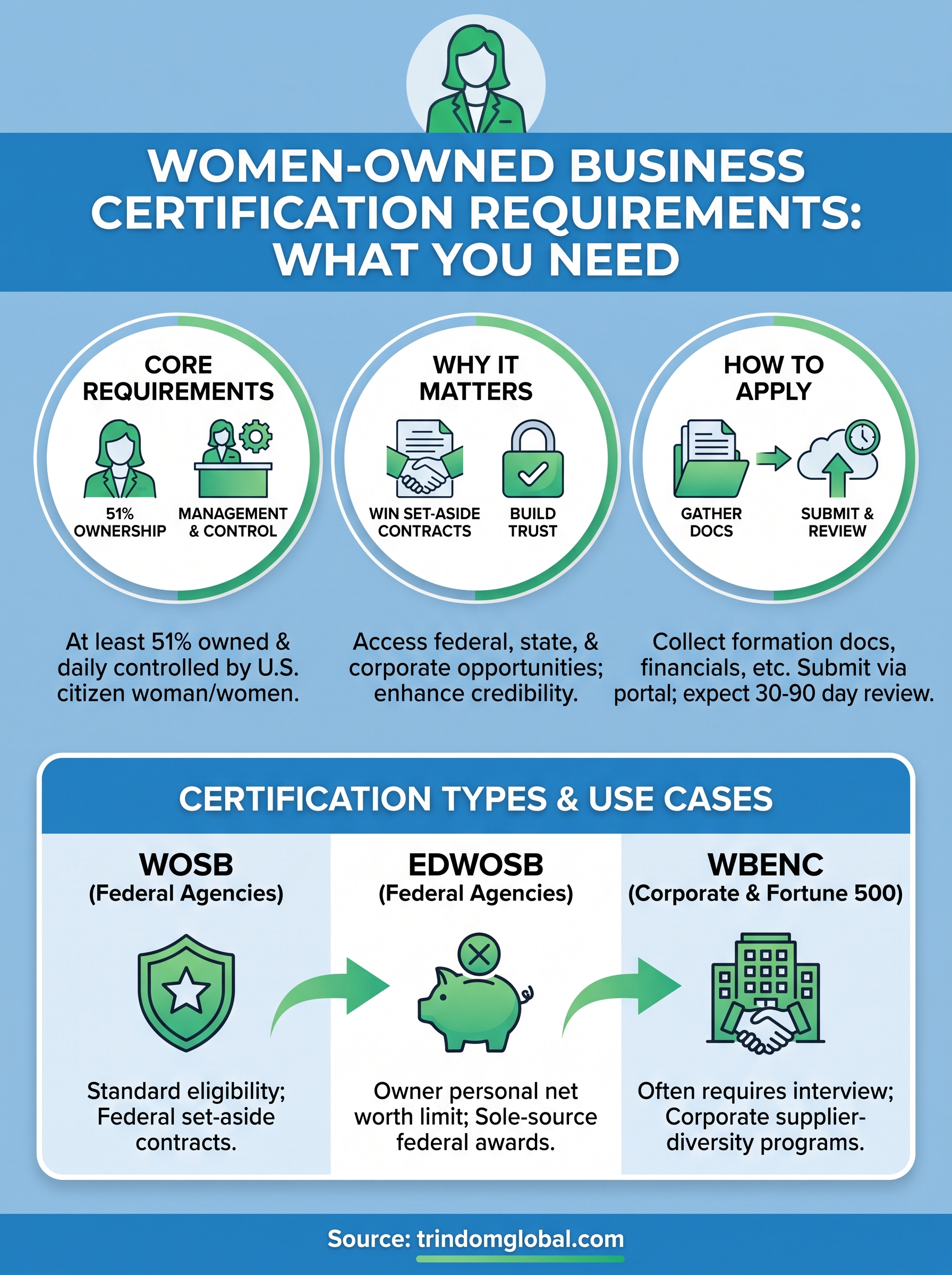
The short answer is that most certifications require at least 51% ownership by a woman or women who are U.S. citizens, plus proof that those owners hold real operational and management control of daily business decisions, not just a title on paper. You’ll also need to show the business has operated for a set period, usually one year, and submit financial records, licenses, and other documentation depending on whether you’re pursuing a WBENC, WOSB, or state-level certification.
In this article, we’ll break down the ownership and control criteria in detail, walk through the documentation you’ll need to gather, and outline the application steps so you know exactly what to expect before you start. We work with certified MWBE partners on infrastructure projects daily, so we understand how much clarity here matters for getting bids approved without delays.
Why women-owned business certification matters
Certification opens doors that stay closed to unverified businesses. Federal, state, and corporate procurement programs set aside a percentage of contracts specifically for certified women-owned firms, and without the paperwork to prove eligibility, you can’t even bid on those opportunities. Hospitals, government agencies, and large contractors we work with at Trindom Global routinely require proof of certification before they’ll add a vendor to their approved list, regardless of how strong the proposal looks otherwise.
Winning set-aside and sole-source contracts
Government buyers use the Women-Owned Small Business (WOSB) federal contracting program to meet statutory goals, and agencies actively search for certified vendors when they need to fill that quota. The U.S. Small Business Administration confirms that certain contracts are set aside exclusively for WOSB or EDWOSB firms, meaning uncertified competitors are locked out entirely.
Certification isn’t a formality, it’s the ticket that gets you into rooms your competitors can’t enter.
Building trust with buyers and partners
Buyers rely on third-party verification because it removes guesswork. A certification from WBENC or the SBA tells a procurement officer that someone already checked your ownership structure, so they don’t have to take your word for it. That trust translates into faster vendor approval and fewer follow-up questions during due diligence.
Strengthening your position in competitive bids
Beyond eligibility, certification signals operational credibility to larger primes looking for subcontractors. Many corporate supplier-diversity programs track spend with certified women-owned vendors to meet internal goals, which means certified firms often get invited to bid before an RFP even goes public. That early access alone can be worth more than the certification fee itself.
Core eligibility requirements you must meet
Every certifying body checks the same core facts, even if the paperwork looks different. You need to prove ownership, control, and business standing before a reviewer will even look at your industry codes or revenue numbers. Skip any one of these, and your application stalls no matter how strong the rest of your file looks.
Ownership by women
A woman or group of women must own at least 51% of the business, and that ownership has to be direct, not through a trust or holding company that muddies the paper trail. Ownership also needs to be unconditional, meaning no outside party can restrict how that owner sells, transfers, or votes her shares.
Management and daily control
Beyond ownership, the woman owner must run daily operations, not just hold a title. Reviewers ask for organizational charts, resumes, and payroll records to confirm she makes hiring, financial, and strategic decisions without another person’s sign-off.
Business size and operating history
Most programs also require:
- U.S. citizenship of the owner(s)
- At least one year in business
- Compliance with SBA small business size standards for your industry
If you can’t document control, ownership alone won’t get you certified.
How to apply for certification step by step
Applying feels overwhelming until you break it into a checklist. Certifying bodies want the same documents in roughly the same order, so once you gather your paperwork once, you can reuse most of it across programs. Preparation before submission saves weeks compared to fixing errors after a reviewer flags them.
Gather your documents first
Before you touch an application portal, pull together:
- Formation documents (articles of incorporation, operating agreement)
- Proof of citizenship for the woman owner(s)
- Financial statements and tax returns for the past year
- Organizational chart showing management control
- Licenses relevant to your industry
Submit and respond to reviewer requests
Once your file is complete, submit through the certifying body’s portal, whether that’s the SBA’s certify.sba.gov system or WBENC’s regional affiliate. Reviewers often come back with follow-up requests for clarifying documents, so respond quickly to avoid restarting your review clock.
A complete file on day one beats a fast submission with gaps.
Expect the review itself to take anywhere from 30 to 90 days depending on the program and how busy that quarter’s application volume is. Applying early, well before you need the certification for a bid deadline, keeps you from scrambling later.
Comparing WOSB, EDWOSB, and WBENC certifications
These three certifications overlap in purpose but differ in who accepts them and what they unlock. WOSB works for general federal set-asides, EDWOSB targets economically disadvantaged owners competing for a narrower pool of sole-source contracts, and WBENC carries weight with corporate supplier-diversity programs rather than federal buyers. Picking the wrong one wastes months, so match the certification to where you actually plan to bid.
Match the certification to your buyer, not the other way around.
Side-by-side comparison
| Certification | Who accepts it | Extra requirement beyond 51% ownership | Typical use case |
|---|---|---|---|
| WOSB | Federal agencies | None beyond standard eligibility | Federal set-aside contracts |
| EDWOSB | Federal agencies | Owner’s personal net worth under SBA threshold | Sole-source federal awards |
| WBENC | Fortune 500 and corporate buyers | On-site or virtual interview with reviewer | Corporate supplier-diversity programs |
Choosing based on your buyers
If hospitals or government agencies make up most of your pipeline, prioritize WOSB or EDWOSB through the SBA. If you’re chasing subcontracts with large primes or corporate accounts, WBENC often matters more, since procurement teams there specifically track WBENC-certified spend. Many businesses eventually hold both, since the documentation overlaps enough to make dual certification manageable once you’ve done the work once.
Common mistakes that delay or derail applications
Applicants trip over the same handful of issues every cycle, and most of them come from rushing the paperwork instead of the business itself. Incomplete ownership documentation tops the list, especially when stock certificates or operating agreements don’t clearly show the 51% threshold in writing. Reviewers won’t guess on your behalf, so anything ambiguous gets flagged and sent back.
Blurring ownership with control
Many owners list themselves as president but let a husband, business partner, or general manager handle contracts and payroll. That gap between paper ownership and real control is the fastest way to get denied, since reviewers specifically look for evidence that the woman owner signs contracts, manages finances, and makes hiring decisions herself.
A title on a business card doesn’t prove control on a reviewer’s checklist.
Missing deadlines and outdated records
Stale financials cause almost as many delays as ownership issues. Watch for these common slip-ups:
- Submitting tax returns older than the required filing year
- Forgetting to update licenses after a business address change
- Ignoring reviewer follow-up requests for more than a few business days
Catching these early keeps your file moving instead of sitting in a queue.
Putting your certification plan into action
Getting certified isn’t complicated once you know the checklist: prove 51% ownership, document real management control, and match your certification to the buyers you actually want to reach. Skip the guesswork by gathering formation documents, financials, and organizational charts before you open any application portal, then submit early so a 30 to 90 day review doesn’t jeopardize a bid deadline.
Certification is only half the equation, though. Winning the work still depends on delivering projects that meet the standards hospitals, government agencies, and corporate buyers expect from a certified vendor. That’s where partnering with an experienced team pays off, especially on infrastructure and installation work where procurement teams scrutinize both credentials and execution.
If you’re preparing to bid on IT infrastructure, structured cabling, or medical equipment installation projects and want a partner who understands MWBE requirements from both sides of the table, talk to Trindom Global about your next project.


