

If you run a woman-owned company and you’ve watched federal contracts go to competitors who don’t seem any more qualified than you, the WOSB program exists for exactly that problem. Women owned business government contracts are set aside through a federal program designed to route a share of agency spending toward companies that meet specific ownership and control requirements, and the rules are more concrete than most people expect.
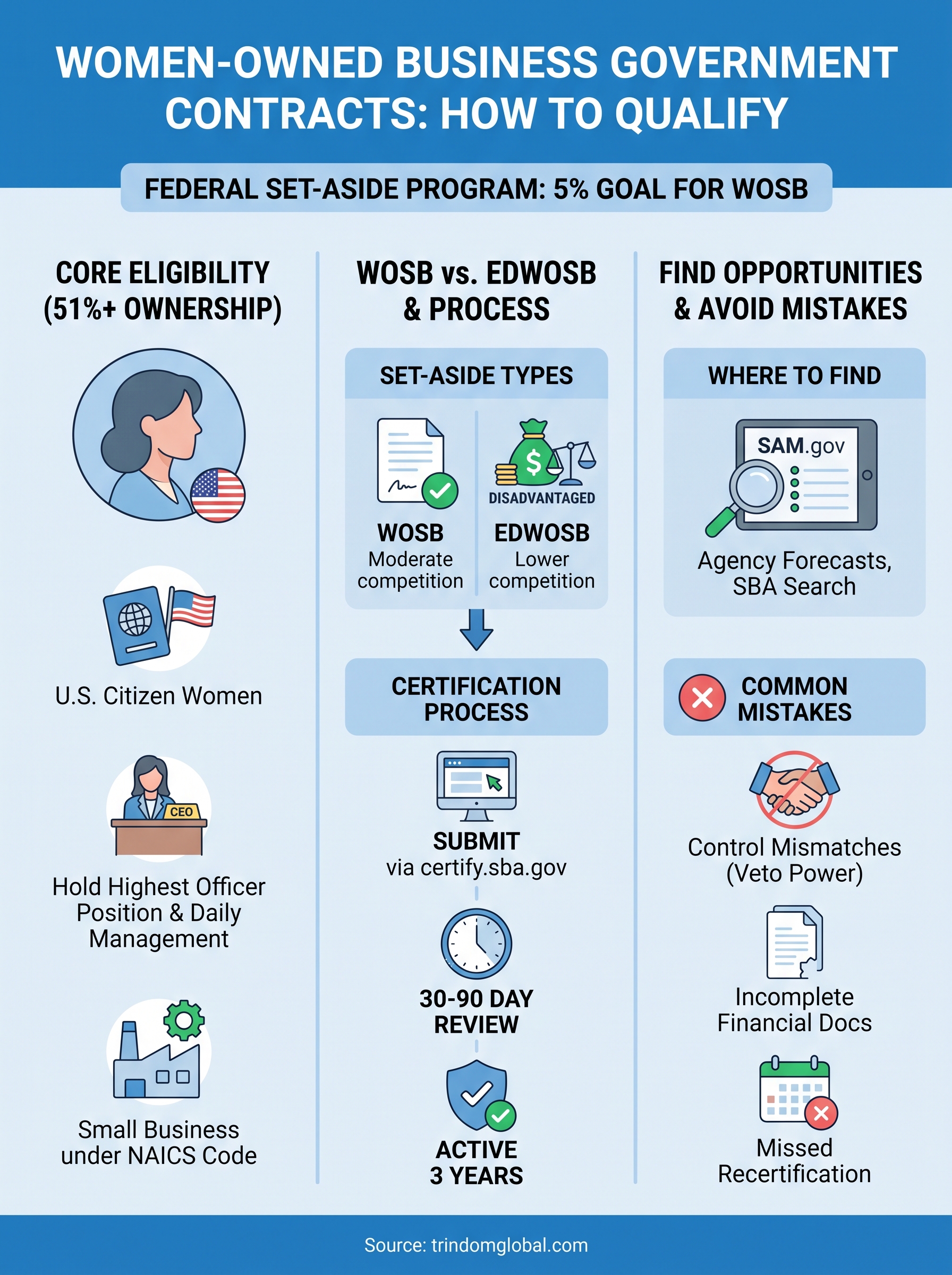
Qualifying comes down to three things: your business has to be at least 51% owned and controlled by women who are U.S. citizens, it has to fall under an eligible NAICS code, and in some cases you’ll need economic disadvantage documentation to access the most competitive set-asides. Skip any of these and your certification gets rejected, no matter how strong your past performance looks.
We’ve guided infrastructure and equipment contractors through procurement requirements for years at Trindom Global, and this article breaks down exactly what agencies check, how the certification process actually works, and where to find set-aside opportunities once you’re approved.
Why WOSB certification matters for your business
Certification isn’t a formality you check off once and forget. It’s the mechanism that makes your business eligible for set-aside contracts that competitors without the designation simply cannot bid on. The federal government has committed to awarding at least 5% of all federal contracting dollars to women-owned small businesses each year, a goal set under the Small Business Act and enforced through agency-level reporting. When you’re certified, you’re competing in a smaller pool against businesses that meet the same ownership standards, not against every large contractor chasing the same open bid.
Set-aside dollars add up fast
Agencies track WOSB awards closely because they’re measured against that 5% target, and shortfalls draw attention from oversight committees. That pressure works in your favor. Contracting officers actively look for certified firms to fill set-aside requirements, which means your certification can put you on shortlists you’d otherwise never see.
| Contract type | Who can bid | Typical competition level |
|---|---|---|
| Open/unrestricted | Any qualified business | High |
| WOSB set-aside | Certified WOSB firms only | Moderate |
| EDWOSB set-aside | Certified economically disadvantaged WOSB firms only | Lower |
Certification doesn’t guarantee a contract, but it guarantees a seat at a much smaller table.
It builds credibility beyond federal work
Many state and local agencies, along with private prime contractors filling diversity goals, give real weight to WOSB status when scoring proposals. Prime contractors on large federal jobs often need subcontractors with MWBE credentials to satisfy their own small business plan commitments, and your certification becomes a selling point in those conversations too.
Qualifying also forces a level of documentation discipline that pays off later. You’ll have clean records on ownership, control, and financials that make audits, loan applications, and future certifications faster to complete. Businesses that skip certification often assume they’re too small or too new to bother, but agencies award set-aside contracts to companies with modest revenue every year. The barrier isn’t size. It’s whether you’ve done the paperwork to prove what’s already true about who owns and runs your company.
How to qualify and get certified as a WOSB
Getting certified starts with proving what’s already true about your business on paper. The Small Business Administration runs the WOSB program directly through its own certification portal, and since 2020 self-certification is no longer accepted for federal set-asides. You’ll upload ownership documents, control agreements, and financial records, then wait for SBA review. Processing typically takes 30 to 90 days depending on how complete your initial submission is.
Eligibility requirements you must meet
Before you apply, confirm your business actually meets the baseline standards SBA checks first.
- At least 51% owned by women who are U.S. citizens
- Women hold the highest officer position and manage day-to-day operations
- The business qualifies as small under its primary NAICS code
- Ownership and control decisions aren’t subject to outside restrictions
If a man can override a major business decision on paper, your certification will get flagged.
Applying for economically disadvantaged status
If you want access to sole-source EDWOSB awards, you’ll need additional financial documentation showing personal net worth, adjusted gross income, and asset limits fall under SBA thresholds. This is where most certification process delays happen, since applicants underestimate how detailed the financial review gets.
Submit through certify.sba.gov, and treat every document request as final. Reapplying after a rejection costs more time than getting it right the first pass. Once approved, your certification stays active for three years before recertification is required.
Where to find WOSB set-aside contract opportunities
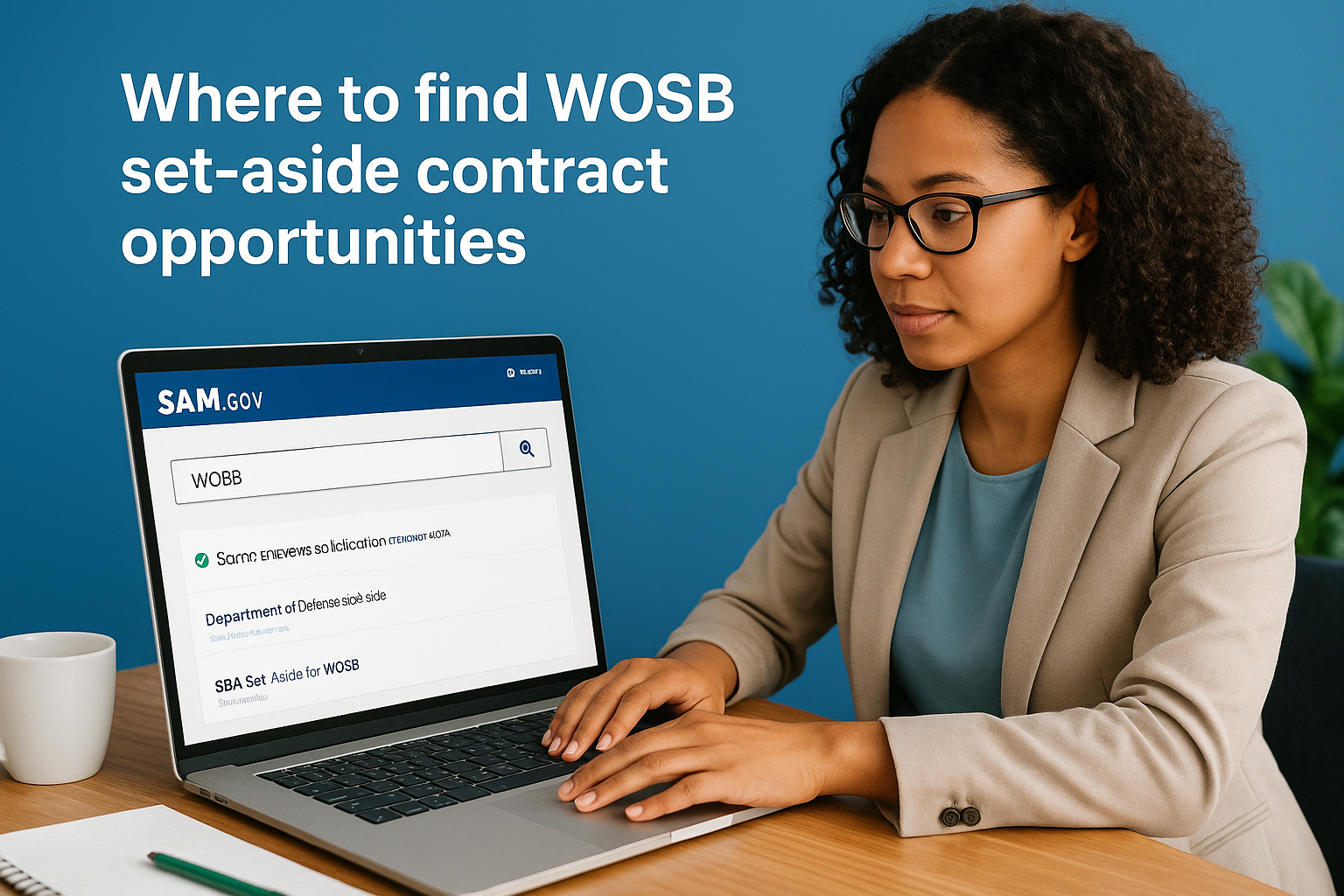
Once your certification is active, finding opportunities means checking a handful of specific platforms, not scanning general job boards hoping something relevant shows up. SAM.gov is the primary system, and every federal set-aside gets posted there with a filter for WOSB and EDWOSB status. Set up saved searches by NAICS code so new postings land in your inbox instead of requiring daily manual checks.
Federal databases worth bookmarking
Beyond SAM.gov, a few other sources consistently surface opportunities that smaller contractors miss:
- SAM.gov for active solicitations and set-aside filters
- The SBA’s Dynamic Small Business Search to see how agencies find certified firms
- Individual agency forecast lists, which many departments publish before contracts go live
- GSA Schedule solicitations if you’re pursuing multiple-award contracts
The businesses winning consistently aren’t the ones with the best products. They’re the ones checking SAM.gov every week.
Working relationships matter as much as portals
Contracting officers often issue sources-sought notices before a formal solicitation, and responding to those signals interest that can shape how the requirement gets written. Reach out directly to small business liaisons at agencies you want to work with, since many will walk you through upcoming needs that haven’t posted publicly yet. Prime contractors bidding on large IT infrastructure jobs also need certified subcontractors to meet their own small business goals, so building those relationships before a solicitation drops puts you ahead of firms that only respond after the deadline is public. Treat opportunity-hunting as ongoing outreach, not a search you run once a month.
Common certification mistakes and how to avoid them
Most rejections come down to paperwork gaps, not eligibility problems. Applicants assume they qualify because the business is technically owned by a woman, then get flagged because control documentation doesn’t match how the company actually operates day to day.
Ownership and control mismatches
SBA reviewers look for consistency across every document you submit. If your operating agreement lists a male co-owner with veto power over major decisions, or a husband holds a title that outranks the certifying owner, that inconsistency triggers a denial regardless of stated intent.
- Officer titles that don’t match actual decision-making authority
- Buy-sell agreements giving non-qualifying owners control over an exit or sale
- Loan guarantees or leases signed disproportionately by a non-owner spouse
- Bank signatory lists that exclude the certifying owner
A single mismatched signature line can undo months of otherwise clean documentation.
Financial documentation errors
Economically disadvantaged applicants often submit incomplete personal financial statements, missing spousal income or asset disclosures that SBA requires even when a spouse isn’t an owner. Underreporting here isn’t a shortcut, it’s a delay, since reviewers will request the missing figures before moving forward.
Timing and renewal oversights
Certifications expire after three years, and businesses that miss recertification deadlines lose set-aside eligibility mid-bid, sometimes disqualifying a proposal already in progress. Set calendar reminders well before expiration, and treat every ownership change, even a minor one, as a reason to update your file immediately rather than waiting for renewal. Rushing the certification process the first time almost always costs more time than doing it right.
Working with a certified partner on government IT projects
Winning a set-aside is one thing. Delivering on complex IT infrastructure work under a government contract is another. Agencies awarding WOSB set-asides for medical equipment installations, structured cabling, or network buildouts still expect the same technical rigor as any open bid, and that’s where partnering with an experienced design-build firm changes the outcome. Trindom Global brings that combination directly: certified minority and women-owned status paired with hands-on experience installing IT infrastructure in hospitals, government facilities, and commercial environments where downtime isn’t an option.

Why teaming arrangements work
Many certified WOSB firms don’t have in-house crews for every specialty a large IT project demands. Teaming with a partner who already handles design, installation, and integration lets you bid on bigger, more technical scopes without overextending your own team.
- Joint ventures split management and financial responsibility while both firms retain certification benefits
- Subcontracting arrangements let you hold the prime contract while a partner executes specialized installation work
- Mentor-protégé relationships give newer WOSB firms access to established project management systems
A strong technical partner turns a certification into a contract you can actually deliver.
What to look for in a partner
Check for project management credentials, documented experience in your target sector, and familiarity with government procurement rules like RFP compliance and reporting requirements. A partner who’s navigated healthcare or municipal projects before will catch compliance issues you might miss on your first federal award, and that experience protects your certification’s reputation with contracting officers who track performance closely.
Putting your WOSB status to work
Qualifying for women owned business government contracts takes real paperwork discipline, but the payoff is a certification that opens doors competitors without it can’t reach. You’ve seen the requirements: clean ownership documentation, active accounts on SAM.gov and certify.sba.gov, and a sharp eye for the mistakes that stall most applications. None of it works, though, without contracts you can actually deliver on time and up to spec.
That’s where your technical delivery matters as much as your certification paperwork. Winning a set-aside for hospital equipment installation or a network buildout means agencies expect the same quality and reporting rigor as any open bid, no exceptions for your MWBE status. If you’re pursuing government IT infrastructure work and want a certified partner who’s handled that exact scope before, talk to Trindom Global about teaming on your next project.


